
Movie Collectors Guide #1
The Complete James Bond Collection (Part 2)
November 2000
Brian Florian
1973, Color
Aspect Ratio: 1.78:1/16x9
Dolby Digital Mono
2 Hr 1 min, Rated PG-13
Staring Roger Moore, Yaphet Kotto, Jane Seymore, and Clifton James.
Directed by Guy Hamilton. Screenplay by Tom Mankiewick.
0
5
Entertainment:
Video Quality:
Audio:
Extras:
Violence: mild
Sex: mild
Language: no
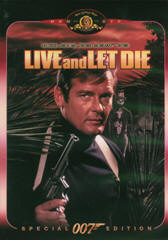
When three British agents die in different places around the world, the only connection is that they were all investigating Dr. Kananga, leader of a small island off San Monique. Bond's investigation acquaints him with Kananga's taro card reader Solitaire, his henchmen, and his opium production. An elaborate boat chase and an extravagant execution-finale round out this 007 adventure.
Though perhaps not the most popular today, "Live and Let Die" is crucial in any look at the 007 franchise. After the success of "Thunderball", Bond mania had started to dwindle . Not only were Saltzman and Broccoli faced with revamping 007 for a new 70's generation of movie goers, they had to, at the same time, introduce a new actor for the part. The role would go to a man who Sean Connery himself had said would make a good Bond: Roger Moore.
Moore had all the right ingredients. He was English and debonair, but brought with him a new humor to the role. Not to imitate Sean Connery, Moore had to find his own niche in the role as 007. No Martini-shaken-not-stirred, no cool car, not even a cameo from Q in this his first Bond picture. Further, care had to be taken that none of the idiosyncrasies from Moore's previous character, "The Saint", made their way into the movie. Notable is that the pre-title sequence does not include Bond and is actually related to the plot, harkening all the way back to the style of "From Russia With Love". Adding to the risky mix was a dangerous script for its day: having all black villains was more than edgy in 1973. While the voodoo overtones may have been over the top for some, the new Bond was absolutely likeable, and the tickets sales proved it. Whereas Connery played a cold, controlled Bond ("for King and Country" as the character would say), Moore played a more candid one with a terrific humor. And for many, the film is remembered most for Jane Seymore as Solitaire, as she had just the right blend of elegance and innocence that the character called for.
The film shows its age in a couple of serious scratches and flat colors. Though the DVD exhibits sharp detail and nice depth, the overall feel is one of aged film with some minor compression artifacts exasperating the situation. Edge enhancement is not only noted but is excessive and detracts from the viewing experience. The mono soundtrack does not bode much better, taking on a harsh and edgy quality with at times noticeable hiss, begging the playback level to be reduced. Dialogue intelligibility does not suffer, but lacks liveliness.
Although its strong 70's feel cause it to age less gracefully than even some older installments, "Live and Let Die" is remembered as bringing Bond into the new decade.
There are two different commentary tracks and an Inside of feature, to name but a couple of the excellent extras.
1974, Color
Aspect Ratio: 1.78:1/16x9
Dolby Digital Stereo Surround
2 Hr 5 min, Rated PG-13
Staring Roger Moore, Christopher Lee, Britt Ekland, Maud Adams, and Herve Villechaize.
Directed by Guy Hamilton. Screenplay by Richard Maibaum and Tom Mankiewick.
0
5
Entertainment:
Video Quality:
Audio:
Extras:
Violence: mild
Sex: mild
Language: no
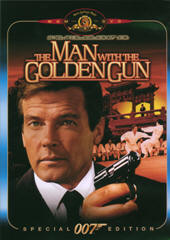
The tables are turned when it seems internationally known hit man Scaramanga has it in for agent 007. As Bond attempts to get to the fabled villain first, he discovers Scaramanga's involvement with the theft of the Solex Agitator, a device that could solve the world's energy crisis. But Scaramanga has his own interests at mind, not humanity's, so Bond teams up with fellow agent Mary Goodnight and gets Scaramanga's mistress Adrea to assist in bringing the legendary hit man down.
With the warm reception given by movie goers to the new Bond in Roger Moore, Saltzman and Broccoli decided to run with it, quite literally, and filming of "The Man with the Golden Gun" starts just 5 months after the release of "Live and Let Die". In retrospect, one has to question their actions, as it was less popular in its release, and, to this day, is among some fans' least favorite Bond films.
Based on Flemings last published novel, the movie presents what should have been an exciting new challenge for Bond in the villain Scaramanga, a mirror character to 007 representing all that is dark within the hero. Yet this tantalizing facet of the story fizzles when we learn that Scaramanga never sent the gold bullet and really wasn't hunting 007. Most memorable is the charming performance turned in by Herve Villechaize as Scaramanga's henchman 'Nick Nack'.
Though gadgets are few, the film still delivers some solid action and a car stunt that still is remarkable: the 'spiral' jump over the river (which unfortunately is presented in the film as an almost comic vaudeville gag, complete with sliding whistle sound effect). Location shooting included Hong Kong, Macau, Bangkok, Phuket, and isle of Khow-Ping-Khan which became for the film Scaramanga's exotic home.
"The Man with the Golden Gun" marks not only director Guy Hamliton's fourth and final Bond picture, but is also the last one to be co-produced with Harry Saltzman. Afterwards, Albert 'Cubby' Broccoli became the driving force to carry Bond forward.
The box credits this DVD as having a Dolby Stereo Surround soundtrack, but I found it to be nothing more than the theatrical mono mix. Though the bitstream is 2-channel, the surrounds are silent, and the front soundstage, though wide, it keenly centered in the middle. It is clean, without pops or dialogue smearing, but quiet passages have a distracting hiss, loud ones a distracting distortion and brightness. Visually, the movie is in fairly good condition but does have some inconsistencies. Detail in the blacks is generally good, but on occasion, turns mediocre, resulting in a washed out look. Some nicks and scratches from the print are apparent, but these are only sporadic and on the whole, things are nice and detailed though edge enhancement is unfortunately so strong that it calls attention to itself.
Beyond the excellent Inside of feature, there is a commentary track, stunt documentary, still gallery, and much more.
1974, Color
Aspect Ratio: 2.35:1/16x9
Dolby Digital 5.1
2 Hr 5 min, Rated PG-13
Staring Roger Moore, Barbara Bach, Curt Jurgens, and Richard Kiel.
Directed by Lewis Gilbert. Screenplay by Christopher Wood and Richard Maibaum.
0
5
Entertainment:
Video Quality:
Audio:
Extras:
Violence: mild
Sex: mild
Language: no
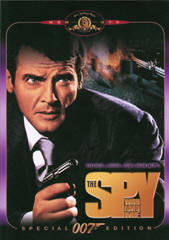
When both a British and Russian submarine mysteriously disappear, Bond runs into his Russian counterpart, Major Anya Amasova, who is on the same case as he. Together, their investigation leads to Stromberg, a man obsessed with the sea and bent on destroying the world above.
A favorite of many, including Roger Moore himself, "The Spy Who Loved Me" is everything a Bond film should be, and a triumphant recovery from the mediocre "The Man with the Golden Gun". With Moore now properly established as 007 and Broccoli now on his own to take all the responsibility (be it glory or failure), one can only imagine the vigor with which he attacked the project, doubling the budget from "The Man With the Golden Gun".
Even though it is the first film not based on an Ian Fleming story, "The Spy Who Loved Me" is a clear return to the quintessential Bond elements: It's a larger than life adventure (including supertankers that swallow up submarines!), with martinis, girls, and gadgets. When Bond's new car, the Lotus Esprit, turns into an underwater vessel, theater audiences simply can't help but cheer.
Broccoli certainly delivered on the advertising line "It's the biggest! (...)". Some very nice but ironically large 'miniature' work was used for shots such as the supertanker and Stombergs headquarters, both filmed on location in the Bahamas. And although he speaks not a word, Stomberg's henchman Jaws is to this day the most memorable of his class of character. Quite possibly one of the most all time memorable Bond stunts is in the opening: Stunt man Rick Sylvester skis off the shear face of a mountain, ditches the skis in mid air, and opens a parachute (with the Union Jack on it!).
"The Spy Who Loved Me" is the first Bond to have been released theatrically with a multichannel soundtrack. In theaters the same year as Dolby Stereo's first commercial release ("Star Wars"), one would expect more dramatic experimentation with the new sound system. The DVD's 5.1 interpretation of the original shows dramatic under-exploitation of the soundfield. The surrounds are only rarely engaged, and while so many scenes could have used ambiance, it seems music is the only thing distributed to the left and right of the screen. Nevertheless, it is clean and dynamic, if a bit bright sounding in some areas, and some new LFE reinforcement is welcome on key explosions. There is an uncharacteristic hiss throughout all quiet passages not present on even the oldest films in this set. The film itself is in rather good condition with lively colors and only a few scratches. Dark scenes are inconsistent with most having rich shadow detail and others leaving you with a washed out feeling. It is still nicely detailed, a little bit soft, and would please if it weren't for the hefty application of edge enhancement.
In addition to the excellent Inside of feature, commentary track, and still gallery, there is a very interesting piece, Designing Bond, which focuses on production designer Ken Adams and his tremendous contribution over the years to the look and feel of all the bonds.
1979, Color
Aspect Ratio: 2.35:1/16x9
Dolby Digital 5.1
2 Hr 6 min, Rated PG-13
Staring Roger Moore, Lois Chiles, Michael Lonsdale, and Richard Kiel.
Directed by Lewis Gilbert. Screenplay by Christopher Wood.
0
5
Entertainment:
Video Quality:
Audio:
Extras:
Violence: mild
Sex: mild
Language: no
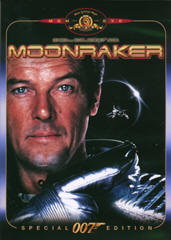
When one of the new Moonrakers (a.k.a. Space Shuttle) is stolen in transit, 007 is put on the case, starting the investigation with Drax, owner of the company that makes the spacecraft. Bond crosses paths and eventually teams up with American CIA agent Holly Goodhead, and together they discover Drax's secret space station and his plan to wipe out the human race and start it anew.
If "The Spy Who Loved Me" is Moore's "Goldfinger", then "Moonraker" is surely his "Thunderball". With Bond mania back in full swing, the now lone Cubby Broccoli opened the floodgates on what is possibly the most extravagant and over the top adventure for the 007 series. With "Star Wars", audiences demonstrated a liking to space adventure, so it could be no better time to bring "Moonraker" alive. All of the icons and nuances are accounted for in what could be construed as a 'high-light' Bond feature.
The action is literally out of this world with the incredible opening parachute (or lack thereof) sequence, the cable car ordeal, speed-gondolas in Venice, and of course the effects-laden space station battles. Settings are many and exotic with location shooting that includes Brazil, Italy, Guatemala, and the US. Casting is also up to the caliber of the picture with memorable French actor Michael Lonsdale as the evil Drax, and Richard Kiel as the henchman Jaws for the second time around. But more notable is the lead female role played by Lois Chiles, a fresh departure from the previous female characters, she brings a new more American spin with her cool exterior.
One almost feels the film is trying to best all previous 007 iterations: The boat chase from "Live and Let Die", the parachute jump of "The Spy Who Loved Me", the cable car encounter from "On Her Majesty's Secret Service", even Shirley Bassey singing the title song as she did for "Goldfinger", and the list goes on. Though many of today's viewers find "Moonraker" too over the top and almost goofy, audiences of the day (myself, a then young man, included) were absolutely enchanted by the adventure. James Bond would not see such ticket sales again until the release of "Goldeneye" more than a decade later.
Though theatrically released with a Dolby Stereo soundtrack, the DVD features a redone 5.1 mix. The surrounds engage inconsistently, but when they do, the effect is one of envelopment and is very pleasant. Subtle directional cues are peppered throughout, and some deep LFE is present, but only on the rarest of instances, and comes across as out of place. It is nonetheless clean with intelligible dialogue throughout and has decidedly spacious music. Only a select few explosions give away the age of the soundtrack with a slight harshness.
The print used for the transfer comes across as being in rather good condition. Colors are rich and balanced, giving a lively feel to the picture. Shadow detail is mostly very good and on the whole a nice film-like softness is noted. Only the very rare print scratch is evident. Unfortunately edge enhancement was applied at what seems like the maximum and distract the viewer on small screens while viewing on a large one results in disaster.
In addition the audio commentary track, excellent Inside of feature, there is a Special Effects documentary, still gallery, and more.
1981, Color
Aspect ratio: 2.35:1/16x9
Dolby Digital 5.1
2 Hr 8 min, Rated PG-13
Staring Roger Moore, Carole Bouquet, Topol, and Lynn-Holly Johnson.
Directed by John Glen. Screenplay by Richard Maibaum and Michael G. Wilson.
0
5
Entertainment:
Video Quality:
Audio:
Extras:
Violence: mild
Sex: mild
Language: no
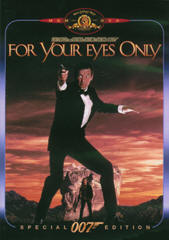
A secret Navy vessel sinks near Albania with an ATAC on board, a device which could be used to control nuclear missiles on England's subs. When the man sent to discreetly locate the wreck is murdered, Bond is on the case to find out who else is after the ATAC and get to it before they do. He hooks up with the lovely Melina, out to revenge her father's death, as they hit the Alps and other exotic locations. Together they locate the ATAC, lose it to the villains, then pursue them to a spectacular mountain hideout before the piece can be sold to Russia.
Following the high-flying and literally out of this world adventure in "Moonraker", an effort had to be made to bring Bond back down to earth, back to his basics if you will.
Perhaps the most striking evidence of this is the Lotus, a car which previously had done everything from underwater navigation to missile launches, and which is destroyed early in the film before it could be of use. 007 is more on his wits and less on his gadgets. John Glen, who had been in the editor's chair on several previous Bonds, would now take up directing with a seasoned flair for the franchise. A more gritty and hard-edged Bond for the 80s, we see Moore play the part with more coldness, harkening back to the day of Sean Connery. Beautifully cast in every regard, a special note goes to Carole Bouquet, stunning as the cross-bow toting Melina, she would go on to become the face of Chanel Perfumes. None of her diving scenes were real, having been done rather well with a few old cinematography tricks. The only thing out of place is the character of Bibi. Though charming, her youth comes off as awkward next to the seasoned Roger Moore. Another notable is that the then up and coming Sheena Easton sings the title song and is the only singer to ever appear in a Bond title sequence.
In its theatrical release, "For Your Eyes Only" featured a soundtrack in the then standard Dolby Stereo format. This DVD release is credited as having a new 5.1 Dolby Digital soundtrack and is evidenced by some split surround effects and LFE reinforcement. Unfortunately, directional cues, especially dialogue, are at times steered too hard and fold down into one speaker or another. Add the strident, gritty quality of some action sequences, and the result is at times a distracting sonic environment as opposed to an immersive one. Music, however, is consistently spacious.
"For Your Eyes Only" featured some spectacular visuals, including an extended ski/motorcycle chase and the dramatic execution attempt on the coral reef (which by the way was meant to be in "Thunderball", but the means to do the stunt safely were not available at the time). The print used for this transfer is of generally good quality and does the film justice. With very few scratches or defects, the film provides a nice visual experience, detailed, with fairly good color. Free of really noticeable compression artifacts, the picture is on the soft side, imparting a nice film-like feel but is marred by an overdose of edge enhancement.
Story Boards and still gallery are just some of the extensive extras which support the excellent Inside of feature documentary.
1983, Color
Aspect Ratio: 2.40:1/16x9
Dolby Digital Stereo Surround
2 Hr 11 min, Rated PG-13
Staring Roger Moore, Maud Adams, Louis Jourdan, and Kristina Wayborn.
Directed by John Glen. Screenstory and screenplay by MacDonald Fraser, Richard Maibaum, and Michael G. Wilson.
0
5
Entertainment:
Video Quality:
Audio:
Extras:
Violence: mild
Sex: mild
Language: no
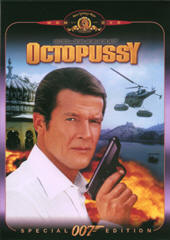
A case of Jewel smuggling and forgery puts Bond on an exotic trip to India. There, he discovers Octopussy, international jewel smuggler among other business interests. She unwittingly is helping a war-bent Russian general get a bomb into an America air force base in Germany, favoring his military plans.
When pre-production began on "Octopussy", the announcement came that a rival film staring Sean Connery, "Never Say Never Again", was being produced. Faced with this sort of ultimate challenge, "Octopussy" sets out to deliver unprecedented 007 material. What results is a tremendous success and a welcome addition to the now long line of films.
But the rival picture was not the only obstacle. Moore was now off his multi-picture contract, so each film had to be individually negotiated. In the end, he is signed on once more. "Octopussy" is heavy in the action department with one high-adrenaline scene following the other throughout the picture. The opening with the now infamous mini jet genuinely set the pace with a finale that marks what is one of the best aerial fight sequences.
Be it a stroke of luck or genius, all key parts are brilliantly cast. Maud Adams has the distinction of being the only Bond leading lady to do so for two roles, "Octopussy" being notably more significant than the mediocre "The Man With The Golden Gun". Louis Jourdan brings one of the most suave villains in the character Kamal, Steven Berkoff is a brilliant high-energy Russian villain, and real life tennis player Vijay Amritraj fits right in as the character of same name (to highlight just a few).
Location shooting included Germany and England, but most noteworthy is sensuous India, which provided dozens of delightful settings for a 007 adventure. "Octopussy" is Bond action and escapism at an all time high, as the title song suggests.
Unlike the other DVDs in this collection, "Octopussy" features its original Dolby Stereo soundtrack. There are delicate directional cues and at times aggressive surround effects, but the art of ambiance was seemingly not yet perfected. It is for the most part clear and intelligible, but at times, in particular during the title sequence, it distorts in an uncharacteristic fashion. Though dynamic, it wants for more bass content and causes one to wish for the grandeur of its 6-track magnetic soundtrack from the 70mm release prints. The DVD presents a picture that is mostly free from print defects and has consistent, if subdued, color. Compression artifacts are minor but edge enhancement is not and distracts as such. Blacks are deep, and shadows are adequately delineated, but overall it comes across so soft that detail is sacrificed.
In addition to the an audio commentary track and the excellent Inside of feature, there is a documentary on production designer Peter Lamont, storyboard sequences, and more.
1985, Color
Aspect Ratio: 2.35:1/16x9
Dolby Digital 5.1
2 Hr 11 min, Rated PG-13
Staring Roger Moore, Christopher Walken, Tanya Roberts, and Grace Jones.
Directed by John Glen. Screenplay by Richard Maibaum and Michael G. Wilson.
0
5
Entertainment:
Video Quality:
Audio:
Photography:
Violence: mild
Sex: mild
Language: no
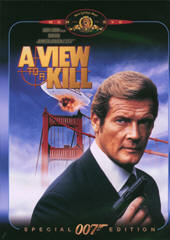
Ex KGB agent Zorin has made a good fortune as an industrialist, but it is not enough. His plot is to flood no less than Silicon Valley and secure a monopoly on the microchip industry. Bond pursues Zorin and his henchwoman Mid Night to locales including Paris and San Francisco to foil the plan before it can be completed.
It was again touch and go as to whether Roger Moore would do another Bond film, but at the last minute it was announced to fans that he would be back for one more round.
"A View To A Kill" presents what could be seen as a loose remake of the "Goldfinger" plot, but unfortunately it doesn't inherit that great film's phenomenon charm. All the requisite Bond elements are accounted for, but Moore appears to be tiring
of the role and his leading lady's character is a most unwelcome addition to the lineage, as she lacks an intelligent presence. Dramatically more positive is Walken as the villain Zorin, and he was the first Academy Award® winning actor to play in a Bond film. There are some terrific action sequences, such as the parachute jump from the Eiffel tower, and the finale on the Golden Gate bridge, a most challenging feat to undertake.
Like Connery, Roger Moore ends his 007 tenure with what many fans consider to be a mediocre installment.
The DVD features a 5.1 remix of the original theatrical Dolby Stereo track, evidenced by the occasional split surround effect and discrete front stage. It is fairly well integrated with ambiance and envelopment that is a little less than discretionary. There are some hard directional cues, and dialogue is perfectly intelligible, but distortion is noted during certain sequences. The visual presentation shows no noticeable signs of print wear, and digital distractions are at a
minimum. It is nicely detailed throughout with good blacks. Colors, though consistent, are not as saturated as they could be and come across as less than lively while ugly edge enhancement is strong enough to be noticed on even small screens.
Beyond the excellent behind the scenes documentary, audio commentary track etc, there is a very interesting piece, The Music of James Bond, which chronicles the evolution of the theme songs and the various contributors to "the sound" of James Bond over the years.





|
Introduction | Part 1 | Part 2 | Part 3 | Extra
Copyright Secrets
of Home Theater and High Fidelity |
All James Bond images, titles, and artwork © 1961-1999 United Artists and/or MGM Home Entertainment
|
|
 |




 YouTube
 Facebook
 Twitter
 LinkedIn
 Pinterest
 Google+
 Instagram
Magazine Publishing Solutions by
 Advontemedia