
Movie Collectors Guide #1
The
Complete James Bond Collection (Part 1)
Brian Florian
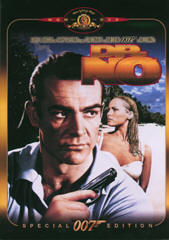
1962, Color
Aspect Ratio 1.78:1/16x9
Dolby Digital Mono
1 Hr 50 min
Rated PG-13
Staring Sean Connery, Ursula Andress, and Joseph Wiseman.
Directed by Terence Young. Written by Ian Fleming.
0
5
Entertainment:
Video Quality:
Audio:
Extras:
Violence: mild
Sex: mild
Language: no
The one that started it all.
Cape Canaveral is having trouble with their rocket launches due to radiation emanating around Jamaica. When the man investigating the trouble disappears, agent 007 is sent down to unearth the mystery. His sleuthing leads him to Crab Key, home of "Dr. No", member of the terrorist organization SPECTRE. Bond must put a stop to his plans to ruin the space program.
It is said that producers Broccoli and Saltzman had no idea at the time that their venture would mark the beginning of something as big as the franchise we are now familiar with. Billed in its days as the motion picture adaptation of the popular novel by Fleming,
"Dr. No" set the pace for generations of films. Many actors were naturally considered for the lead with a nod going to Carey Grant, but because he was not interested in doing multiple installments, it was up and coming Sean Connery who got the role. He is remembered by many not only as the first, but as the favorite actor to play 007. Yet it is director Terence Young who is most credited with creating the on screen images and style that have endured till the present. Though he would direct only three 007 film, Young is described by some as having lived the James Bond life, always having the finest and the best, an outlook that carries over to the smallest details in the films, right down to 007's fashionable clothes.
It's hard to look at all the elements we've come to expect with the same eye of freshness that viewers of the day must have felt, as everything was being done for the first time in "Dr. No". The gun-barrel opening, the "Bond, James Bond" introduction, Martini shaken not stirred, Moneypenny, 'M', the game of Baccarat, SPECTRE, and so on. Some from Fleming's mind, many from the creative talents on the film, all would become icons of 007 films.
"Dr. No" presents a fresh new entity for a motion picture hero: the 'gentleman spy'. At this point, Bond is without Q-branch, favoring wits and intelligence over gadgets. No one ever seems to forget the trick with the hair across a doorway or talcum powder on the briefcase latches. The concept of license to kill is put in motion as 007 executes without remorse, yet oozes sexuality and is wrapped in a suave style.
Inevitably, every James Bond film would get compared back to this classic original. In no other way is this more true than in regards to the Bond women. Ursula Andress as Honey Rider epitomizes the term memorable and set the pace for 007 leading ladies for decades. The vision of her rising from the ocean in a bikini with knife on hip was, in the words of Hugh Hefner, "delicious". And lets not forget Dr. No himself, establishing the eerily cool and controlled villain, he sets the stage for Bond bad guys. Also notable is that the film employs a daring new style of editing for its day. Where classic wisdom called for no cuts during motion, "Dr. No" features multiple cuts within a single action. Add exaggerated sound effects, and action takes on a whole new appeal.
The print used for the DVD has not faired well in the preservation department. It is worn, plagued with scratches and hiccups, and comes across as rather grainy. Colors are not washed out, but neither are they lively or bright. On the whole, detail in the blacks is adequate, but one cannot help but be preoccupied with the feeling of age that the film imparts. Edge enhancement has been applied liberally and this unnecessary artifact distracts even the casual viewer. The soundtrack has fared no better than the print with noticeable hiss, pops, and scratches. It tries to be dynamic but comes across as harsh and strident.
Dialogue intelligibility on the other hand, does not suffer at all, even at a reduced playback volume which the other characteristics demand.
These shortcomings of the print should not discourage you from enjoying this timeless classic over and over. Now that we've trapped it on DVD, it shouldn't deteriorate any more.
Our comments on the extras of these DVDs is going to sound like a broken record after a while: They all constitute a comprehensive resource for the serious fan, especially when one has the entire collection to draw from as many discs include quality documentaries transcending just the individual movie. For example, here on Dr.No, in addition to the excellent behind the scenes documentary narrated by Patrick Macnee, there is a segment on director Terence Young covering his contribution across three movies in the franchise. A well produced commentary track is included splicing sound bits from a wide variety of involved persons. Still galleries, trailers, radio spots and more round out the set.
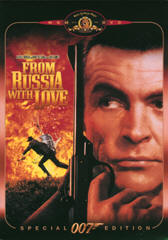
1963, Color
Aspect Ratio: 1.78:1/16x9
Dolby Digital Mono
1 Hr 55 min
Rated PG-13
Staring Sean Connery, Daniela Bianchi, Pedro Armendariz, and Lotte Lenya.
Directed by Terence Young. Screenplay by Richard Maibaum.
0
5
Entertainment:
Video Quality:
Audio:
Extras:
Violence: mild
Sex: mild
Language: no
SPECTRE is back with a plan to steal the coveted Russian 'Lektor' decoding machine. England and Russia are used as pawns in SPECTRE's game: Russian consulate worker Tatiana is fooled into thinking she is part of a secret Russian operation when she is asked to tempt agent 007 with the possibility of getting him a Lektor, something England just can't pass up. 007 must use his wits to uncover the truth when no one is really who they seem.
At the time, "From Russia With Love" was just catching the upswing of Bond mania. Today, it is regarded by many fans as their favorite of all the films. It has a strong cold war 'spy' feel which few of the other films capture quite so well. Connery is now fully immersed in the role with a suave debonair presence. The budget is doubled from "Dr. No" and producers Saltzman and Broccoli have the most charming Daniela Bianchi as leading lady.
Though her dialogue is dubbed, she is a favorite for many older Bond fans, despite the absence of a bikini scene. To that point, one has to remember "From Russia With Love" comes from an era where the story was most important and sensuality was still discreet. Also memorable is the short Lotte Lenya as the hard Col. Klebb. 'Q' appears for the first time to introduce the first Bond gadget: the brief case of hidden surprises.
Every element is spectacular and embodies the Bond philosophy of larger-than-life. The extravagant gypsy camp battle, the violent fight on the train, and the climactic boat chase push the day's envelope for on screen action. With numerous technical and logistics problem plaguing filmmakers, editor Peter Hunt deserves recognition for very clever assembly and sequencing of the mixed footage brought before him. For the first time, the opening scene is put ahead of the opening credits, a move that immediately became a hallmark of Bond films. The title sequence itself is inspired: Often imitated, the ingenious technique of artfully projecting the title credits on an undulating dancer's body is forgotten by few.
Filmed in Pinewood Studios and on location in exotic Turkey, "From Russia With Love" simply has it all. The film hints at a continuity to come in the films' series: SPECTRE is uptight about the death of Dr.No, and Bond's opening fling from the first movie is back for a cameo of the same capacity.
On a personal note, I had really hoped that this 'Collectors Edition' would have included information on the infamous jump cut, perhaps even including the footage as an extra. At the very end of the film, while Bond and Tatiana are chatting in the gondola, there is an abrupt and obvious jump cut. Even the music skips a few notes. A popular explanation is that a line of dialogue related to the blackmail film was cut because it was too racy for audiences of the day. The mystery lives on . . . .
The print is in good condition for the age of the film. Scratches are quite small and call attention to themselves only in the darkest of scenes. Color is surprisingly life-like, not feeling as dated as others from the era. On the whole, it is nicely detailed with a slight film-like quality and deep blacks but is ruined by an overdose of unnecessary edge enhancement. The mono soundtrack, though dated, is not as brash as other films this old. Though the dynamics and fidelity are old, there is pleasantly little harshness and hiss is noticeable only in the quietest of passages. Dialogue remains rewardingly intelligible.
In addition to the excellent behind the scenes piece, there is an audio commentary track, documentary on Harry Saltzman, stills gallery, and more.
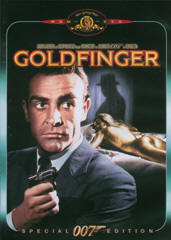
1964, Color
Aspect Ratio: 1.78:1/16x9
Dolby Digital Mono
1 Hr 50 min
Rated PG-13
Startin Sean Connery, Gert Frobe, Honor Blackman, and Shirley Eaton.
Directed by Guy Hamilton. Screenplay by Richard Maibaum and Paul Dehn.
0
5
Entertainment:
Video Quality:
Audio:
Extras:
Violence: mild
Sex: mild
Language: no
Considered by many to be the best Bond, there is no question "Goldfinger" is an important one.
When international jeweler Goldfinger begins hoarding gold, 007 is put on the job to find out what he is up to. Bond plays an intellectual game of cat and mouse with Goldfinger while investigating his activities. Eventually 007 falls into the villain's hands and learns of Goldfinger's vision to take no less than the Fort Knox gold reserve. When the plan turns out to be even more diabolical, Bond must persuade Goldfinger's personal pilot, Pussy Galore, to question her involvement and help turn things around.
While the first two films were a resounding success, it is "Goldfinger" that began the 'Bond craze'. An absolute phenomenon, "Goldfinger" entered the Guinness book of records as the fastest grossing film of all time.
Saltzman and Broccoli set out to make a bigger, more daring film, and new director Guy Hamilton delivered in spades. Absolutely everything works together in perfect harmony to perform movie magic: The characters, the story, the places, the action, the romance, the adventure, and even the music. "Goldfinger" solidified the Bond formula including the "pre-title" action sequence which has since become a hallmark of Bond films. Although introduced in "From Russia with Love", "Goldfinger" pioneered it as being unrelated to the plot, a sort of mini adventure which encompasses sexuality, action, and humor, setting the stage for the film that ensues. The title sequence itself would now be set for decades to come, where a featured song is sung to the parading of female silhouettes. With the confidence gained from the first two films, the budget was large and permitted director Guy Hamilton to pull out all the stops and deliver unprecedented adventure, pushing the envelop of what could be done in terms of action and, of course, on screen sexuality:
Forever we will remember the 5 seconds of character Jill Matheson's gold painted 'naked' body. And to this day, some still hesitate to say out loud the tongue-in-cheek character name Pussy Galore.
Making a debut in "Goldfinger" was a new car for Bond, the Aston Martin DB5. The car would see a relationship with Bond for several films and a fame that many actors could envy. Called the most famous car in the world, toy versions of the DB5 by Corgi are now remarkably valuable items, as are the wave of merchandise that "Goldfinger" spawned.
Although "Goldfinger" locations span from Miami, to Switzerland, to Kentucky, much of the footage from these exotic locales was brought back to studios in London and employed with the rear projection method while actors stood in front to do their thing. Perhaps not known to the more casual viewer, all the dialogue of legendary villain "Goldfinger", played by Gert Frobe, was dubbed with the voice of Michael Collins. And what superb action given the limited technology of the day!
Goldfinger's soundtrack earned it the Academy Award for sound. For a mono soundtrack that is decades old, "Goldfinger" plays decidedly well, still able to impart a sense of 'big'. Though a few scratches are scattered throughout, hiss is pleasantly inaudible at civilized playback levels. The dialogue is intelligible and lively, but lacks dynamics, and the whole thing takes on a gritty, shrill quality during the action, especially if pushed toward reference level (yet Bassey's soaring rendition of the title track is still enchanting).
The DVD preserves the visual art adequately. Though the overall look is detailed, tiny scratches are abundant (may even give a sense of nostalgia for certain viewers). Color, though dated, is generally good as well. The occasional digital or compression artifacts are limited to some solid backgrounds. A thick application of edge enhancement is sadly present and spoils the overall look of the picture. Despite these shortcomings of the DVD, "Goldfinger" remains a thrilling hallmark of cinema, maintaining its charm almost four decades later.
In addition to the excellent behind the scenes documentary, a second segment, The Goldfinger Phenomenon focuses specifically on the impact the movie had on pop culture. Beyond that there is a huge still gallery, 2 commentary tracks, and more.
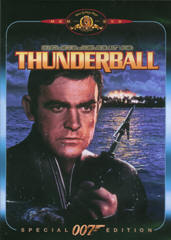
1965, Color
Aspect Ratio: 2.35:1/16x9
Dolby Digital 5.1
2 Hr 10 min, Rated PG-13
Staring Sean Connery, Claudine Auger, Aldolfo Celi, and Luciana Paluzzi.
Directed by Terence Young. Screenplay by Richard Maibaum and John Hopkins. Story by Kevin McCorey, Jack Whittingham, and Ian Fleming.
0
5
Entertainment:
Video Quality:
Audio:
Extras:
Violence: mild
Sex: mild
Language: no
When the international terrorist organization SPECTRE steals two nuclear bombs from NATO, operation 'Thunderball' is initiated to get them back. Bond's assignment naturally takes him to the heart of the action: Miami. There, Bond crosses paths with SPECTRE's number 2 man, Largo, his innocent 'kept' woman Domino, and the devious Fiona. Largo and Bond exchange pleasantries and socially interact with each other in high fashion. All comes to a delicious climactic underwater battle, as 007 saves the day.
Thunderball had its film inception even before "Dr. No". Fleming had been looking to take Bond to the big screen during the 50s and began to work with Kevin McClory on a screen play.
Loosing interest, Fleming later released the story as a novel, and McClory filed a lawsuit because some of the material was his work. When Saltzman and Broccoli took up Bond, they wanted "Thunderball" to be the first picture, but there was still too much going on with it legally. A settlement was finally arrived at, and production on "Thunderball" became a reality with McClory getting the producer credit.
Director Terence Young was brought back in, and, as became a tradition, every effort was made to top the previous film in terms of larger-than-life adventure. The now established pre-title sequence had to be high-octane, encompassing drama and gadgets in a frenzy of action. Again the envelope of the day was pushed, the scene in the steam bath where nurse Patricia is supposedly nude catching particular attention.
Most notable of Thunderball is that 25% of the screen time takes place underwater, culminating in the spectacular battle between the two armies of divers. The film's action would get it the Academy Award® for special effects. It is thought by many that "Thunderball" is perhaps the peak of Bond mania for the 60s: Merchandise was rampant, and images from "Thunderball" were on all magazine covers, including Popular Science (the jet pack used in the opening sequence was real, flown by one of two men in the world qualified to do so).
Special attention has to be paid to the DVD's soundtrack, as it makes effort to modernize the theatrical mono track into 5.1 surround sound. "Thunderball" deserves the effort and is well rewarded, as any improvement over mono is highly desired. But, the final result in this film is a mixed bag. Although the music is always open and spacious, effects are at times well integrated and at others collapse to mono. LFE reinforcement is definitely new and very interesting, but appears only sporadically. Dialogue intelligibility suffers on occasion, but hiss is kept remarkably inaudible for such old source material. On the whole, a good effort for a film that deserves it. The title song sung by Tom Jones is as memorable as ever.
To give the film a more epic feel, "Thunderball" is the first Bond to use the wide 'scope' format. In fact, the larger Todd-AO was even considered by the producer, but the more mainstream Panavision format was used in the end. The shear spectacle surely thrilled audiences in the grand cinemas of the 60s. Credited as a new digital transfer, Thunderball's video quality is clean and detailed but unremarkable. The film rarely shows signs of wear, but the colors, though consistent, are less than lively. Compression artifacts are few, and these only on flat fields of color but edge enhancement was applied during encoding and there is more than enough of it to distract from this great movie. Thankfully for the abundance of underwater shots, shadow detail is quite good.
As with Goldfinger, there are two main documentaries here, one being the excellent behind the scenes piece, the other focusing on "Bond Mania" which had swept the public at the time (Note that the labels for these two are reversed in the DVD's menu. Select the opposite of the one you want to watch.). Beyond that there is a huge still gallery, 2 commentary tracks, and more.
1967, Color
Aspect Ratio: 2.40:1/16x9
Dolby Digital 5.1
1 Hr 57 min, Rated PG-13;
Staring Sean Connery, Akiko Wakabayashi, Tetsuro Tamba, and Mei Hama.
Directed by Lewis Gilbert.
0
5
Entertainment:
Video Quality:
Audio:
Extras:
Violence: mild
Sex: mild
Language: no
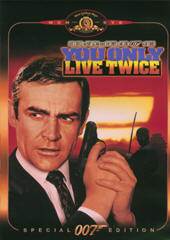
USA and Russia are on the brink of war, when both of their manned spacecraft are stolen from orbit. England feels they are landing somewhere in Japan and sends 007 to investigate. With the help of Japanese Secret Service, Bond discovers that SPECTRE is behind the hijackings and becomes a Japanese fisherman in order to infiltrate the island which houses the spectacular hideout.
"You Only Live Twice" embodies some interesting elements, not the least of which is 'killing' Bond in the pre-title sequence. Japan is naturally a most exotic locale, and much of the film highlights both the country and culture with extensive location shooting. Though the English language was difficult for them, both Akiko Wakabayashi and Mei Hama brought a striking new flavor to the Bond women. Unfortunately, they trade the spotlight late in the film, and the potentially more charming Mei is not given enough screen time to develop.
Many talents on the film were new to Bond, including director Lewis Gilbert. Yet the overall tone is consistent with the previous pictures while adding a flavor of its own. Among the films memorable elements are 'Q's compact gyrocopter, and the amazing fight scene in the Osaka office. But most significant is the elaborate volcano set, a project whose cost exceeded the entire budget for "Dr. No". Enormous in scale, it was one of many brilliant pieces from production designer Ken Adams.
So impressive, the monorail really worked, as did the moving helicopter pad from which the craft could actually fly in and out of the set. Perhaps too much of a good thing, the second half of the picture feels tedious as we are shown shot after shot of the remarkable set and one gets a feeling of 'been there, done that'. Though the numbers were not as high as "Thunderball", "You Only Live Twice" performed handsomely at the box office.
In its release, nothing could shadow the announcement made by Connery at the start of filming: This was to be his last picture as 007. History would record a different scenario.
The mono soundtrack is in poor condition. Although one expects fidelity to be dated, it is not only thin sounding, but has a harsh shrill quality and often distorts. Even below reference playback level, it is distressful. The print has not faired much better with an abundance of scratches and defects. It is grainy, and the edge enhancement applied by the makers is so strong, that it distracts even on smaller screens and makes it virtually unwatchable on large ones. On the positive, blacks are nice and deep, but color, though consistent, looks washed out.
In addition to the excellent behind the scenes documentary, there is a piece on the world famous Bond Title sequences and Morris Binder, the man who influenced them the most. There are storyboard sequences, commentary tracks, and more.
1969, Color
Aspect Ratio: 2.35:1/16x9
Dolby Digital Mono
2 Hr 22 min, Rated PG-13
Staring George Lazenby, Diana Rigg, and Telly Savalas.
Directed by Peter Hunt. Screenplay by Richard Maibaum.
0
5
Entertainment:
Video Quality:
Audio:
Extras:
Violence: mild
Sex: mild
Language: no
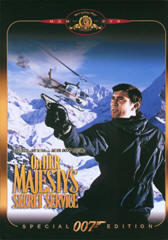
Through his acquaintance with Tracey, daughter of known crime leader Draco, 007 learns the whereabouts of SPECTRE leader Blofeld. By posing as a genealogy expert, Bond infiltrates Blofeld's alpine hideout and discovers the biological weapon the villain is preparing to blackmail the world with. With the help of Tracey and her father, they bring down Blofeld and save the world. The film closes when Bond marries Tracey, but they never make it to the honeymoon . . . .
With the wrap on "You Only Live Twice", Sean Connery resigned as 007. The search was on to find just the right person to play Bond. The part would ultimately go to Australian model George Lazenby. Peter Hunt, previously in the editor's chair, directs the challenging, and somewhat longer Bond film. OHMSS is tied very closely to Ian Fleming's book, with virtually nothing in the way of gadgets and a lot more emphasis on character development.
Practically the whole first half of the movie is story development with such things as the spectacular ski sequence occupying the latter portion of the film. Superb aerial photography highlights these action sequences along with the ambitious bobsled scene.
OHMSS could be called the black-sheep of the Bond series and in no way is this more true than in the marriage of Bond and Tracey. All of a sudden, Bond is human, believable, possessing real feelings evident in particular when she is tragically killed. At the same time, the film displays an uncanny continuity with the previous films: At one point, 007 is going through his desk pulling out memorabilia from "Dr. No", "From Russia with Love", and "Thunderball". A janitor whistles the theme to "Goldfinger" and the title sequence is peppered with numerous shots from previous installments.
It set certain box office records for its day, but the film earned its profits slowly and is regarded as one of the less successful Bonds. As George Lazenby's one and only Bond film, he is often regarded as the cause, but in hindsight, OHMSS has become a favorite of fans and many agree that Lazenby would have had a good tenure had he been kept on.
The print used for the master of the DVD is a very mixed package. Most of the time, the film is in excellent condition, but on occasion, shows very noticeable signs of wear and scratches. The colors, though consistent, don't feel natural and are wanting for deep blacks with some dark scenes coming off as washed out. Further, edge enhancement is pronounced and distracts even the casual viewer. The mono soundtrack fairs better than most of its age: clear and intelligible without hiss or scratches. Thought it does not have a harsh quality, the treble can at times be piercing.
Beyond the excellent Inside of feature, there is a documentary on "Q" which, while of interest on the larger scope of things, seems out of place here as OHMSS doesn't feature him or his gadgets. Stills, trailers, and commentary tracks are sure to keep you busy.
1971, Color
Aspect Ratio: 2.40:1/16x9
Dolby Digital Mono
2 Hr, Rated PG-13
Staring Sean Connery, Jill St. John, Charles Gray, and Lana Wood.
Directed by Guy Hamilton. Screenplay by Richard Maibaum and Tom Mankiewicz.
0
5
Entertainment:
Video Quality:
Audio:
Extras:
Violence: mild
Sex: mild
Language: no
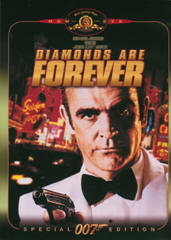
Diamond smuggling is on the rise, but since they are not appearing on the market, stockpiling is suspected. 007 is on the case by slipping into the smuggling pipeline. In Holland, he connects with Tiffany Case and ends up in beautiful Las Vegas. There, he finds arch nemesis Blowfled using the diamonds for a satellite mounted laser with which he plans on bringing the world to its knees.
The time had come to take Bond in a new direction. It was initially thought that "Diamonds Are Forever" should be an 'American' Bond, but with George Lazenby stepping away from the role, who would play 007? John Gavin (of "Psycho" fame) actually got booked for the role, but United Artist wanted Sean back and ultimately snared him for what was then an absolutely unheard of 1.2 million dollars
(which, by the way, Connery gave in its entirety to his Scottish Education trust fund), and other perks such as a commitment to finance two additional films of the actor's choosing.
Diamonds still makes a departure for 007 films. Peppered with delightful characters and charming one-liners, the main attraction, Connery, feels more like he's just along for the ride and even looks detached from the character we've been accustomed to. Las Vegas is still a fantastic spot to shoot any film. Difficulties that any other crew may have met were minimized by Broccoli's friendship with Howard Hughes, whom the character Whyte is based on. Shooting a Bond finale on an oil rig must have been challenging enough as it is.
Casting is a real melange. Charles Gray is a favorite of many fans as the arch nemesis Blowfeld. Bruce Glover and Putter Smith are comical as the gay henchmen. And the recluse Willard Whyte is well played by none other than Las Vegas entertainer Jimmy Dean!
Though the novelty of Connery returning to the role surely had something to do with the renewed ticket sales, fans today feel the tenure, and decade, were closed on a mediocre note. It would take a whole new Bond to pick things up.
The mono soundtrack, though dated, is still clear with intelligible dialogue. Only on occasion does it take on a distorted shrill quality and is otherwise dynamic and enjoyable. Application of Academy filter or THX's Re-Eq is recommended. The print is in reasonable condition with the expected occasional scratches, and the bright colors of Las Vegas are consistent but less than lively. Though the DVD exhibits deep blacks, it is lacking both in shadow detail and overall detail, and at time feels washed out. An excess of edge enhancement only further spoils the visual content of the film.
In addition to the excellent behind the scenes feature, audio commentary track, and deleted scenes, there is a feature on legendary Bond producer Cubby Broccoli.






|
Introduction | Part 1 | Part 2 | Part 3 | Extra
Copyright Secrets
of Home Theater and High Fidelity |
All James Bond images, titles, and artwork © 1961-1999 United Artists and/or MGM Home Entertainment
|
|
 |




 YouTube
 Facebook
 Twitter
 LinkedIn
 Pinterest
 Google+
 Instagram
Magazine Publishing Solutions by
 Advontemedia