
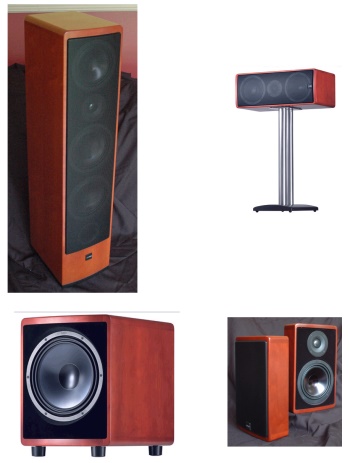
Canton ERGO 609 DC Floor-standing Speakers, 605 CM Center Channel Speaker, 601 Wall-mounted Speakers, and AS 650 SC Subwoofer Part I October, 2006 Sandy Bird
 |
|
Introduction
To me, Germany brings thoughts of beautiful engineered road machines, such as Porsche's timeless 911 chassis or BMW's M class.
Germany is the place where art and engineering become one. This extends to Germany's speaker manufactures as well. Canton, the manufacture of speakers being reviewed in this article, has always engineered excellent products, but what makes them stand apart from the competition is their cabinet finishes and designs.
From the moment the Canton ERGO speakers were removed from the cartons, I had to admire the design and craftsmanship this company placed in its cabinet building. When purchasing Canton speakers, you are not just getting a loudspeaker you are investing in a piece of furniture.
The Design
The ERGO series from Canton is a classic design (they even call it that) with tall cabinets that achieve most of their volume from their depth.
I am not a fan of the newest trend of "lifestyle" speakers with their curved little cabinets that are designed to blend into your local IKEA better than a Theater. It isn't that lifestyle speakers necessarily sound bad (although they sometimes do), but in my theater I want my speakers to stand out a little more and be part of the decor. The ERGO lineup does just that.
The ERGO cabinets are manufactured from MDF, one of the best materials for speaker building, and then covered with real wood veneer. The precision with which the ERGO cabinet is crafted and how the veneer is attached is incredible. You would be hard pressed to tell the cabinet isn't solid cherry wood.
All the ERGO speakers have black metal mesh grilles which contour to the slightly curved speaker face. The grille's edge is inserted under tension into a thin slot on the face of the speaker cabinet to keep them in place. Small pieces of felt attached to the edges of the grilles make a high pressure mechanical fit for the grille. In fact, the grilles are under so much pressure they are hard to remove. This tight fit ensures no unwanted vibrations or noises associated with the grilles can occur.
Canton claims the grilles to be acoustically transparent and in my listening I tend to agree with them. Sometimes your mind plays tricks on you and these speakers seem a little more detailed with the grilles off, but putting them back on and listening to the same selection of music seems to prove otherwise. Even rapping on the grilles with your knuckles results in a solid thud sound just as the cabinets do.
Under the grilles, Canton has covered the front of the speakers with a velvet material that is soft to the touch and should absorb any stray high frequencies waves that might reflect off the front of the speaker. The velvet is also so black it is almost hard to see.
Remember in middle school when they explained black absorbs all light, well not only does the velvet absorb high frequencies sounds it sucks up all the light around it as well and appears pitch black which is very pleasing to the eye when contrasted against the black anodized cones and cherry wood of the cabinet.
On to the Technical Stuff . . . .
I have listened and owned a lot of speakers over the last 15 years, many of them auditioned in my own environment. After working with enough companies, you discover a trend that many "high-end" speaker manufacturers would rather you not know, but here it is: A speaker manufacture that has its own research and manufacturing facilities that design and engineers their own drivers, crossovers, and cabinets, using tools like computer simulation and anechoic chambers, will build great speaker after great speaker. Their models from the bottom to the top of the line will sound good in most rooms and over time their speakers get better and better (to the point that sometimes those companies struggle with what else to upgrade or change in newer models).
Manufacturers that do not have this profile for the most part produces speakers that are hit or miss. They often make one or two great speakers and a bunch of not so great speakers. Their speakers also have a tendency to sound good in one room but horrid in the next.
The point is that Canton is one of the manufacturers with their own research facilities and builds their own drivers and it shows when you listen to any of their speakers in your own home.
Canton, like many manufacturers, shares technology between their model lines. This allows a better value for the customer as the cost of design is shared across many speakers. The Ergo lineup reviewed here borrows a substantial amount of its technology from the Vento series, which is Canton's top of the line speaker. In fact, all the drivers and crossovers are shared between the Vento and ERGO models with just slightly different crossover frequencies chosen to compliment the cabinet design and speaker placement.
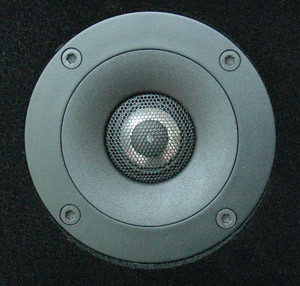 |
The tweeter used is an aluminum-magnesium dome with a silk surround. In the past I preferred soft dome tweeters as a rule of thumb, but over the last few years that has changed. At one time I found almost all metal dome tweeters to be too bright and analytical sounding, but manufacturing techniques and crossover designs have improved metal-dome tweeters to the point they can sound every bit as smooth as a soft/fabric dome with the added benefit of higher flat frequency response due to the lighter more rigid driver material.
Another somewhat unique feature of this tweeter is the fact the dome and the voice coil housing are made from one piece of material which will have better heat dissipation, allowing for better power handling.
|
© Copyright 2006 Secrets of Home Theater & High Fidelity |
|
|
|





 YouTube
 Facebook
 Twitter
 LinkedIn
 Pinterest
 Google+
 Instagram
Magazine Publishing Solutions by
 Advontemedia