
|
|||||||
|
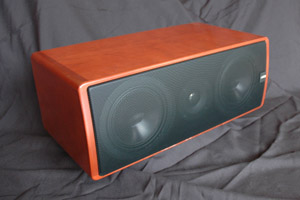
The mid-bass and woofers used in the ERGO lineup all have black anodized aluminum cones with inverted (concave) dust caps of the same material. The surround is UV-resistant rubber, molded into a sine wave pattern, which, assuming the same size cone and baffle, will provide more surface area for the surround, allowing for further extension. In the center channel and mains, the drivers are also magnetically shielded so you can set them close to your old CRT display. Crossovers are always a key part of any loudspeaker, but there are a couple of interesting points to note with the ERGO speakers. First, the center channel may look like a standard MTM (midrange-tweeter-midrange) design, but it is not. It is a 2-1/2 way system where frequencies below 350 Hz are sent to both the mid-bass drivers, but frequencies from 350-3000 Hz are only sent to one. This means the center channel has all the aspects of a two way system from 350 Hz and above, but the additional output level provided by the second driver from 350 Hz down where it is needed. I have mentioned in reviews before that the MTM design for a center channel is not optimal because of some of the off-axis frequency issues, but Canton has worked around this by using a 2-1/2 way system (great idea). The second thing to note is that all the ERGO speakers have high-pass filters at 20 Hz, which prevents them from responding to frequencies near their natural resonance. Otherwise, this could cause harmonic distortion at higher frequencies that could end up being audible.
The ERGO speakers are not overly efficient, and range from 86 dB for the 601s to almost 88 dB for the Center and present a load between 4 and 8 ohms for nominal impedance. What this means is that you wouldn't want to drive them using a budget receiver with only 55 watts, unless you only want background music levels. Given the price point of the ERGO speakers, most owners will drive them with plenty of power. The Anthem P5 I used during the review certainly had no issues with them, but it doesn't have issues with any speakers I know of. Floor-standers and Center First off, I like floor-standing speakers for my left and right channels. In theory, we only need monitor-style speakers for mains, as we all have subs to deal with the lower end of the frequency range. In some cases, isolating all low frequencies to one point source (your sub) can aid in minimizing room nodes, so if you subscribe to that mindset, the ERGO 603 monitors might be a better choice for the front. I would have to mount monitors on stands which take up as much space as floor-standing speakers, so why not have the extra cabinet space and lower frequency response (if I end up with problems with room nodes I can always just set the crossover higher in my processor). Brian Florian made a good comment the other day. He said, "I need an almost full-range speaker for my mains so that I can get by in case anything goes wrong with the sub". That isn't a bad argument especially in my house where I have a tendency to sell off my speaker setup every couple of years, and lately it seems the sub is always the first component to sell, leaving me with no LFE for a couple of weeks.
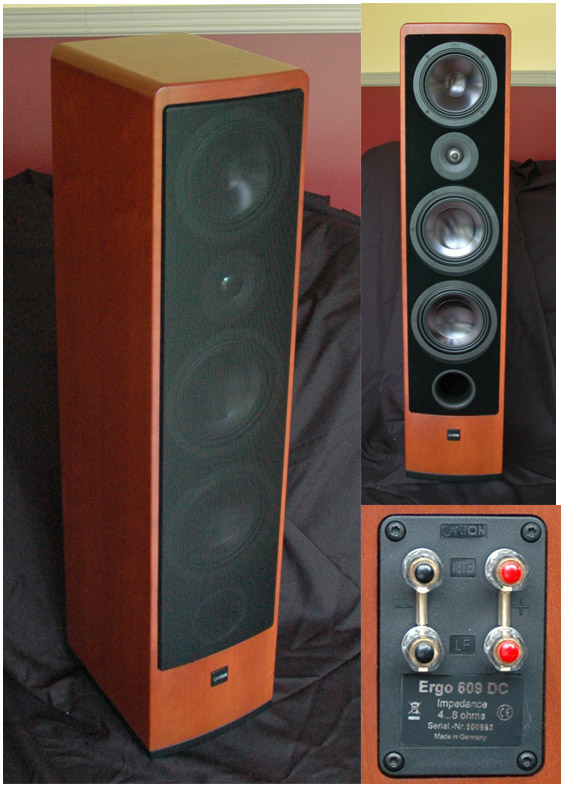
The DC 609s are almost four feet high, and are a 3-way system. The mid-bass driver is 7", and the dual bass drivers are 8" in size. The drivers are made of black anodized aluminum. They speaker has a flared port on the front and high quality bi-wireable gold plated binding posts on the back. The center channel is a 2-1/2 way system as mentioned earlier and is ported out the back of the speaker.
|
|||||||





 YouTube
 Facebook
 Twitter
 LinkedIn
 Pinterest
 Google+
 Instagram
Magazine Publishing Solutions by
 Advontemedia