
|
|
|
Specifications:
● Codecs: DD, DD-EX, DPL-IIx, DTS,
● Power: 95 Watts RMS x 7 into 8 Ohms ● THD: < 0.06%, 50 Watts into 8 Ohms ● 24/192 DACs on All Channels ● Video Bandwidth: 60 MHz (- 3 dB)
● Dimensions: 6.75" H x 16.2" W x 16.5" ● Weight: 27.6 Pounds ● MSRP: $549.95 USA
Yamaha |
Introduction
Secrets' continuing look at budget receivers (MSRP less than $600) picks up again with a very exciting model from Yamaha, the RX-V657.
In recent years, Yamaha has been very
aggressive about trickling down technology from their high-end flagship models
into their more budget-oriented products. About two years and two product
cycles ago, I looked at Yamaha's
RX-V740, a $600 receiver that I thought
offered good sound and a great balance of features for the price. The new
Yamaha RX-V657 ($549.95 MSRP) adds even more useful features for less money,
including an additional powered channel, so obviously I was very excited to have it in for review.
Features
Of the many unique features of the Yamaha RX-V657, the most interesting is its
built-in XM radio tuner (Satellite Radio). In order to receive an XM radio signal, you have to
buy an optional XM Connect and Play receiver antenna ($49.99 MSRP), plug in
the antenna and subscribe to the XM radio service. Using the web subscription
for XM, I was registered and listening to XM radio in less than an hour.
Yamaha's new RX-V series of receivers is one of the few receiver lines out
there that have built-in XM.
Another new feature of the RX-V657 is the Yamaha Parametric Room Acoustic
Optimizer (YPAO), an automatic system set-up and equalization tool that makes
configuring your receiver very easy. It's also unique in its use of parametric
equalizers (PEQ), which are more effective than fixed band equalizers at solving
room response problems. Competing models from other companies offer similar functionality, but none offer both
parametric equalization and automated set-up. PEQ allows flexibility in the
frequency of a particular band of EQ, and also has adjustments for the width
(how much on either side of the center frequency the EQ works).
The RX-V657 offers the current full complement of Dolby and DTS surround codecs including DPL-IIx and DTS 96/24. The RX-V657 also
has
Yamaha's well known movie and music DSPs, including the ones that use presence
speakers (you put these on the side, near the front speakers) for the Cinema DSP. In addition you can simply get rid of all of this
processing with the very nice Pure Direct mode for purist's stereo listening.
The RX-V657 offers multi-zone features with the ability to receive a remote IR signal and either power the remote speakers with an external amplifier or use two of the unit's internal amplifiers.
On the video side, the RX-V657
features full video up-conversion to component (converts S-Video inputs to
component video) and a video bandwidth of 60 MHz
on its component inputs.
Front Panel
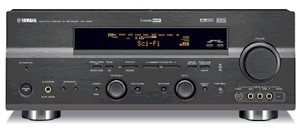
The Yamaha RX-V657 has a handsome and simple front panel that is anchored by a
large solid feeling volume control to the far right. Input selection and sound
field selection are taken care of by two smaller knobs below the main display.
These knobs also have variable purposes, e.g., serving as the tone controls,
which can be activated by their neighboring buttons. Above these two knobs are
the tuner controls with buttons for search mode, band, preset group, tuning,
and memory.
Finally, there is a headphone jack and a full featured
front channel A/V input with both S-Video and an optical digital input. The
display is a yellow-orange color, and the main areas of interest - the volume
level and the center text portion used to display surround setting and song
info for XM - were both easily legible from my listening position. The display
also shows information on the channels of the input signal and has
surround indicators for the Dolby and DTS modes. You do need the remote
though, for set-up. You can't do it by using just the receiver display panel
panel.
Connections
The back panel of the Yamaha RX-V657 is clean, well laid out and offers good
connectivity for a unit of this price. The RX-V657 has five digital inputs (three
optical and two coaxial), which is one more than most of its competing products.
The rest of the inputs are relatively standard: four A/V inputs, two stereo inputs, multi-channel audio input, and
two component video inputs. These are generally
sufficient for most basic home theater setups, but three component video
inputs would be better for future upgradeability. Actually, it would be really
nice to see HDMI inputs, but it may be awhile before we see those in the value
priced receivers.
There are also inputs for the FM, AM and XM antennas as well as for a Zone 2.
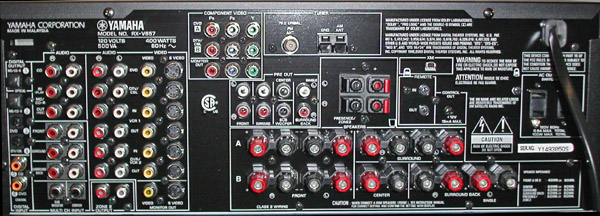
On the output side there is an optical digital out and the normal VCR and tape loops. There is also a full set of pre-outs, which is always very nice to see. The speaker binding post are all modern five-way connectors that worked well with my banana plugs and provided a sound and solid connection.
Zone 2 has its own pre-outs as well as a separate set of spring clip speaker connectors for use with the internal amplifiers. These spring clips are also where one connects the Presence speakers (a set of small speakers placed above and wider than the main speakers, used by some of the Yamaha Cinema DSPs).
When you set your system up, you have to decide between powered Zone 2 or Presence speakers. Overall, the connections are blocked out into logical and well-spaced units and I had no problem hooking a full complement of sources to the RX-V657.
Remote Control
The RX-V657 comes with a nice non-learning multi-component remote control.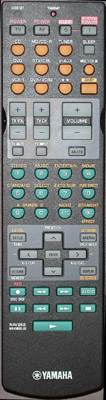 There
are a fair number of buttons on the remote, but they are laid out in logical
groups (Source, Surround Setting/Numeric Keypad, Cursor, and Player), making it
relatively easy to learn.
There
are a fair number of buttons on the remote, but they are laid out in logical
groups (Source, Surround Setting/Numeric Keypad, Cursor, and Player), making it
relatively easy to learn.
The remote should be comfortable for most people to hold. It was also relatively light which was nice for those epic XM radio channel surfing sessions. The remote is pre-programmed to control a variety of other components, and set-up is accomplished by entering the appropriate code from several pages in the back of the instruction manual.
Controlling my DVD player with the Yamaha's remote was easy and
straightforward. Like many remotes, selecting a source automatically changes
the remote to the appropriate button layout for that source. In order to
return to the receiver controls, one has to press the Amp button. This can
create some problems, since the numeric keypad in DVD mode, which gives one
direct chapter access, uses the same keys that adjust the surround field
settings in Amp mode. If one forgets to switch back to Amp mode before
changing a surround setting, the DVD will skip to a new chapter, which can be
somewhat annoying.
Set-Up
Activating the set-up with YPAO couldn't have been easier. All of the set-up is
performed through the On-Screen-Display (OSD), using the remote control. To
begin, all one has to do is connect the included microphone and select
Start on the Auto Set-up menu. After a few minutes of test tones, the
system asks if you want to accept the configuration that it has made. It's easy enough from here to
check on all of the settings the receiver wants to implement. If anything is
wrong, one can simply manually adjust that setting.
I found that everything was spot on for my setup when I performed the YPAO. The only change I might have made is that it selected 90 Hz as the crossover frequency, where I normally prefer 80 Hz. I think this might just be a default setting for Yamaha as they traditionally have preferred a 90 Hz crossover. However, unlike older Yamahas, the crossover is selectable to 40, 60, 80, 90, 100, 110, 120, 160 or 200 Hz which should cover most all speaker systems. This is a global crossover that is applied at the same frequency to all speakers.
Regardless of how your Auto Set-up turns out, you can always go back and manually adjust any of the values that you want to. Auto Set-up also provides a Parametric EQ, which in my case was implemented in my surround channels and center channel. Overall, I thought the EQ was reasonable for the center, but the surrounds were heavily EQ'd due to their position. It seems to work though as I left the EQ in place for all of my listening tests, and those results were all very positive.
Another nice feature of the set-up is the ability to reload either the default
settings or the last YPAO run. This was nice as it allows one to tweak away on
the settings safe in the knowledge that they can return everything to a
reasonable starting point if their efforts don't improve the sound.
General Use
Simply put, the RX-V657 was a joy to use. Playing DVDs with most receivers
these days is simply a matter of selecting the input and adjusting the volume
in a relatively narrow range. The surround processing should automatically
select the best option and off you go. The RX-V657 does this
with absolutely no fuss. The volume control on the RX-V657 offers good control
and nice 0.5 dB steps to really dial in the right level.
Out of the box, there
was a big difference in levels switching between my two most common inputs,
DVD and the XM tuner. This would normally be quite a nuisance, but the Yamaha
has a Volume Trim option that allows you to adjust the level of the signal at
each input, so that volume remains constant when switching inputs.
Using the XM radio functionality on the RX-V657 was uniformly excellent. The
XM tuner is implemented as one of the bands, along with the standard AM and
FM. Once you have selected the XM radio, you can either directly enter the
station of your choice using the numeric keypad or select a channel, category,
or preset using the cursor buttons. Surfing between channels was a cinch with
the radio locking on to the next channel's stream relatively quickly.
The
front display on the receiver can either be set to show the station name and
number, the music category, or the artist and song title. You can also show
all of this info simultaneously on your TV. It's nice, but could be made more
interesting. Overall, I found it easiest
just to leave it set to the artist and song title mode, since when you change
channels, the receiver initially displays the station name and number before
switching over to the artist and title anyways. Names that are too long to
display scroll at reasonable pace and were clear enough to be read from
listening position.
The
Sound
Starting with XM, I thought it sounded quite good, but to be honest calling it
CD quality might be a bit on the optimistic side. However, it isn't that far
off, I'd say it's more like a really good MP3 and it's certainly better than
your standard 128 kbps digital audio. Note that this is due to the compression
of the broadcast signal, not the receiver. With that said, the tonality was good
and so were the dynamics. Most lacking was the soundstage in comparison to
good CDs. However, processing it with DPL-IIx music did wonders to help
alleviate the problem.
In the end I did most of my listening to the XM radio
in the seven-channel stereo mode. This is Yamaha's Party mode, where the sound is
evenly distributed to all of the speakers so that one can get decent sound
regardless of the direction you are facing or where you're positioned. This is
a killer feature for good background music, as it allows you to keep the level
relatively low, but still maintain enough definition so the music can clearly
be heard. I essentially kept the Yamaha on, playing the XM radio using seven-channel
stereo all the time I was home during the review period, and I enjoyed every
minute of it.
After countless hours of listening to XMU, my favorite XM station, I started
out the rest of my critical listening with Gustav Holst's "Second Suite in F",
Fantasia on the Dargason (Telarc CD-80038), which has become my standard
starting point for evaluating sound quality. The Yamaha provided a very
capable performance with a very clean and balanced sound. Instruments were
well-defined in the acoustic space, and there was a realistic soundstage. I
thought the percussion instruments worked particularly well with crispness and
snap that is both true to their original sound and a pleasure to listen to.
The bass was full and well defined, with the bass drum at the end creating an
excellent acoustic presence in my room.
In my relatively small space, I was able to achieve high volume, but I would not necessarily expect this in a larger space or with less efficient speakers as it felt at times that the Yamaha was at the very edge of starting to compress the dynamics.
Overall, I really liked the sound of the Yamaha with music,
especially using just the Pure Direct mode. I have previously spent a
considerable amount of time fiddling with Yamaha's music DSPs, with my preference being to just leave
the receiver in Pure Direct for serious music listening.
Next, I decided to move on to a concert DVD of U2 Live at Slain Castle. I
particularly like the take of “Out of Control”, and the Yamaha did a very good
job of capturing the essence of this performance. Using the DTS soundtrack,
the Yamaha presented a very well-balanced sound field that gave the track an
excellent atmosphere. The key thing on this track is Bono's vocals which came
through very clear and very nicely presented.
For movies, I began with an old
favorite, the DTS edition of Saving Private Ryan. I did most of my critical
listening on the last battle sequence around the bridge. I have always liked
this DVD for its very active surround field and its impressive sonics from the
score, the dialogue, and the effects. The Yamaha gave me everything I needed
out of the scene with a clear rendition of the complex surround effects, and
the rich, full bodied harmonics of the musical score filling things in.
To finish things off, I pulled out the Star Wars (Episode IV) DVD,
which is
one of my favorite movies of all time. There are so many great things about
the movie from a sonic standpoint, but my favorite is John Williams' classic
score. It has an extensive use of the French horn (my
instrument), and I like the Yamaha for how it presented the horn in its
featured moments throughout the movie. The RX-V657 gave the horn the full rich
tone one would expect and was sufficiently detailed to effectively delineate
its sound in the overall sound field.
Essentially, everything just sounded
like it should. Vader sounded like Vader and a TIE fighter sounded like a TIE
fighter. Overall, the Yamaha RX-V657 was able to provide very accurate and
enjoyable renditions of test DVDs and CDs, so I was extremely pleased with
the sound. As with other receivers in this price category, you should use
speakers with 8 ohm impedance and good sensitivity (88 dB/w/m or higher),
for the best results.
Conclusions
What's most important when you buy any piece of home theater or stereo
equipment is that you enjoy it when you use it, and that you use it frequently.
With the Yamaha RX-V657, I had fun every time I fired it up, and I can honestly
say that I ended up using it more hours per day than I have any other
receiver I have ever owned or reviewed.
Everything about it just worked well,
from its excellent DVD playback to my favorite feature, the XM radio. In fact,
the XM radio was the main contributor to all of the hours I racked up on the
RX-V657. Now part of this is XM itself and the fantastic content it provides
on its stations, but equally important was the excellent execution of
integrating the XM tuner into the RX-V657, which operated smoothly, simply, and
efficiently. I think most users will simply end up getting more use out of an
RX-V657 and thus better value than they would any of its competition, because
of its XM tuner.
Even without the XM tuner, the RX-V657 would be a formidable challenger in its
class. Features like Auto Set-up, parametric equalizers, and video up-conversion
were unheard of at this price point just a few years ago, but the Yamaha has
them all. On the rest of its features, the Yamaha RX-V657 gives up very little
to any of its peers, and again I feel it has one of the best balance of features of
any model in its class. Ultimately, if you're in the market for a budget
receiver, I don't think you could do any better than the Yamaha RX-V657.
Highly, highly recommended.
- Matthew Abel -
|
© Copyright 2005 Secrets of Home Theater & High Fidelity |
|
|
|





 YouTube
 Facebook
 Twitter
 LinkedIn
 Pinterest
 Google+
 Instagram
Magazine Publishing Solutions by
 Advontemedia