
|
||||||||||
|
Introduction Finally I made my decision and paid the princely sum of $400 hard-earned high school dollars for a basic Pro Logic receiver that elevated the cobbled together speaker set in my bedroom to a true surround sound system. Despite the fact that I have moved beyond entry-level receivers in my system, I keep a relatively updated surveillance on what the latest receivers offer in the upper budget price range. I do this just so that if I had to buy one, I would still know which would be the ideal one for me. When I look at these
models, I tend not to gravitate toward the absolute bottom of most
manufacturers' ranges, as a few hundred dollars more generally yields a
receiver that has a feature set frighteningly competitive with models
further up the chain. It seems that throughout the years, different
manufacturers have gained slight upper hands with more and better
features, but as it stands today, all of the major electronics'
manufacturers are offering relatively similar feature sets in their
midrange receivers as well. However, despite my constant surveillance of the
receiver scene, my physical experience with most of these models was
limited to brief encounters in various demo rooms. Thus I was quite
intrigued to bring Yamaha's new RX-V740 into my house for an extended
review. At $599, it would be considered a budget receiver, but mid-level. The Yamaha RX-V740 is a six-channel (6.1) receiver sporting an equal 90 watts into all six channels (not necessarily driven at the same time) and has all of the standard decoding facilities (DTS, DTS-ES, DTS Neo:6, DD, DD-EX and DPL-II). The only missing decoding feature is DTS 96/24. While I think DTS 96/24 is a great format and it certainly has potential if the one disc I own is any example, there simply is no software (music) to speak of for this format and the future does not look particularly bright on this subject. Instead of having only one rear center channel, it should have two, as this allows 5.1 to be configured as sides, rears, or both (7.1). Yamaha also includes a host of their
own DSP programs, something Yamaha for quite some time has been known for.
I'll go into greater detail later, but the RX-V740 features five unique
music modes and nine unique cinema modes. Like THX, you can layer most of
the cinema modes on top of the standard DTS and Dolby Digital processing.
The first thing I noticed about the 740 as I hoisted it out of its box is
that it is relatively heavy (28 lbs 11 oz) for a receiver of its class.
Upon later inspection, much of this weight could be attributed to a large
power supply and heat sink inside its case. The nice thing about this is
that Yamaha does not use a fan to cool the 740, which is always
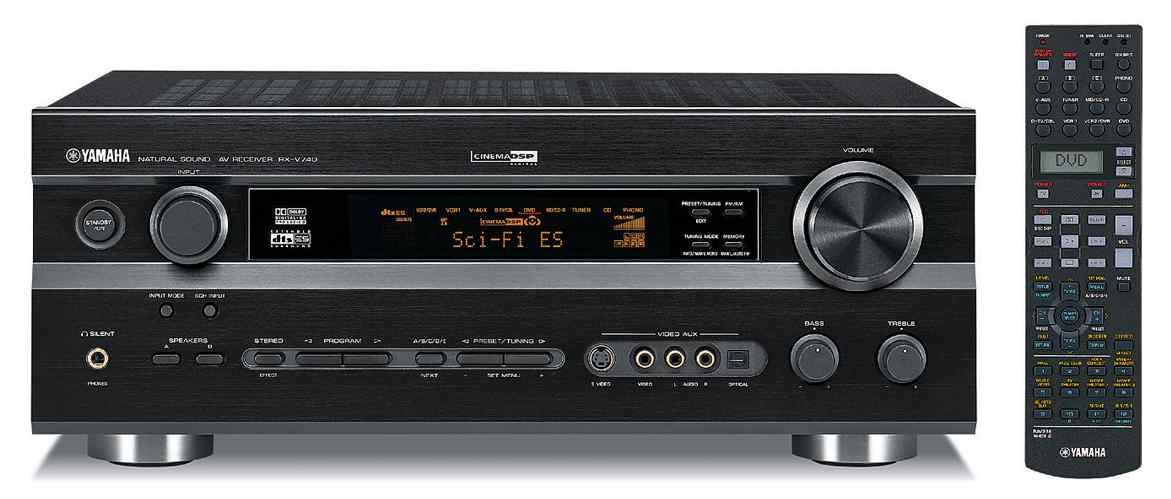
preferable. Examining the 740's front panel reveals a handsome unit with a simple black faceplate, a substantial volume knob and a separate input selector knob. The front panel also includes buttons for surround field programs, radio tuning, input mode priority, speaker select, and the six-channel discrete input (you could use this for connecting the analog outputs of a DVD-A or SACD player). There is a standard ¼” headphone input, which mutes the speakers and preamp outputs when you plug in your phones. The front panel
A/V input includes S-Video as well as an optical digital input. Lastly, a
large pair of bass and treble tone control knobs are located on the front
panel, something you don't see on every receiver. I left the tone controls
in their flat position for the entirety of my evaluation period. One thing
I liked about the layout of the front panel is that Yamaha managed to keep
a nice clean look without having to resort to using a trap door to hide
the controls. Another thing I liked is that one could operate 95% of the
receiver's functions from the front panel including doing system setup.
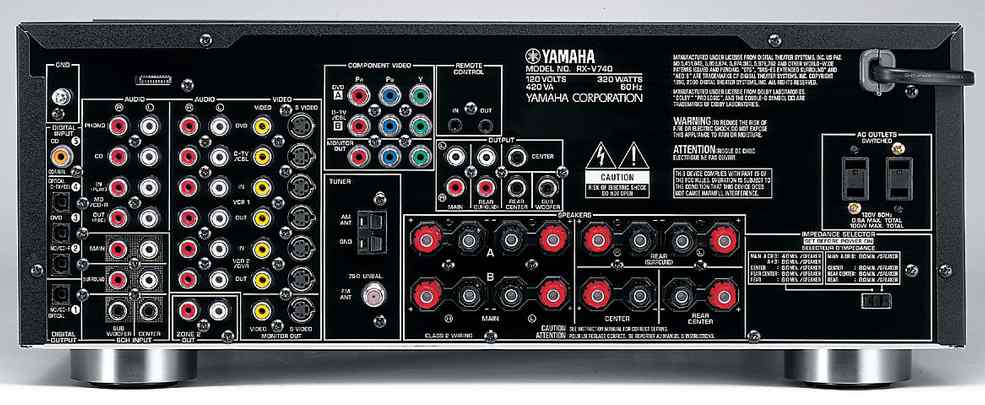
The RX-V740 was excellent in both its quality and its functionality. Turning the RX-V740 around reveals a well thought out and relatively complete back panel for any receiver. The input selection is par for the course with three optical and one coaxial digital input. On the analog side there are six line level stereo inputs, four with video inputs, a phono input, and a six-channel input. The video side consists of two component inputs as well as four S-Video/Composite pairs.
Click on Photo Above to See Larger Image The RX-V740 can up-convert composite video to S-Video for simplicity of hookup to your TV. I didn't test this feature, but it is nice to see its inclusion on a budget receiver. There are spring clips for an AM antenna and a coaxial hookup for the FM antenna. Moving on to the speakers yields sets of two-way binding posts for banana plugs for all of the main speakers as well as “B” second main speaker outputs. I wasn't overly impressed with these binding posts, as they felt a bit flimsy when unscrewed, but my banana plugs fit nice and tight and never game me any problems during the testing period. The final thing that really got me excited was the inclusion of a full set of 6.1 preamp outputs. In comparison, I would say that only about 50% of the receivers in the RX-V740's class include full preamp outputs. Receivers like the RX-V740 are often the first component one will buy when setting up a home theater, and the upgradability afforded by preamp outputs is important for someone just starting out. Whether you choose to add an external amp to improve the dynamics of the receiver, or if you decide that you really want a full on stereo rig with supplemental surround, the preamp outs give you this option. While the back panel didn't bowl me over with class leading connectivity, it was the nice, clean, logical layout that truly impressed me. The Remote Control The remote for the Yamaha is a very traditional looking medium sized rectangular model. The remote is on the thinner side of receiver models and is not too heavy. It fit comfortably in my hand, and the buttons were easy to use. The remote can control a number of other components through its internal preset library, but it does not have either learning or macro capabilities. When one selects any of the twelve input buttons at the top of the remote, the receiver will switch to that input (there are three extra remote areas, A, B, C, ostensibly for controlling components not attached to the receiver) and will change the remote to that input's control mode. The name of the selected
component appears in a very cool red LCD and you can rename the
component's display here (only four letters though). You can also scroll
through the components on the LCD to control a component without changing
the input. This is a really good idea that a lot of other multi-component
remotes miss. The volume punches through to the receiver on most inputs,
which is another nice feature. When controlling normal playback
components, like a DVD player, there is a five-button menu select area, as
well as a similar play, stop and chapter select area. With the distinct
positions of these areas and their natural layout, I had no problem using
these controls in almost all conditions. I set up my RX-V740 using the front panel and its relatively intuitive menu system. One can individually set speaker levels in one dB increments for all of the speakers, as well as the speaker distance in one foot increments. The speaker size can be set in the symmetric groups of main, center, surround left and right and surround center (back). I set all of my speakers to "Small" and matched my levels using the test tones. For a number of years, Yamaha has bucked the industry standard 80 Hz crossover frequency in favor of 90 Hz. The RX-V740, like other Yamaha models, only has a fixed 90 Hz crossover. However, throughout my listening tests, I did not find it to be an issue at all. The RX-V740 allows you to
reassign the component video and digital inputs to all of the logical
input choices and rename the components on the front display with up to
eight characters. There are also some unique setup features that are worth
mentioning even though I did not find uses for them. The 740 lets you set
subwoofer levels independently for your speakers and your headphones and
also gives you separate tone controls for your headphones. There is also
an equalizer for the center channel offering five bands (100 Hz, 300 Hz, 1
kHz, 3 kHz, 10 kHz) with up to six dB of boost or cut. The RX-V740 spent a couple of months as the centerpiece of my
home theater, where it played back its fair share of music, DVDs and TiVo.
Throughout this time, I had no problems whatsoever in the operation of the
receiver, and in fact, there were even a few things that stood out to me as particularly
nice about its operation. The first of these was the
volume control, which Yamaha has dubbed their “Accurate Touch Volume
Control.” The nice thing about this was the narrow 0.5 dB steps that
really let you dial in the volume you want with a very intuitive fast-up,
fast-down that seemed to minimize any overshoots. This may seem
trivial, but when it comes right down to it, there is no more used feature
on a receiver than its volume control. With the 740, you don't have to
dive into a bunch of
menus every time you sit down to watch a movie or some TV. In fact, it
speaks highly to the painless operation of the RX-V740 that all I usually
did was turn it on, toggle up my desired input and dial in the volume. As I mentioned previously, Yamaha makes a big deal out of its
DSP modes, so I was instantly curious as to how they sounded. Yamaha
offers five modes for music, Concert Hall, Jazz Club, Rock Concert,
Entertainment – Six Channel Stereo and Entertainment – Disco. I'll
concentrate on the first three, as they are the ones designed to produce a
simulated acoustical environment, where as the other two are more “party
modes”. None of these three modes use the center channel, for better or
for worse. All of the modes use some kind of delays and reverberation
enhancement to give the effect of listening to your music in an acoustical
place. When I listened, it seemed that generally the Concert Hall was
using the most delay and reverb, followed by the Jazz Club and then the
Rock Concert. Overall, the use of the surround channels was not
particularly aggressive, but of the three, the Rock Concert had the loudest
surround effects, followed by the Jazz Club and then the Concert Hall. I
tried to evaluate each of these modes versus straight stereo and DPL-II
using a host of different music that I felt might suit each mode well. The sound from DVDs with Dolby Digital and DTS was detailed and clear with above average dialogue intelligibility. Being completely convinced of the Yamaha's worth as a surround receiver, I started to experiment with the Cinema DSP modes to see if it could improve the sound further. In general, I felt that the Cinema DSP modes worked better than their music DSP variants, but I still found the same faults befalling them. The general problem is that most of the Cinema DSP Modes seem to trade detail and immediacy for a more expansive sound field. Now I feel a number of people will be more than willing to make this tradeoff, as it really is a very impressive effect, I'm just generally not one of them. I tried all of the
different modes and ultimately I settled on the Enhanced mode, which to me
was the subtlest of all of the Cinema DSP modes and the most true to the
original source. This made even more sense when I read its description in
the user manual, since the “digital sound field processing create precise
effects without altering the original surround orientation.” Enhanced mode
seemed to trade very little detail for a nice increase in the fullness of
the sound field. I liked Enhanced since it worked well on all of the DVD's
that I used it with and not just a specific disc or genre. I really liked
the RX-V740's performance on DVDs and using the Enhanced mode definitely
increased my enjoyment of the movies I watched with it. As it's pretty obvious to tell, I really liked the Yamaha RX-V740. It is a well-built, well-designed receiver that can handle music, movies, and television with equal aplomb. I kept the Yamaha in my system for three months, and it kept me happy the entire time. I'm still amazed that all of this performance can be had for such a reasonable price, $599 MSRP, and if you can forgo the phono input, the onscreen display and the LCD remote, you can have this performance for $100 less. When I finished
my review of the Yamaha, I hooked my Pioneer VSX-49TX back into my system
and I started to see just what the extra money buys you: more dynamics,
more detail, and more inputs. The RX-V740 is
also an ideal choice for someone looking for their first receiver to start
building a system around, as it has the inputs, outputs and sound quality
to keep pace with someone's growing system and taste. Ultimately, the
Yamaha is not perfect, but no audio component is and especially not one at
this price. There are many competing products, and some surpass the Yamaha
in one category or another, but the Yamaha RX-V740 offers the performance
and the right balance of features to make it my choice and an easy
recommendation.
|
||||||||||




 YouTube
 Facebook
 Twitter
 LinkedIn
 Pinterest
 Google+
 Instagram
Magazine Publishing Solutions by
 Advontemedia