
Product Review Yamaha RX-V795A DD/DTS Receiver December, 1999 by Brian Florian
|
5.1 channel A/V receiver featuring Dolby Pro Logic, Dolby Digital, and DTS surround decoding in addition to DSP processing 5 channels rated at 85W RMS each (8 Ohms), 20 Hz - 20 kHz, 0.04% THD Features 5.1 channel input, preamplifier outputs for all channels Size: 17 1/8" W x 6" H x 15 3/8" D Weight: 28 pounds (13 kg.) MSRP: $799.95 USA |

| Yamaha Electronics, USA, 6660 Orangethorpe Avenue, Buena Park, California 90620; Web http://www.yamaha.com. |
Introduction
While
I have your attention, I will dispel some vicious rumors about product review
writers. Simply stated, we do not make piles of
money writing articles. Even
slick high-end magazines don't pay out large fees. Unlike some end-users who have the means and the passion to own the best,
we are more obsessed with hearing and seeing as much a variety as we can and
trust that our readers are the benefactors of the obsession. True, we are privileged by getting to hear and see some really nice
equipment from some terrific manufacturers (and we hope that they in turn
consider it a reciprocal privilege to have us write about their products). But at the end of the day, we don't get to keep what we borrow: If we want to keep it, we or the publications we write for, have to pay
for it like anybody else. We
don't have a magic fountain of high-end gear.
Why
is this important? The subject of
the current review is the sort of product that is within reach of my real world
income and thus the sort of receiver I might choose for my own system. Never be ashamed of your price range. It does not define you as a listener or a viewer. Can't afford a $3,000 Pre-Amp/Amp combo? I hear you buddy!
Now, on with the show
Yamaha's 795 has been on the market for about a year now and must have struck a very pretty chord with the public. The demand is such that it has taken quite a while for us to get our review sample. This review is no less timely though as the 795 has been revised to a 795A with a couple of nice additions.
Positioned
right in the middle of Yamaha's product line, the 795A is crammed with
features including most of the ones we consider essential. The front panel looks as intimidating as any contemporary AV
receiver, but I assure you half of the buttons are for the sole purpose of the
tuner. Once you are acquainted with
the relevant controls, it all makes sense. Important controls, from left to right, include A/B speaker selection,
tone bypass and bass boost, bass/treble/balance knobs, level/set-up controls,
effect (DSP) selection, rotary source selector, and finally a rotary volume knob with
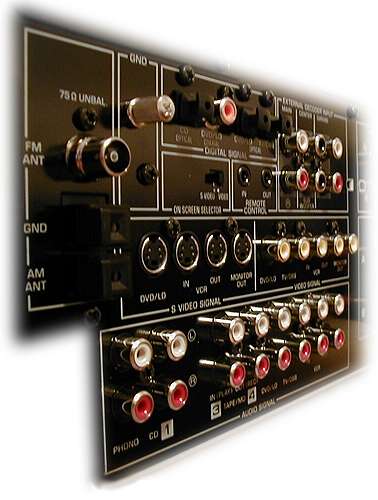
a solid feel. There are six inputs
(counting the phono set). Three have digital input, three have composite video
input, and two have S-Video input. There
is an additional seventh input on the front with both video types. A full
set of record outs and monitor outs complete the package. At this point, a lot of receivers draw the line, but with the 795A, Yamaha
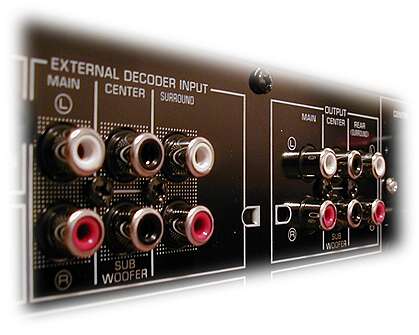
includes what we believe are further essentials: a complete set of 5.1 input jacks for future sound formats, and not only a
subwoofer output but the complete 5.1 pre-out set for future outboard amplification. These features position the 795A as a legitimate budget AV preamp.
Time
was when a surround processor just had level controls for center and surround, a
surround delay setting, and a Dolby Stereo on-off button. How the times have changed. No
need to be intimidated; there is simply more to do. The 795A breaks setup into two groups: Level and Set.
Levels
should be straightforward for most: Center,
Left Surround, Right Surround, and Subwoofer are adjusted to match the Mains in
level. Use your trusty Radio Shack
SPL meter and the built-in test tones (or suitable external set such as may be found
on Video Essentials) and match the 5 (or 6) channels.
“Set”
parameters comprise the modern settings. 13 items in all:
· Bass management. Setting any of the main speakers to “small” invokes a 90 Hz high-pass
to those speakers. Any bass
information that is redirected as such is combined with the LFE (“0.1”)
channel and can be sent to either the main left and right speakers, the
subwoofer, or both.
· The level of the mains can be normal or set at
-10 dB. This is useful when a two
channel power amp is used and the center and rear channels cannot be set high
enough to balance the front mains.
· Offset subwoofer levels for Dolby Digital and DTS. In short, if you sum all the bass from the main channels and then add the
LFE channel of either digital format, you could end up with a subwoofer level
that is too high. These settings are used to reduce the sub output level when
either format is used.
· Dolby Digital Dynamic Range. Max (default), Standard, Min. Use to change the range
of volume between the soft and loud sounds. Useful when
you have to listen at low levels but don't want to miss the quieter details.
· Center delay. You add 1ms (millisecond, or one thousandth of a second) of delay for every foot that the center is closer to the
seating position compared to the mains.
· Reset DSP mode (more on this later)
· Memory Guard. Invoke to prevent accidental change of any level or parameter.
· TV input mode. Can be Auto or Last (analogue or digital)
· Dimmer. Dim front panel to one of 5 levels.
Follow the yellow brick road
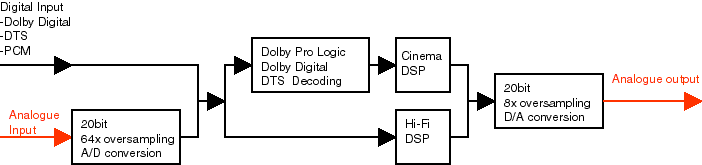
The basic signal path can be
seen in the flow chart above. If
you are playing a two channel analog source, the signal goes right around the
section pictured here. When you
invoke either Dolby Pro Logic decoding or any Hi-Fi DSP function, the analog
signal must be converted to digital. 20
bit
A/D converters with 64x oversampling generate digital data. These data, or those of a DD or DTS digital input, are then fed to the
decoder. After decoding into 4 to 6
channels, these digital streams can go through DSP modification
("Hall", "Stadium", "Jazz Club", etc.) if desired. Finally, a set of 20 bit D/A converters running at 8x oversampling bring us
back to analog and on to amplification. A
few comments here: If you have
Pro Logic CDs, LDs, or DVDs, you have never heard them as cleanly processed as
when you can shoot a PCM digital signal straight from the disc into the 795a's
decoder. By bypassing the D/A/D
stage that normally would occur, the most solid Pro Logic decoding results with
dramatically better directional cues. The
same D/A/D stage should be avoided for regular CD music whenever you decide to
use the Hi-Fi DSP modes.
It bears noting that the bass management is also carried out in the digital domain, and it remains active for stereo playback. A "pure-direct" can still be accomplished using the 5.1 inputs. Here the signal bypasses any and all processing or decoding, turning the 795A into a glorified volume knob.
Did you say DSP?
DSP (Digital Signal
Processing). The term itself is
thrown around way too loosely these days. In
the context of Yamaha receivers, DSP is the method of simulating an acoustic
environment, accomplished in the digital domain. Contrast this with listening to your discs in unaltered surround sound or
stereo playback. It's something
that Yamaha is big on and quite proud of, so “tweakaholics" or anyone else
curious about it, click here for a detailed look at the 795A's capabilities.
But how does it sound?
Step into the DA's office
A simple fact that seems to
get largely ignored is that every digital processor is a DAC. And I have yet to find a Dolby Digital receiver, preamp, or
stand alone decoder that does not also double as a PCM (CD) DAC as well. With PCM CD audio, the sound is on par with a typical mass market CD player—clean
but with a touch of sibilance. DD and DTS film soundtracks fare better with a lot of punch and negligible
background noise. DTS music CDs really take the cake. Maybe it's because they are engineered better, but of all the
material I've thrown at 795A, they sound the best by far. Now that DTS is being built into units even more modest
than the 795A (and that every DVD player doubles as a CD player with digital
out), I'd like to see more DTS music material.
With the 795A in the analog domain, I
simply can't complain. When
feeding it the analog results of some 24/96 DVD audio material, the best
source I have access to, I could find nothing detrimental that the preamp
section was doing to the music. If
anything, it could use just a hair of attenuation to the high frequencies.
You're going to tell me I need a power amp
 At Secrets we are very fond of
the virtues of dedicated power amplifiers, and this is one of the reasons that we
put a high value on pre-out jacks. Depending
on your tastes, and more importantly the size of your room, the 795A could very
well make you happy, as is. After I unpacked the unit and
connected it first to my 5 channel power amp, I was certain I'd be devastated when I heard the internal amps after a
week of THX power. However, I was pleasantly surprised. In what I consider to be a modest living room of <1500 cubic feet, the
795A was able to drive wife and cat from the room. True, it lacked the solidity
and confidence it had when coupled with my THX, 100 watts per channel outboard power amp. Then it occurred to me: The speakers were still all set to small and the
powered sub was doing all the hard work. As
expected, asking the 795A to do all the work in all channels finally brought its
limits to bear. Tracks such as
Jurassic Lunch, the T2 opening battle, or Lucia di Lammermoor (The Fifth Element)
now showed signs of stress at the top end and less control at the bottom. Still, for the money, Yamaha is stretching every one of your dollars as
far as they can, and I think they've struck a good split between power supply
size and system features. Simply
stated, investing in a good solid powered subwoofer will give you a double
return: Not only will you reinforce your low end but substantially
improve the 795A's contribution as well (the power supply can concentrate on
the preamp section).
At Secrets we are very fond of
the virtues of dedicated power amplifiers, and this is one of the reasons that we
put a high value on pre-out jacks. Depending
on your tastes, and more importantly the size of your room, the 795A could very
well make you happy, as is. After I unpacked the unit and
connected it first to my 5 channel power amp, I was certain I'd be devastated when I heard the internal amps after a
week of THX power. However, I was pleasantly surprised. In what I consider to be a modest living room of <1500 cubic feet, the
795A was able to drive wife and cat from the room. True, it lacked the solidity
and confidence it had when coupled with my THX, 100 watts per channel outboard power amp. Then it occurred to me: The speakers were still all set to small and the
powered sub was doing all the hard work. As
expected, asking the 795A to do all the work in all channels finally brought its
limits to bear. Tracks such as
Jurassic Lunch, the T2 opening battle, or Lucia di Lammermoor (The Fifth Element)
now showed signs of stress at the top end and less control at the bottom. Still, for the money, Yamaha is stretching every one of your dollars as
far as they can, and I think they've struck a good split between power supply
size and system features. Simply
stated, investing in a good solid powered subwoofer will give you a double
return: Not only will you reinforce your low end but substantially
improve the 795A's contribution as well (the power supply can concentrate on
the preamp section).
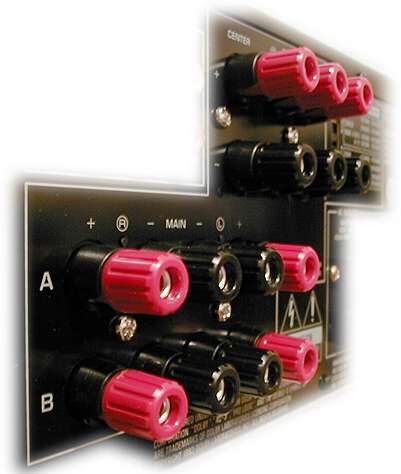
New on the "A" revision are binding posts for all five speakers, not just front left and right. This is a huge improvement in my book. I'm fond of big speaker cable, and there is just no way to fit a 12-gauge wire properly in a friction clip connection. Bananas are accommodated but not spades. Who can blame them: the posts are very close together, too close for my tastes, and nobody wants an accident.
 When I first beheld the remote,
my predominant thought was, “this is the most poorly designed interface I've
ever seen”. After using it for a
week, I upgraded my opinion to, “this isn't very good”, and after a month
of getting used to it, I've settled on, “they could do better”. In a nutshell, it is a universal remote which knows the
functions of almost any brand of component you may have. The problem is the “wheel” at the top. By rotating it, you change which component the remote will control. Turning this wheel is cumbersome at best, so it is a good thing that the
volume buttons don't ever change function. I wouldn't be so critical if the remote at least controlled the 795A
properly, but even its functions are split over two stops on the wheel: “AMP/REC”
and “DSP” (and they're not even adjacent to each other). DVD control wouldn't be so bad if cursor and transport functions were
on the same wheel stop. And if you
can handle the wheel turning, look at those buttons. Most have three different labels. In
the end, my wife and I still keep 4 remotes by the couch. If you can ask your Santa to put an excellent learning remote in your
stocking this year, this all becomes a mute point.
When I first beheld the remote,
my predominant thought was, “this is the most poorly designed interface I've
ever seen”. After using it for a
week, I upgraded my opinion to, “this isn't very good”, and after a month
of getting used to it, I've settled on, “they could do better”. In a nutshell, it is a universal remote which knows the
functions of almost any brand of component you may have. The problem is the “wheel” at the top. By rotating it, you change which component the remote will control. Turning this wheel is cumbersome at best, so it is a good thing that the
volume buttons don't ever change function. I wouldn't be so critical if the remote at least controlled the 795A
properly, but even its functions are split over two stops on the wheel: “AMP/REC”
and “DSP” (and they're not even adjacent to each other). DVD control wouldn't be so bad if cursor and transport functions were
on the same wheel stop. And if you
can handle the wheel turning, look at those buttons. Most have three different labels. In
the end, my wife and I still keep 4 remotes by the couch. If you can ask your Santa to put an excellent learning remote in your
stocking this year, this all becomes a mute point.
Other notables:
· IR In-Out jacks are included. Often used by custom installers to control the 795A from a
central system, others may find them useful for a quazi-2nd zone
operation.
· An OSD (on screen display) is available. At Secrets we try to not use these because they are often confusing,
along with the TV's own OSD. Even
so, it might not be a bad idea to hook it up to a spare input on your TV for the
first little while, as it can make playing with the receiver's settings easier.
· An S-Video input for the DVD has been
added with the “A” revision permitting S-Video switching between DVD, VCR, and front Aux jacks should the need arise.
· Word of advice: If you use optical (Toslink) digital connections, take a small piece of
masking tape and attach the dust caps to the rear of your unit. If you ever stop using this connection, you will really want to keep the
openings protected.
· A tone bypass switch is provided.
Synopsis and conclusions
This
is the 4th Yamaha receiver I have owned, and I have never been disappointed in the overall quality of the
product—only some occasional disappointments about the lack of a jack or
feature here and there. In all of the
areas that count, the 795A pleases me with flying colors. Consumers demand a lot for so little of the green stuff. Time and time again our pages
chronicle how it's just not possible to have it all for just a few bucks, so something has
to give. Ultimately, I think that
with the 795A, Yamaha has struck an excellent balance resulting in a holistic
product for those who just can't afford any more for their AV centerpiece.
I'd
like to leave you with this thought: Earlier
this year, while brochure shopping for a Dolby Digital preamp, the absolute
cheapest unit my local store could find was a featureless, bland unit of
questionable quality for $1,600cnd. At
$1,000 the 795A woks well and has amplifiers in it to boot!
- Brian Florian -
Related
hardware:
Rotel RB-985 Five Channel Power Amplifier
Paradigm
Mini-Monitor, CC-350, and Titan speakers. PS-1000
powered sub.
Toshiba
2108 DVD Player
Yamaha
CDC-675 CD Player
Sony
KV-27S36 TV, geometry and level calibrated
Sanyo
Hi-Fi VHS VCR
UltraLink
Analog, Digital, and Video Interconnects
AudioStream Speaker Cable



 YouTube
 Facebook
 Twitter
 LinkedIn
 Pinterest
 Google+
 Instagram
Magazine Publishing Solutions by
 Advontemedia