
Product Review - Myryad MI-120 Stereo
Integrated Amplifier - September, 1997
John E. Johnson, Jr.


Click here for larger image
Myryad MI-120 Amplifier; Two channel integrated amplifier; 60 watts rms/ch into 8 Ohms, both channels driven, 20 Hz - 20 kHz; Frequency response 20 Hz - 20 kHz + 0 - 0.3 dB; Input impedance 10 kOhms; Damping factor 100; Slew rate 60 V/� Sensitivity 0.25 V rms for full output into 8 Ohms; THD 0.05%; S/N 104 dB; Remote control included; Size 3 3/4"H x 17"W x 12"D; Weight 22 pounds; Black sheet metal with brushed silver anodized aluminum front panel (also available in black front); $899; Myryad Sytems Ltd., 2 Pipers Wood, Waterberry Drive, Waterlooville, Hants, United Kingdom PO7 7XU; Telephone 011-44-(0)1705-231405; Fax 011-44-(0)1705-231407; USA Distributor: Audio Influx Corporation, P.O. Box 381, Highland Lakes, NJ 07422, USA, Phone 973-764-8900; Fax 973-764-8479; E-Mail [email protected]; List of dealers available on their website at http://www.audioinflux.com.
With the popularity of home theater surround sound receivers, the selection of stereo (two-channel) integrated amplifiers is pretty slim. Numerous readers have requested that we review some units, and we chose a product from the venerable British Manufacturer, Myryad. We obtained their model MI-120, which is a 60 watt/channel (8 Ohms) package.
The front of the 120 is a brushed aluminum panel with a large motorized volume control and several small LED-illuminated push buttons. The main on/off toggle is located on the rear panel with the detachable AC cord (non-grounded). When the rear power toggle is switched to "on", a standby button in the front left corner illuminates. This means the amp has trickle current but is not fully powered up. To give full power, the standby button can be depressed, and the amp becomes fully powered in about one second, with the distinct click of internal solenoids preventing any turn-on thump. The amp can also be fully powered from standby mode from the remote control. There are two pairs of five-way all metal speaker binding posts, and a connection for daisy-chaining to another power amplifier, as well as a link to other Myryad products. [Click here to see rear panel.] Also on the rear are RCA input jacks for CD, TV, Tuner, and Aux (all line-level). An optional phono cartridge module is available ($99) that connects through the Aux jacks. There are two tape loops. Grounding is via a threaded post. A headphone jack is situated on the front. A remote control allows access to the functions, including the volume.
The power supply uses a large toroidal transfomer, two 10,000 �, 50 Volt capacitors, and the DC Voltage on the power capacitors is � 44 Volts. This provides 19.4 Joules of energy storage. There are two pairs of Toshiba bipolar 2SC3821/2SA1302 - 200 Volt/30 Amp peak (one pair per channel) output transistors. I could hear absolutely no hum when I turned the amp volume control all the way up (no music playing). This is one of the benefits of an integrated design, where the trace connections between the preamplifier and power amplifier sections are very short.
We tested the 120 using our Audio Alchemy CD system, Nordost Flatline interconnects and speaker cables, and a pair of Monitor Audio Studio 20SE speakers. CDs included all types of music.
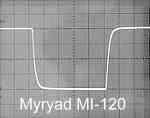
I immediately noticed that the 120 has enormous capability for presenting detail, even when faced with overwhelmingly complex musical passages, such as the Allegro scherzando from Rachmaninoff's Piano Concerto Number 2 in C Major. The melody simply vaulted, and I was amazed. Of course, such detail can only become manifest on speakers like the Monitor Audio Studio 20 SEs, which I consider to be one of the 10 best speakers ever designed. Such complicated music can otherwise sound mushy. I also found that, in spite of the detail, the sound was not the least bit edgy or harsh. The 10 kHz � 10 Volt square wave response [click here] confirmed that the amplifier reproduces complex waveforms smoothly rather than in an abrupt way, as evidenced by the rounded leading edge. This also shows that an amplifier can be equable in its presentation without losing detail. The upper frequency response rolled off 3 dB at 160 kHz compared with 10 kHz (using sine waves, not square waves).
I listened to some piano solos that were very simple. Some might call it "elevator music", as there were no serious melodies to distract from the mechanics of the playing. It's the kind of stuff you hear in department stores that have live pianists rather than recorded music over the intercom. I could distinctly hear the hammer felts striking the strings, and it was very lifelike.
The human voice was reproduced with clear sibilance, but not overdone. The general feeling of this amplifier was definitely solid state, and quite enjoyable. The realism of detail presentation without harshness makes this amplifier rather unusual. Often with amplifiers that have high detail, they are so accurate that the metallic quality of many CDs delivers an irritating sensation. Not so at all with the Myryad MI-120. The top of the chassis became quite warm with use, suggesting that it is probably biased well into Class A. The fact that there are only two transistors per channel, one for the positive and one for the negative portions of the waveform, can also benefit the sound. Lastly, I have the feeling this amplifier is conservatively rated, which is old fashioned and refreshing.
Myryad has just recently begun marketing here in the United States, and I am very impressed with the sound as well as the build quality. I highly recommend that you audition the MI-120 if you are in the market for a stereo integrated amplifier. If you have the slightest intention of using LPs, then order it with the phono module, as it it is very inexpensive, making the whole package still less than $1,000.
John E. Johnson, Jr.
� Copyright 1997 Secrets of Home Theater & High Fidelity
Return to Table of Contents for this Issue
.



 YouTube
 Facebook
 Twitter
 LinkedIn
 Pinterest
 Google+
 Instagram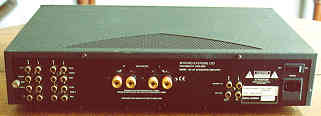
© Copyright 2016 Secrets of Home Theater and High Fidelity / Terms of Use and Privacy Policy
Magazine Publishing Solutions by Advontemedia
Magazine Publishing Solutions by
Advontemedia