
|
||||||
|
The Sound With all the disclaimers and limitations about in-wall subs in mind, I prepared myself for an experience that would be heard rather than felt. Wrong. I immediately starting pulling out discs with 32 Hz bass/organ pedals (the SC-IW's are rated to 22 Hz). "Cans and Brahms" from Yes-Fragile (DVD-A),
"Dance On a
Volcano" from Genesis-Trick of a Tail (SACD) and Virgil Fox's direct-to-disc
recording of "Bach's Tocatta and Fugue in B minor". With the SC-1250 amp
providing 1250 watts of power, and the SMS-1 smoothing out room modes, it
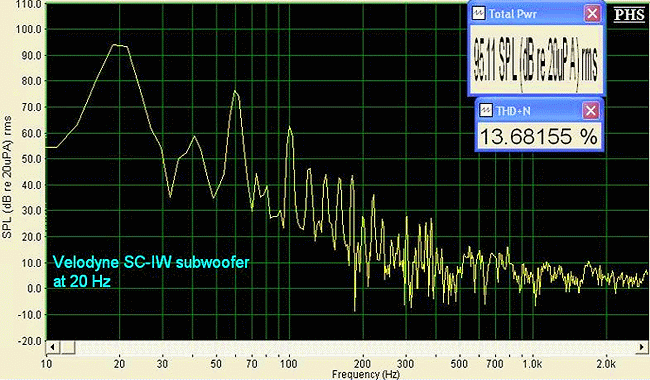
was an impressive display. The SC series in-walls are designed so that two of them can be driven by a single Velodyne SC-1250 amp, which is stable down to 4 ohms. Thus, the SC-IW's are rated at a nominal impedance of 8 ohms each. The calibrated microphone was placed 1 meter from one of the driver openings in the wall for measurements. The other driver was disconnected for these measurements. At 20 Hz, THD+N was 13.7%. The maximum SPL setting was 95 dB. With two drivers, you will be able to get 3 dB additional.
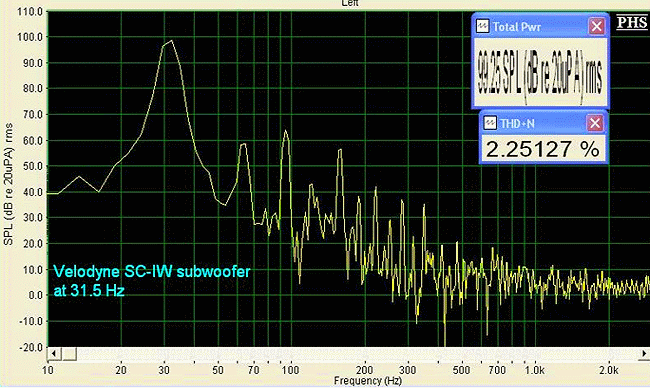
At 31.5 Hz and 100 dB, distortion decreased to 2.25%.
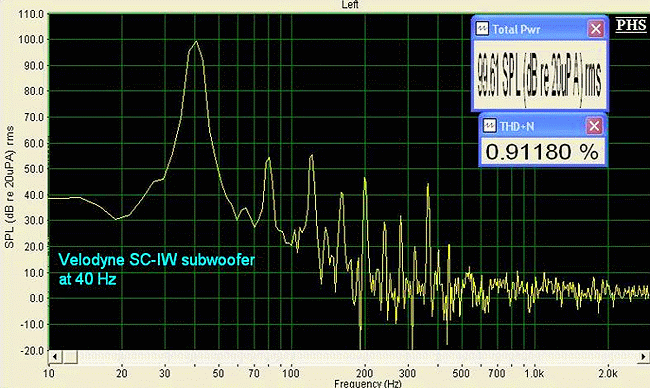
At 40 Hz, THD+N was less than 1%.
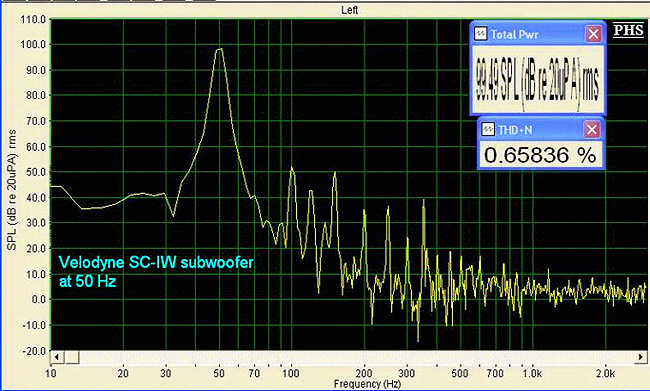
And at 50 Hz, 0.66%. Overall, very good for a driver that is in the wall with limited enclosure volume.
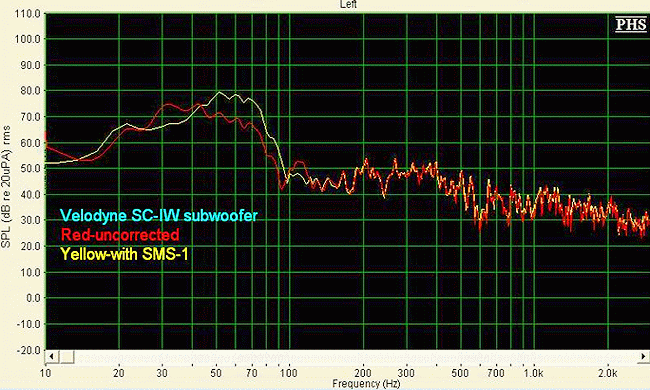
Below is the room response with and without the SMS-1 correction added. Pink noise frequency sweeps were conducted at 1 meter, with the SMS-1 equalization off (red), and engaged (yellow). The uncorrected response graph demonstrates that the SC-IW's frequency response is basically flat (the hump resulting from room modes) before dropping off at 22 Hz, as advertised. The yellow graph (SMS-1 engaged) means that it is equalizing for flat response at the prime seating position 12 feet away, but since the room response measurement was taken one meter from the subwoofer, EQ corrections are magnified in the closed-mic response.
Between 20 Hz and 100 Hz, except for the tuning frequency, the impedance is 8 ohms. Electrical phase stays within ± 500.
Conclusions - Ross Jones -
|
||||||






 YouTube
 Facebook
 Twitter
 LinkedIn
 Pinterest
 Google+
 Instagram
Magazine Publishing Solutions by
 Advontemedia