
|
||||||
|
The 805 "60 pounds eh?" I said to the Fed Ex guy as I signed his manifest. "You're not kidding!" he mumbled. The TX-SR805 arrived remarkably well packed. There was an abundance of Styrofoam, and the unit was wrapped in a soft foam sheet inside the requisite plastic bag. Nice touch, but anyone can make you feel like a product is special. The proof is in the pudding, or rather, the power supply. But I'm getting ahead of myself here. At the front we find a panel layout consistent for Onkyo over the past several years. Direct input selection is available, and the large machined aluminum volume knob has a nice solid feel. Behind the drop down panel are a plethora of mainly "one-use" buttons such as the setup cursor pad, but also mode selection buttons should the occasion arise where they are more convenient than reaching for the remote. Turning to the back, it is evident that the 805 is after all a classic A/V receiver with its plethora of Inputs and Outputs. Yes, there is still a phono/turntable input but beyond that there are in fact eight "core" inputs (counting the front convenience input), six composite and S-Video, two with rec-out lines. Each of these core inputs can be customized by assigning to them any of the three coax and two optical digital audio inputs, the multi-channel analog input, three component video inputs, or any of three HDMI inputs. This is a true three-zone processor with stereo output for zones 2 and 3. Zone 2 can be powered by giving up the surround-back amplifiers, reducing the main zone to 5.1 operation. Monitor-out for all video formats (composite, S-Video, component, and HDMI) is available in the Main zone, composite only in Zone2. Onkyo has included a basic implementation of the Sage/Faroudja FLI2300 video scaler/processor which will convert and scale up all analog video formats to component and/or HDMI. We'll deal with its implementation and limitations a little later. The speaker jacks, like the multi-channel line-level jacks, are nicely and comprehensively color coded. While certainly of adequate strength, they won't take a spade lug, but they worked famously with my speaker wire termination of choice: the venerable banana. Inside of course is where the real fire lies.
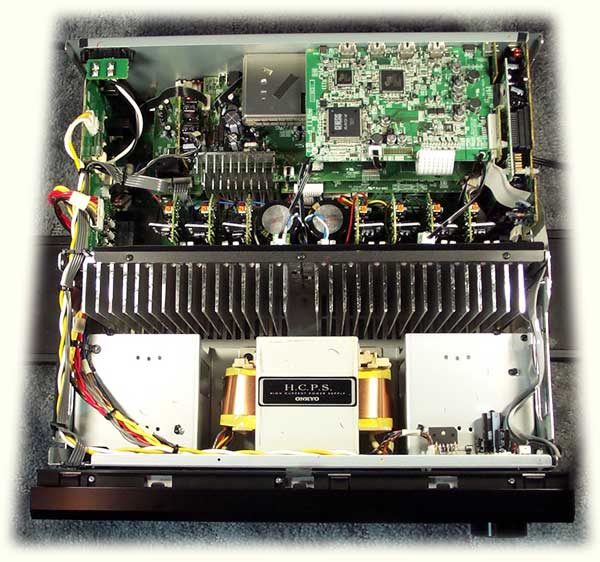
Popping off the lid we make two immediate observations. One is that the top cover is slightly heavier than previous iterations of this series, and there are strategically located pads to dampen it. This speaks directly to a complaint I had about flexing and ringing of the cover on the model 800.
One can see at a glance the unusually large (for a receiver of this size at this price) power supply. The chassis is then divided by one large full-width heat sink, beyond which all the boards are laid horizontally and thus "stacked". What is not immediately apparent in the photograph is that to the left and right of the power supply are air conduits, each with a 9.2cm on-demand fan which, if activated, draw air in from grilles at the sides of the unit, forcing it towards the center of the heat sink. This will be of particular importance when we discuss amplifier power further on in this review. For the 805, Onkyo is using no
less than BurrBrown 24bit/192kHz DACs on
|
||||||
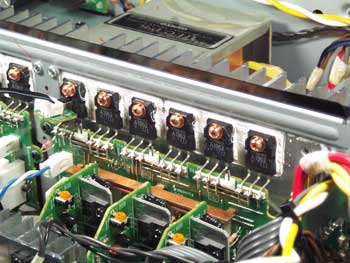 More significant is the
content of the box and how its laid out. The overall build quality is
unquestionably excellent with a rigid frame and appropriately sized leads and
the use of bus-bars for the high-power audio sections.
More significant is the
content of the box and how its laid out. The overall build quality is
unquestionably excellent with a rigid frame and appropriately sized leads and
the use of bus-bars for the high-power audio sections.




 YouTube
 Facebook
 Twitter
 LinkedIn
 Pinterest
 Google+
 Instagram
Magazine Publishing Solutions by
 Advontemedia