
|
||||||||||
|
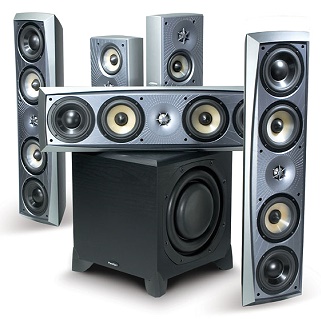
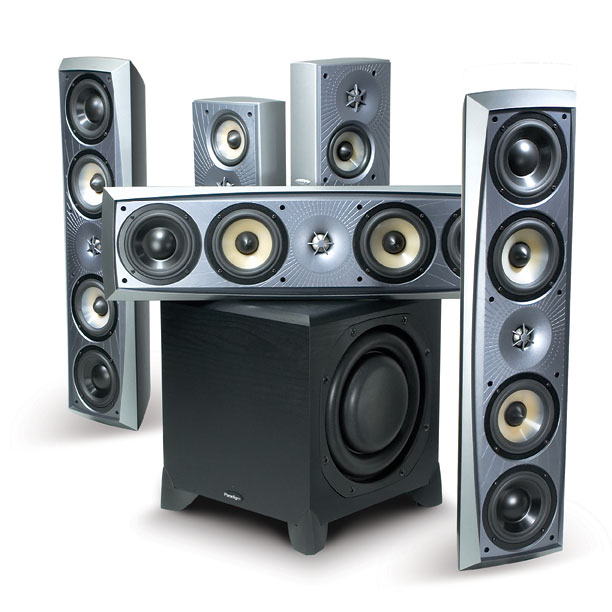
Introduction They incorporate the Monitor Series technology, are very modular, designed to be easily mounted on walls, and are price competitive (not to mention, beautiful too). The Cinema Series includes numerous models, from the bookshelf sized Cinema 70, up through the Cinema ADP (reviewed here), which is a four-driver bookshelf speaker (used for the rear surrounds in this review), and the much larger (yet still wall mountable) Cinema 330 LCR, which has five drivers, and are reviewed here in a front left, center, right configuration. The Design The Cinema 330 LCR speaker is the largest offering in the Paradigm Cinema line and pulls triple duty in this package. It's a five-driver, 2-1/2 way sealed speaker that stands over four feet tall when attached to a floor stand. The bases of these speakers are curved, the cabinet is long, and the whole speaker is skinny, requiring you to either mount them to the wall or to a Paradigm stand. The wall mount is not a bad idea as long as
your display is less then 4" deep. There is an integrated keyhole
mounting bracket that unfortunately prevents the use of banana plugs. Two
stands are alternatively offered: a table-top / shelf stand and a floor
stand model on a thick glass base with a hollow triangular stem which easily
rings when tapped. The cabinet of the speaker is a strong plastic composite
that appears to be very solid. Sealed designs are great, yet they can lack a few extra Hz in the bottom end which is why you see a lot of ported boxes. Ports can add 1/2 octave right where it counts, in the deep end. The downside to using a port is that the smaller the box gets, the larger the port needs to be to keep a low tuning frequency. Seeing as the Ultracube 10 only has an internal 0.58 cubic feet, the required port would be 62" long and 4" diameter in order to have a tuning frequency of 25 Hz. The port itself would increase the internal volume another 0.45 cubic feet, so there goes the small box size. Instead, Paradigm uses passive radiators to extend the low end. Passive radiators allow for increased low frequency response without adding too much to the internal volume. By using two 9" passive radiators, Paradigm was able to construct a subwoofer that takes up less than 1 cubic foot of living space. The downside to passive radiators is the cost. These radiators are in essence a woofer minus the voice coil and magnet, and that does contribute to the price of the Ultracube 10.
I normally use a three foot tall 15" cylinder subwoofer tube that has a 12" driver and a 1000 watt amplifier. While I enjoy the level of output and quality of sound produced by this behemoth, it is lacking in the spousal acceptance factor. In my listening tests, the UltraCube 10 was better with music perhaps due to the higher tuning frequency, where the tube sub was able to extend lower giving it the nod for movies. If you need a small subwoofer and don't want to sacrifice much output, put this sub on your audition list. It is so acceptable my wife actually said it looked like a cute little robot. Remember, that is the function of a small subwoofer: giving you some good bass, but practically disappearing into the room decor. The UltraCube 10 does it all.
|
||||||||||





 YouTube
 Facebook
 Twitter
 LinkedIn
 Pinterest
 Google+
 Instagram
Magazine Publishing Solutions by
 Advontemedia