
|
||||||
|
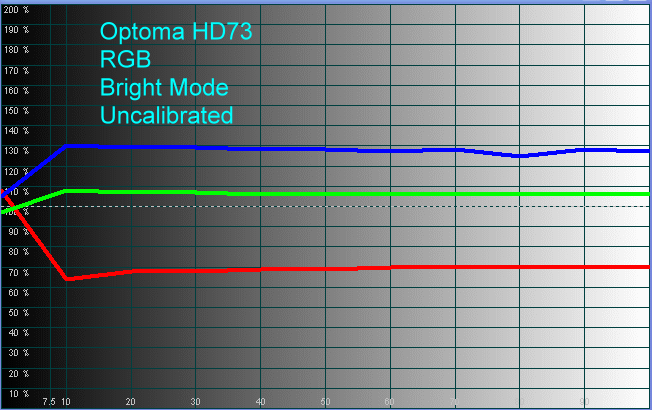
At this point, you can probably guess what the RGB (Gray Level) tracking is going to look like for the Bright mode on the HD73. The blue is somewhat higher than the red across most IRE levels.
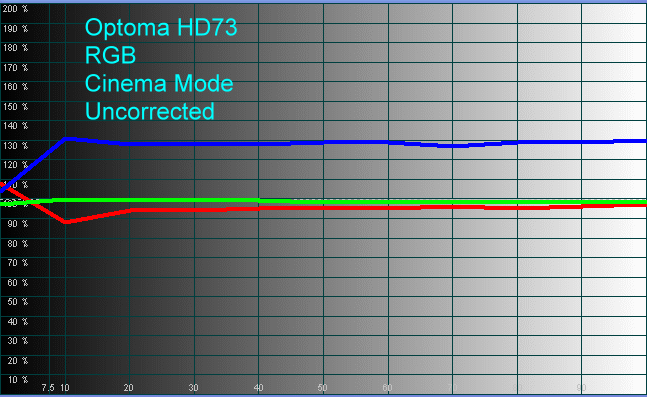
Changing to Cinema mode does get the red and green tracking better, but blue still has too much gain.
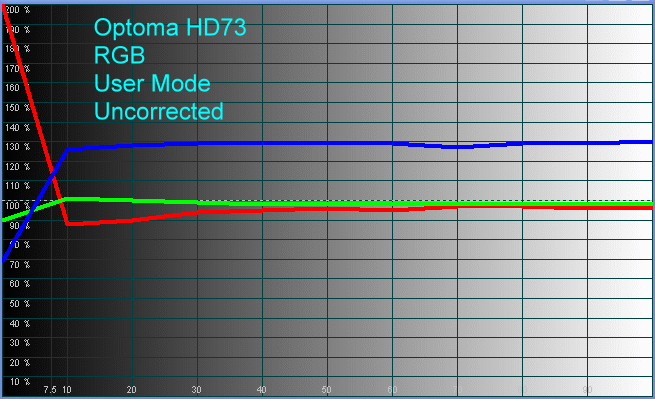
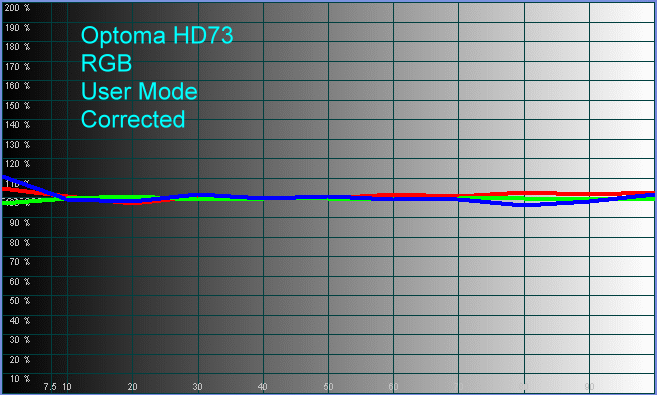
However, in the User mode, with the standard user level calibration controls (no service menu required) RGB tracked almost perfectly. In fact, for $1,999, the gray level tracking is superb!
The Full On/Off Contrast (High Bulb Brightness mode) was 2213:1 in Bright mode, 1366:1 in Cinema mode, and 1277:1 in User mode (uncorrected). The contrast in the User mode, corrected, was 1159:1. The light output in the User mode, High Bulb Brightness, corrected, was 600 lumens. In Low Bulb Brightness mode, it was 437 lumens. ANSI contrast in Low Bulb Brightness, corrected, was 524:1, which is very good compared to some projectors we have tested, even those that cost more. The light output in the specifications of projectors usually refers to the output with everything cranked to the limit. Once you have calibrated the projector though, the light output when you are watching movies, is lower. You can calculate that you will end up with somewhere around half the specified brightness when all is said and done. So what's not to like? The only issue I had with the projector is the chromatic aberration of the lens. This is a real shame, as one of the biggest benefits to a single chip DLP projector is there can be no panel mis-alignment, so in theory there should be no convergence errors. I used CRT projectors for years, and spent countless hours getting them convergence perfect. The lens in the HD73 has enough chromatic aberration that, on the far edges of both sides of the screen, the red is shifted almost an entire pixel toward the center of the screen (the center of the image is pretty good, maybe a ¼ pixel out). This problem is almost impossible to fix even for a very good video processor, because the red shift varies across the screen. However, note that chromatic aberration is common in projectors, especially in lower priced units, because very fine lens grinding is required to obtain low aberration (aspherical lens elements are sometimes used), and that raises the cost. At $1,999, something has to have a compromise. Fortunately, most users will never notice this. Just consider it one of those things all the obsessed home theater builders like me complain about. If you were to look closely at your TV, I bet it has some convergence issues too, and you probably never even noticed. Conclusions I think many consumers would be very happy using this projector. For best results, calibrate it or have it calibrated. Employ proper light control, such as window coverings. That said, this unit has enough brightness and contrast that if you don't paint your walls and ceiling black, it will still project a very good image. So, you can leave the room painted Seafoam Blue, and your spouse will be happy, not only with the room, but with this fine component. If you were an early
adopter to the home theater market and are using an older projector with a
lower resolution and contrast ratio, this projector could be a perfect
upgrade at a very reasonable cost. If you are new to the home theater world,
this is an excellent starter projector, as you will be amazed by the
image and will spend many hours enjoying hi-definition content with your
friends and family. If you are an old hat to this industry and are starting
to get a little cynical in your old age, perhaps you should look at some
of the higher end models, including the new 1080p units. Even those are
getting to be very affordable. Associated Equipment:
Anthem Statement D1
|
||||||





 YouTube
 Facebook
 Twitter
 LinkedIn
 Pinterest
 Google+
 Instagram
Magazine Publishing Solutions by
 Advontemedia