
|
|||||||||
|
Introduction Up until now I wasn't entirely
convinced that Barney loved me. After listening to him claim his unending
amore again and again (and again) through the life-like sound of the ERA
speaker system . . . I just might now be convinced. To 'properly' break in a speaker, I'm sure with some quick research you can find recommendations to use everything from playing average pop music for an hour or two up to 153.551 hours of carefully constructed, scientifically derived, acoustic break-in CDs played at exactly 70 dB under a solar eclipse. Rebel that I am (sic), I used my own method: my kids. As a
good, caring parent, I let my children watch only the finest educational
programming, like Barney, for no more than twenty or so hours a day. After a
couple of months of that, the speakers were truly ready to go. Through their
diligent viewing of Barney (and Elmo and Dora and . . . others – sigh), I can
bring you this review of the ERA Design 5 (D5) speaker system. ERA is a relatively new speaker line brought to us by the folks at Signal Path International (if you're familiar with Musical Fidelity gear, you know Signal Path already). Specifically, ERA speakers represent the efforts of David Solomon and John Spainhour to create small, affordable, but not cheaply made speakers that have both visual and aural appeal. Speakers that possess the design friendly ascetics required to blend into the décor of today's homes. Speakers that demonstrate smooth high frequency response but also have great bass extension for their diminutive size. The question is, do they deliver? The Design For this review, I requested a
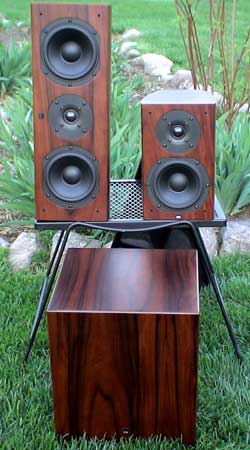
full surround sound setup representing ERA's current top of the line
system. Specifically, the system included three Design 5 LCRs, two Design 5
Satellites, and one Sub 8. The Rosewood veneer applied over MDF exuded a warm glow in my room. Each of the five main speakers tapered
gracefully in an arc from the front to a slightly narrower back. This design
feature is not only attractive but improves the sound of a speaker by
reducing standing waves. Even the
binding posts for connecting the speaker wire were top notch, similar to some
high dollar WBT posts I've used in the past. Speaking as someone who has
built his own, these speakers had the solid feel of quality manufacturing,
and I'm honestly slightly jealous that mine don't always have the ERA's
polish. The Design 5 Satellites use the same
drivers as the LCRs, but just one less mid/bass driver. The Sub 8's 40 Hz - 140 Hz crossover can be
disabled, which allows you to use your
surround processor's internal crossover system. Doing this may lead to a
better overall blend between the subwoofer and other speakers in your
system. Finally, the sub offers an EQ / boundary compensation switch, which
is used depending on how close to the wall you place it. Setup My setup for this system didn't break any new ground. The main speakers flanking the TV were positioned on stands at ear level, slightly toed in. My seating position and two main speakers completed a roughly equilateral triangle. The center was placed on the included rubber pad under the TV and was angled slightly up using the included wedge to point directly at my ears. The rear channels were placed on stands behind my listening position at roughly ear level facing one another. Completing the setup was the Sub8 in my usual corner placement. As ERA notes in their
literature, these speakers are not the most efficient and have low 4- 6 ohm
impedance, so to get the big bass out of this small box, these speakers
require a substantial amount of high power to sound their best. To
accommodate this, I used a variety of amplifiers for testing, including an Adcom GFA 555 Mark 2 (200 Watts per channel), a Bryston 3B (100
Watts per channel), and the internal Yamaha amps of the Yamaha DSP-A1 (110
Watts per channel). For critical listening and measurements, I used the
separate components. The Sound The one thing that really struck me when I listened to the Design 5 System is the humongous yet precise soundstage thrown by the speakers. In stereo mode, the D5 LCRs and Sub 8 combo never disappointed, no matter what recording I threw at them. I could close my eyes and picture the room and the performers whenever I dropped in a CD. For nearly all recordings, the bass response of the system was more than adequate. Only a few of the bottom dwelling records that included the lowest notes of a pipe organ or some hip hop left me craving more. However, stereo mode is not where I focused my attention. Although Barney was the focus, I did manage to sneak in a few
movies as well. Over the months, I watched a diverse variety across a number
of genres in order to really get comfortable with the sound of the system. A
few that I auditioned included Saw, The Incredibles, Star Wars Episodes
1-6, Lord of the Rings, The Fifth Element (Superbit Edition),
Grease, The Sound
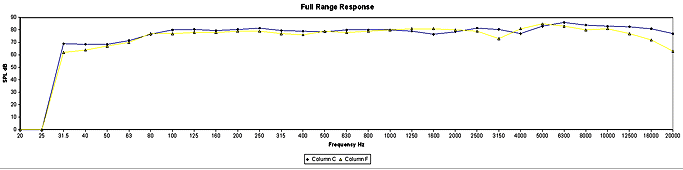
of Music, and V for Vendetta. On the Bench In order to objectively measure the performance of these speakers, I took the 'Average Joe' approach as always. I used some of the inexpensive tools I already had on hand, such as the old standby, a Radio Shack SPL Meter (33-2050). Since it is not the most accurate, I applied the corrections published elsewhere on this site (http://www.hometheaterhifi.com/utilities-download-page.html) to my actual measurements. I also used the Mobile Fidelity Sound Check CD to generate the stepped tests frequencies noted in the table below. Doing my best to measure the speaker and not the effects of the room, I placed the meter as close as practical to the speaker. The results of the test are in the two tables below. First the Full Range Room Response of the LCRs (dark line) and Satellites (yellow line):
The Full Range Response graph showing the Design 5 LCRs and Design 5 Satellites revealed a number of things. Across most of the audio spectrum, especially in the critical midrange frequencies, both speakers had a response within a few decibels of each other. As a general rule of thumb, the few dB differences should not be noticeable for most mere mortals. These speakers will reveal exactly what is in the recording. At the upper end of the audio
spectrum the Satellites response tailed off quite a bit compared to the LCRs.
There was a full 14 dB difference at 20 kHz. This drop-off may not be
noticeable to most listeners – as we age our ability to hear the high
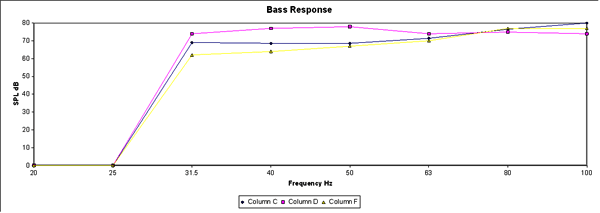
frequencies diminish. Although both speakers did show good bass extension for their size, the system clearly needs a good sub to flush out a low frequency response. Enter the Sub 8. As shown in the Bass Response graph below, the Sub 8 adds a significant 3 dB to the system response at 63 dB and a whopping 14 dB at 31.5Hz when compared to the Design 5 Satellites. However, it never truly plumbs the low frequency depths that I'd like to see in a home theater sub. But that is left to the Sub 10 and other products out there that cost more, but do more. Stepping up to D5 LCRs for the rear channels would also help a bit.
Conclusions After living with this ERA system for a number of months, I can say that I was totally impressed with the fit, finish, and performance of the package. While I generally prefer a diffuse sound field offered by a dipole speaker, I still wouldn't hesitate to recommend the Design 5 LCR's and Design 5 Satellites system. Finally, while the Sub 8 is a good fit for this system, especially cosmetically, I'd hold out for a larger subwoofer, especially in larger rooms. ERA's own Sub 10, rated for deeper extension, would probably be a better match for my tastes. Apparently, this may not even be an issue in the near future.
According to ERA's David Solomon, a full-range floor-stander is in the
works. If this new speaker builds upon the already great bass extension shown in the Design 5 series, a subwoofer may
not be required (but you might want one anyway if you like to feel your
pants shaking).
|
|||||||||





 YouTube
 Facebook
 Twitter
 LinkedIn
 Pinterest
 Google+
 Instagram
Magazine Publishing Solutions by
 Advontemedia