
Introduction
Home theater electronics companies selling directly to consumers are nothing new. Outlaw Audio, Oppo, and Emotiva, among others have been using this business model successfully for several years to "cut out the middle man" and offer high performance
products at lower prices.
Two-channel audio has typically been the domain of high-end audio boutiques, not manufacturer direct sales (with a few notable exceptions, like Perpetual Technologies).
The landscape is changing. Even traditional high-end companies like Bel Canto are now selling their products directly to Internet commerce savvy consumers who are demanding higher levels of performance at lower cost. In this new world, both
manufacturers and retailers will have to adapt or suffer consequences.
Emotiva has recently released a line of two-channel (stereo) audio products using their direct marketing approach, supplementing their already formidable product line of home theater processors and amplifiers. They have always strived to
deliver maximum sound quality at minimum cost, and the RSP-1 preamplifier and RPA-1 amplifier are no exception.
These are the first products by Emotiva that are made specifically for two channel audio, and have amazingly low prices given their build quality and specifications.
Design and Construction
When my pre-production review samples of the RSP-1 and RPA-1 arrived, I was stunned by the mass of the boxes containing the $1,398 preamp and amplifier combo. Normally, components this inexpensive just do not weigh the 110 pounds these two
components totaled. The two most expensive parts of any piece of audio gear are first the enclosure and second the power supply transformer. Most budget electronics skimp on these two areas, because they result in the greatest manufacturing
savings. Upon unpacking the RPA-1 and RSP-1, it was clear Emotiva was not skimping.
Especially with enclosures, high-end manufacturers can go overboard, with some machining the entire chassis out of a single billet of aircraft grade aluminum. Emotiva has, in my opinion, made the optimal choice. Both enclosure chassis are
made from 2mm thick steel, very much like the $70,000 Agilent PNA microwave network analyzer I use in my lab at work. This chassis is far better than typical in average electronics, but not ridiculous. A clever cost saving measure is the use
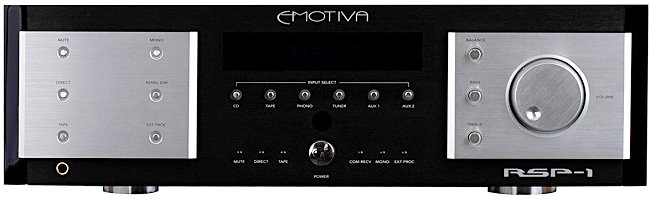
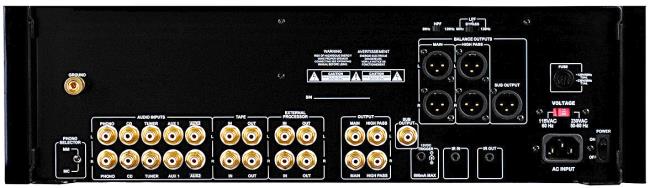
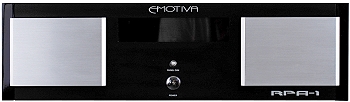
of identical chassis for both the preamplifier and the amplifier, changing only the rear panel cutouts and front panel. On both units, a nicely machined aluminum front panel with a pair of LED-backlit trim panels dress up the units. Acrylic
gloss black side panels also add some elegance without breaking the bank. Sturdy vibration isolating feet are used on both the amp and preamp.
Click on the
photos above to see a larger version.
Emotiva has put the money where it should go in any piece of audio gear: the build quality. The RSP-1 is not what you would call a "purist" preamp. It has a full set of features, including tone controls, balance controls, a processor loop, a
tape monitor loop, a headphone jack, and many inputs and outputs. The tone and balance controls, which are mounted on a separate daughterboard attached to the front panel, can be bypassed with a "source direct" button. All source and loop
switching and muting are relay based, allowing for full remote control with a well-made aluminum remote.
All preamp features can be controlled both from the front panel and from the remote. Volume control is via an analog motorized potentiometer, also mounted on an independent daughterboard attached to the front panel.
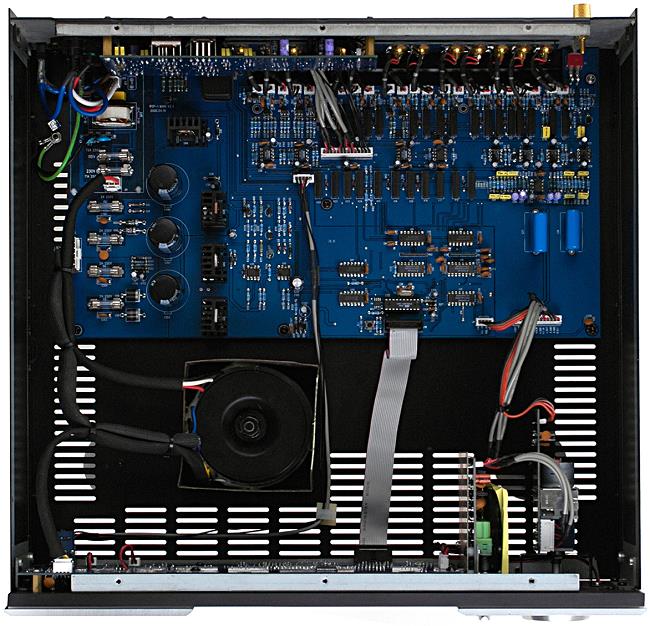
A custom toroidal transformer of considerable size is used for the RSP-1 power supply, which sports 30,000 uF of power supply capacitance. Again, all unused board real estate is covered with ground plane. The preamp is op-amp based, using very
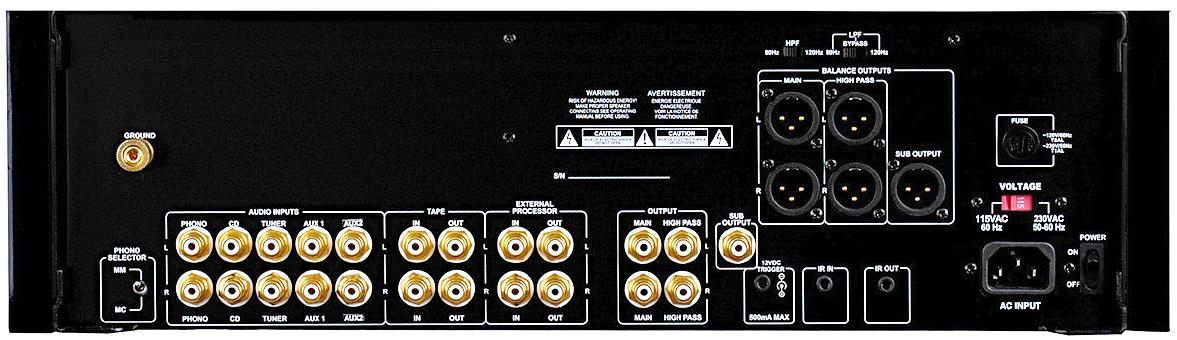
high quality Burr Brown OPA2134 audio op amps (Burr Brown's best audio op amp). Five pairs of high quality RCA inputs are available, in addition to a processor loop and a tape loop. Outputs are via RCA (single ended) or XLR (balanced) connectors,
with a simple bass management option, allowing switchable 80 Hz/120 Hz low-pass and high-pass crossover settings.
Click Here to Go to Part II.







 YouTube
 Facebook
 Twitter
 LinkedIn
 Pinterest
 Google+
 Instagram
 Advontemedia