
|
||||||||
|
Introduction Most reference class speakers are cost-no-object designs that are supposed to be put into cost-no-object listening rooms. They are typically huge, incredibly heavy, and require an enormous listening room to meet their performance potential. I have been searching for years for a speaker system that would provide stellar performance, exceeding the sound of my stalwart Platinum Audio Solos, while still fitting into both my modestly sized family room and my reasonable budget. A great man named Costanza once said,
"Festivus is for the
rest of us!" The Gallos reviewed here are for the rest of us too, those
audiophiles who want reference class performance, but can't afford the giant
"statement" loudspeakers or the listening room to fit them. And I guarantee
they are better in every way than an aluminum pole. There are several reasons why these features are desirable. Cylindrical
tweeters offer a wide, even lateral dispersion, with a relatively narrow
vertical dispersion. This typically results in a very wide soundstage with
lots of air in the presentation, while limiting reflections off the floor
and ceiling. Only ribbon or electrostatic designs can be made easily in
this geometry, and care must be taken in the design to avoid resonances in
the large radiating area. In fact, the Gallo Reference 3.1s have virtually no crossover. Only the woofer, in a standard cylindrical enclosure requires a crossover, and only a low pass crossover at that. The midranges, in spherical enclosures, and the cylindrical tweeter, both require no crossover at all. The midrange and tweeter have had their bands defined only through careful mechanical and acoustical design, eliminating the need for an electronic crossover with their accompanying (and essentially unavoidable) time and phase errors. The
Design The Reference
3.1, an evolution of the original Reference 3, uses the spherical midrange
enclosure and cylindrical tweeter for frequencies above 125 Hz, and a
standard 10" moving coil driver with dual voice coils in a cylindrical
enclosure for frequencies below 125 Hz. This design offers frequency
extension down to 22 Hz with the optional Reference 3 S.A. amplifier, and
makes for a smaller, simpler, less
The Reference AV Center uses four of the same midrange units as the reference 3.1, plus the cylindrical ribbon tweeter, combined in a 2.5 way system (i.e., one pair of the midrange units is tuned to a different frequency range than the other pair). The tweeter has its horizontal dispersion limited to 1200 rather than the 3000 of the units used in the Reference 3.1s. The A'Divas use a single 5" driver in
a spherical enclosure. This very simple design uses no tweeter, only the
single high performance driver to cover the entire frequency range from 80
Hz to 18 kHz. A permanently attached mesh grille covers the
driver, and simple knurled five-way binding posts can accept moderately sized
speaker cable. Their very small size allows them to be unobtrusively mounted
in a myriad of ways. A threaded ball fitting can be screwed into the rear of
the sphere, allowing mounting from a wall bracket, ceiling bracket, or
stand. A recessed mounting fixture is available to mount them in a wall or
ceiling as well. Small tabletop stands, or the included rubber "o-ring" can
be used for tabletop use, which would make them ideal for use as a computer
speaker system. Their fit and finish are excellent, especially for a speaker
of such a moderate price, and they have a great, modern look. All the speakers are carried on a stout MDF pillar and baseplate. This pillar is backed with an anodized aluminum plate, housing two sets of well made five-way binding posts (not for bi-wiring!). Four adjustable spikes that must weigh nearly a quarter of a pound each are provided to level and aim the speaker. Welded steel frames covered with acoustical fabric can be mounted over the speaker and securely bolted to the pillar, but I auditioned them without the grilles.
|
||||||||
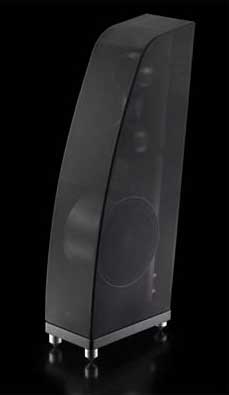
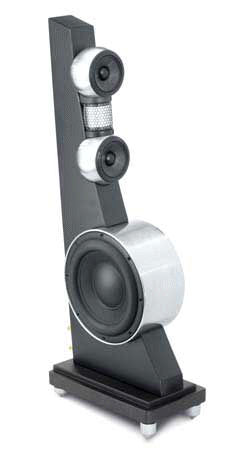 expensive speaker as compared to the
original Nucleus Reference.
expensive speaker as compared to the
original Nucleus Reference.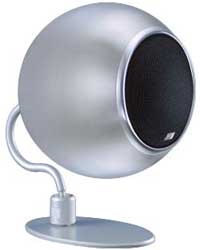





 YouTube
 Facebook
 Twitter
 LinkedIn
 Pinterest
 Google+
 Instagram
Magazine Publishing Solutions by
 Advontemedia