
|
||||||||
|
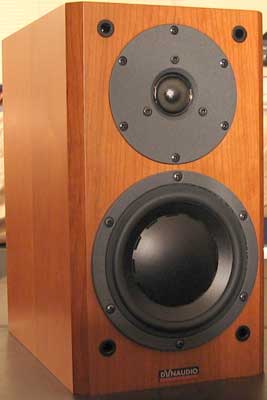
Introduction Dynaudio is a major audio company from Denmark manufacturing speakers for the home, mobile and professional audio markets. Central to this business is Dynaudio's reputation as a premier manufacturer of drivers which are the basis for their "Authentic Fidelity" line of home loudspeakers. The Authentic
Fidelity line consists of a wide range of products from their entry level
Audience series, to their reference and luxury priced Evidence series
speakers. Dynaudio's newest line, and the subject of this review,
are the Focus models. The Design The
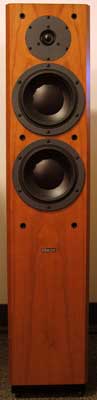
heart of this system is the Focus 220 tower ($3,000/pair) with two 6.5" woofers
and an Esotec+ T380 soft dome tweeter. The 220s are relatively compact tower
speakers at only 8" wide, 12" deep, and 36" tall, and that compactness is
enhanced by the trapezoidal footprint of the spea Complementing the 220s is the Focus 200 C ($1,000/each) center speaker, which features the same Esotec+ tweeter flanked by two 5.5" woofers. This is a particularly attractive center speaker with a neat trapezoidal grille that pays homage to the cabinet's shape. However, the shape can be problematic if you're planning to rest your speaker on top of your TV, since the speaker will rest with the drivers angled in an undesirable upward position. Of course if you're planning on placing your center speaker somewhere below your screen, the trapezoidal shape works out in your favor. For surrounds, Dynaudio sent out the smallest speakers in their Focus line, a pair of Focus 110 bookshelf speakers ($1,400/pair). The Focus 110 uses a different Esotec+ tweeter, the D280, and a lighter 5.5" woofer than the Focus 220. The Focus 110 is a small bookshelf speaker, although it is much deeper than most other speakers of its size at 6.9" wide, 11.2" deep and 12" tall. Finally, to round out the system, there is the SUB 250 ($1,000), a 10" 230W subwoofer. The SUB 250 measures in at a svelte 11.4" wide, 12.5" tall, 11.5" deep, and a very light 22 pounds. In an industry overrun with monster subwoofers, the SUB 250 certainly saved my back when I was setting the system up. Set Up All of the Dynaudio spe It should also be noted though that all of the Focus speakers are somewhat inefficient, with sensitivities in the mid-80s dB/w/m, and this combined with their impedance means that they work best when matched with relatively powerful amplification. The Sound I was also impressed by the overall volume of the system which effectively delivered the percussive gunshot effects very well. The one area that I did find slightly lacking was in the subwoofer; the LFE channel just didn't have the rumble and impact I have experienced on reference quality systems. Moving on, I watched the Solsbury Hill concert track by Peter Gabriel. The 200 C did a nice job with vocals, and overall the system was very musical. An interesting counterpoint to The Transporter scene, I found the bass on this selection to be excellent both rhythmically and tonally. In this scene the bass was spread to more speakers, which did not create such a strain for the subwoofer as in The Transporter scene. After those selections, I moved on to The Incredibles DVD which highlighted the same strengths and weaknesses I found in The Transporter. During the busy action sequences, the speakers were able to resolve tons of detail in the soundtrack, with individual sound effects well rendered and distinct. Throughout the movie, the speakers also exhibited excellent dynamic range. However, I still felt I should be getting a little bit more really deep extension and pants flapping bass from the subwoofer in most action sequences. Most of this can be attributed to the simple fact that the SUB 250 is really a pretty small subwoofer for a system of this overall capability. Despite its inability to shake the rafters, I think a lot of people will find the SUB 250 a desirable option if they want something that is easy to handle physically. It works very well for music, it does add some extension and weight to the bass of the overall system, and it is small, which makes it a perfect subwoofer for a small apartment or condo.
|
||||||||
 ker. Dynaudio uses this
trapezoidal shape on all of its Focus speakers to help alleviate standing
waves in the cabinet, but it also gives them a more attractive and slimmer
form than a standard rectangular box.
ker. Dynaudio uses this
trapezoidal shape on all of its Focus speakers to help alleviate standing
waves in the cabinet, but it also gives them a more attractive and slimmer
form than a standard rectangular box.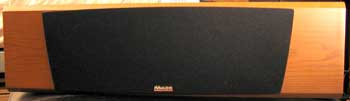 akers are stable 4 ohm loads.
Despite many lower priced receivers warning against their use with speakers
less than 6 ohms impedance, I had no problem running the Focuses with a
variety of budget receivers at reasonable listening levels.
akers are stable 4 ohm loads.
Despite many lower priced receivers warning against their use with speakers
less than 6 ohms impedance, I had no problem running the Focuses with a
variety of budget receivers at reasonable listening levels.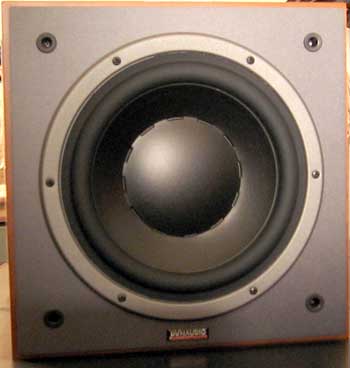 oved around the soundfield.




 YouTube
 Facebook
 Twitter
 LinkedIn
 Pinterest
 Google+
 Instagram
Magazine Publishing Solutions by
 Advontemedia