
|
||||||
|
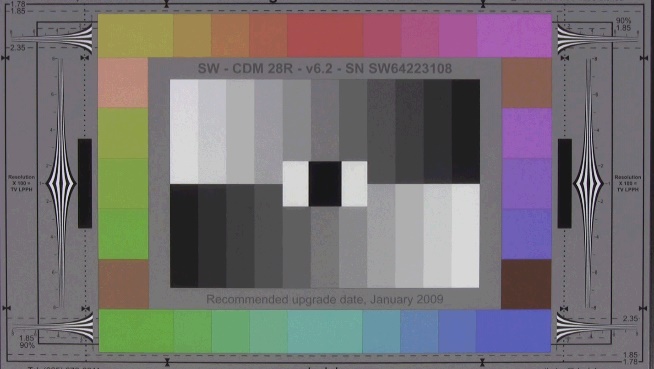
On the Bench At some point, we will have Benchmark standards for HD video cameras. Right now, we are still experimenting, and here are the tests: For color balance, I selected the DSC Labs ChromaDuMonde 28R, as shown below. It has a series of colored boxes, including skin tones. This chart is a standard in Hollywood for setting up professional HD television shoots. The HV10 photographed the 28R chart beautifully, although perhaps just a bit underexposed. This is typical of digital cameras I have seen so far. The gray scale is very good, with all shades visible. No blown out whites. The skin tones are excellent, but the rest of the colors have a little more blue than they should. The curved black lines are called Resolution Trumpets. However, these particular ones don't go all the way to 1,920.
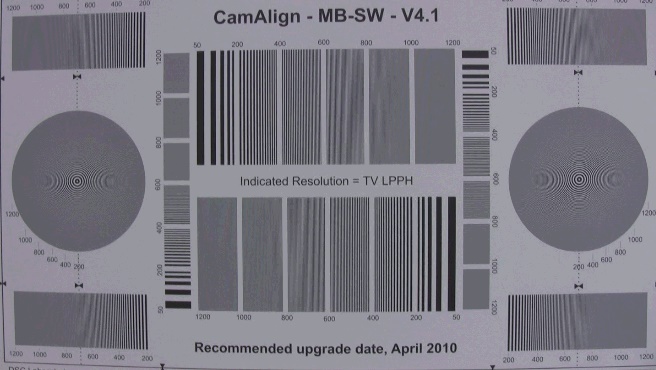
For resolution, I used the DSC Labs MultiBurst chart, as shown below. It has horizontal and vertical resolution tests, in graduated line pairs. The first one was taken in wide angle mode. There is some barrel distortion, but that is typical of ultra-wide angle lenses. The aliasing is due to having reduced the size of the photo for reproduction here.
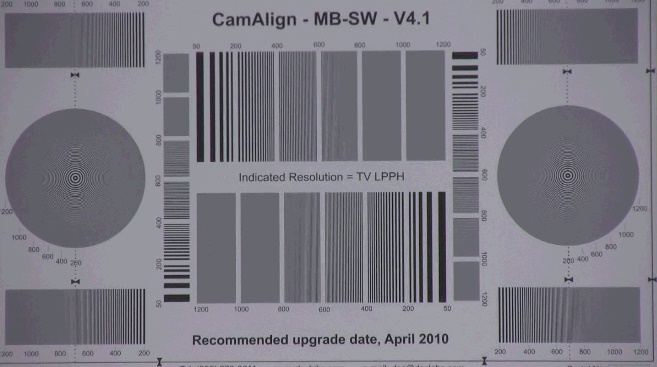
In telephoto (shown below), the barrel distortion is gone. The HV10 delivered 1,440 x 1,080 lines of resolution. The chart is calibrated in line pairs per picture height or picture width, with a line pair being represented by one dark line and its adjacent white line. The pictures of the MultiBurst chart were underexposed, with the white background appearing gray. But, light meters are designed to expose a scene for middle gray, so it came out the way the camera was designed to expose it. Therefore, under circumstances where a scene has a lot of white (say a new snowfall in your yard with the kids), and for any camera, you should go into the manual exposure mode and open up the lens probably somewhere around two lens f/stops. Otherwise, the snow will look gray in your videos. For the HV10, you can simply go to the SCN mode, and select "Snow", which will increase the f/stop accordingly.
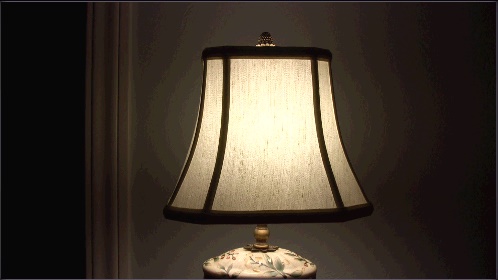
Here, I tested the ability of the camera to adjust the exposure from completely black (my hand over the lens), to a very bright light (a table lamp). It took about 2 seconds. That is a bit long, as I would like to see a response of no more than 0.5 seconds. Click on the photo to download a short compressed video that will show you what the exposure adjustment actually looked like.
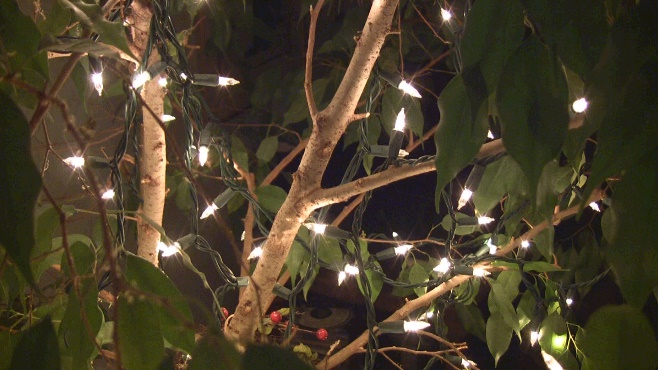
This next test is to see if small points of light in a dark background smear when the image is panned. I saw a bit of smearing, but I expected to see it. This is due to the pixels retaining their charge for a few milliseconds after the bright point of light moves away from those pixels. Click on the photo to download a compressed video so you can see the smearing I am referring to. Video cameras have this problem. The question is, how much? After we have tested some more video cameras, we will be able to put some sort of a number rating on all of the tests.
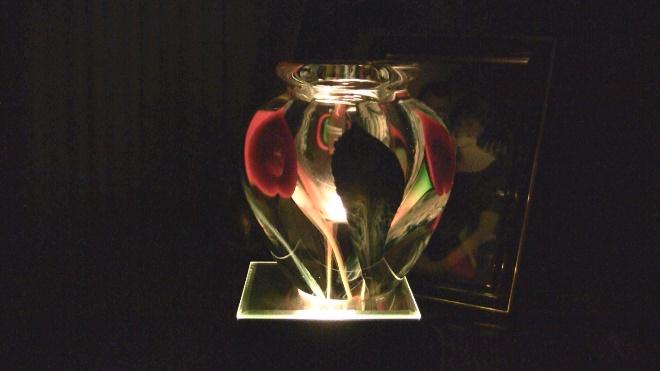
The final test was to see what dark shadow areas in the background look like with a small bright light source in the main part of the field. This example is a glass vase that is illuminated from the bottom. You can see that the vertical curtain folds in the background on the left are just barely visible, but are clear, not muddy. There is also a photograph of my wife and I just to the right of the illuminated vase, with medium shadows. Again, it is not muddy. Very nice. There is some evidence of spurious color pixels (usually red and green) in dark scenes, but this is a universal problem with digital sensors. They have a fixed sensitivity (usually about ISO 100), and in dark scenes where the lens cannot open up any further, and the shutter speed must be maintained, digital image processing has to be performed, and this always produces some artifacts. We will have more formal versions of these tests later on, probably along with some additional ones such as the audio frequency response and detection of a standard sound level from a standard distance.
Conclusions The Canon HV10 is superb! With
HDTVs now supremely affordable, I cannot imagine anyone wanting anything but
an HD video camera to photograph their family vacations and goings on around
the home. For me, HD is the only way to go, and the HV10 is a heck of a way
to make the trip. - John E. Johnson, Jr. -
|
||||||





 YouTube
 Facebook
 Twitter
 LinkedIn
 Pinterest
 Google+
 Instagram
Magazine Publishing Solutions by
 Advontemedia