
|
||||||
|
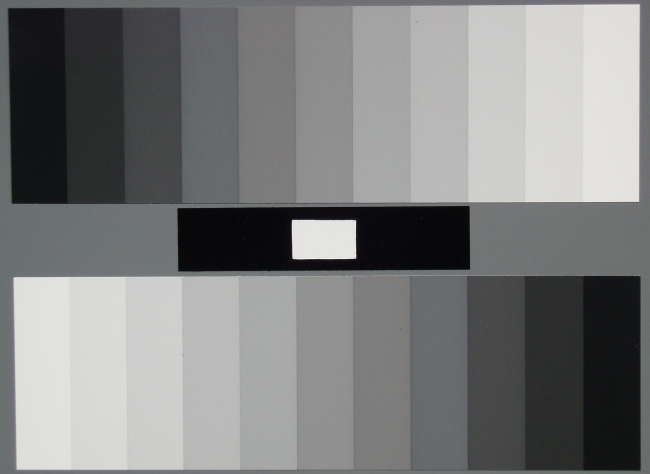
Shown below is our Accu-Chart gray scale test. Again, the photo was taken at 10 MP, Auto ISO, and Super Fine settings. I took the photo outdoors in full sunlight. All gray levels are beautifully exposed and rendered.
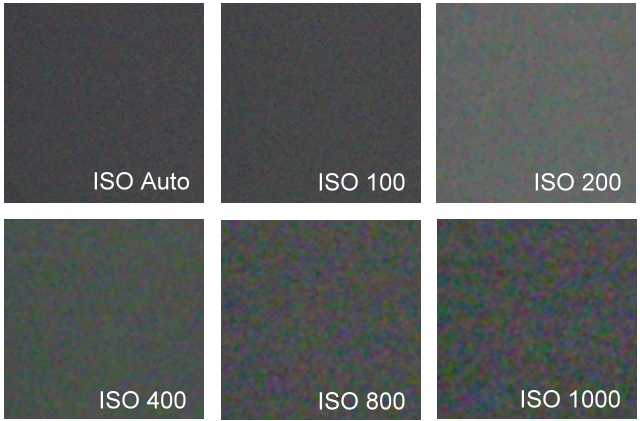
Here is a comparison of the gray scale at different ISO settings. Each square was taken from the third gray band from the left in the top set of gray levels for the gray scale chart shown above, reproduced at 100%, and saved at 100 quality JPG. The Auto ISO square seems to be about the same as the ISO 100 square. At ISO 200, spurious color pixels are starting to show up, and by ISO 1000, the spurious color pixels are very obvious (using ISO 1000 film is no picnic either). I took the ISO 400, 800, and 1000 indoors because the camera could not expose these high ISO settings properly in full sun. This is the same as with film cameras. You don't use ISO 1000 film at the ski slopes on a sunny day. Herein, I believe, is the problem that now faces digital camera manufacturers. The number of pixels on small sensors has become so large, the sensitivity is decreased to the point that we have to use ISO 100 if we want photos with few spurious color pixel artifacts. 10 MP is plenty, so I suggest that manufacturers concentrate on making sensors with higher sensitivity, and thus less artifacts, rather than just plowing ahead with more megapixels.
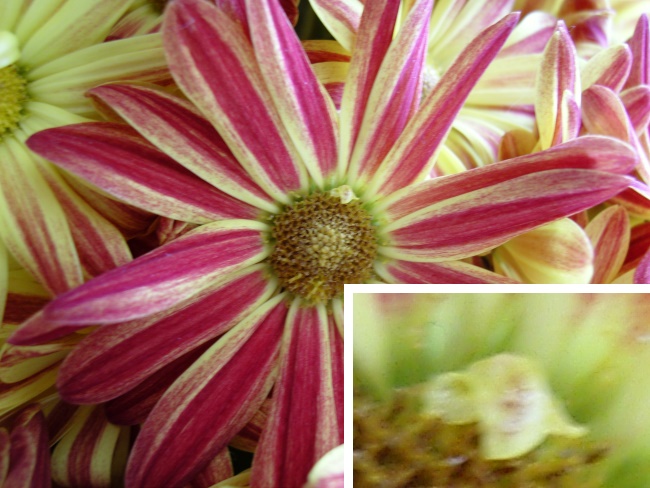
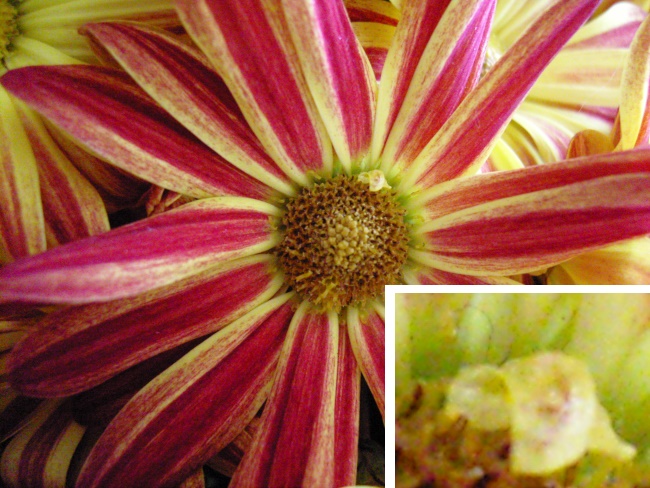
The presence of spurious color pixels at ISO 1000 does not mean that high ISO pictures are not worth taking. In fact, high ISO is very useful under certain circumstances. For example, shown below is a photo of a flower sitting on my coffee table, taken using Auto ISO. It is a bit blurry, due to a slower shutter speed with my hand unsteady. The inset shows a section near the top of the flower's center. When I switched over to ISO 1000, the picture turned out much sharper (second photo). Whatever spurious color pixels might be there, are barely noticeable, lost in the flower's own colors.
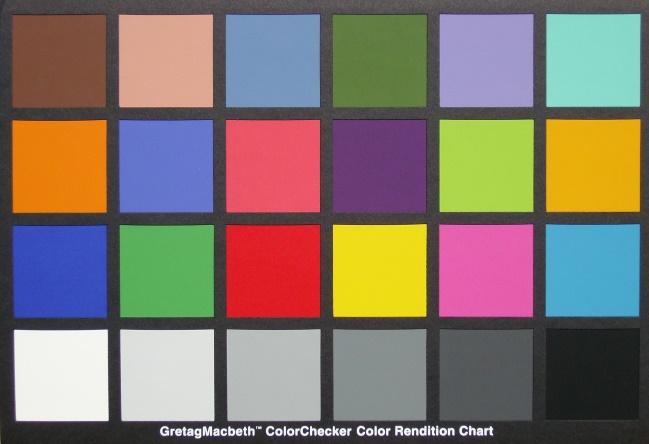
The GretagMacbeth ColorChecker test is shown below. Like just about every digital camera I have tested, the colors are a bit off from the original (the second photo is the scanned version of the ColorChecker, and adjusted to appear as close to the original as I could make it).
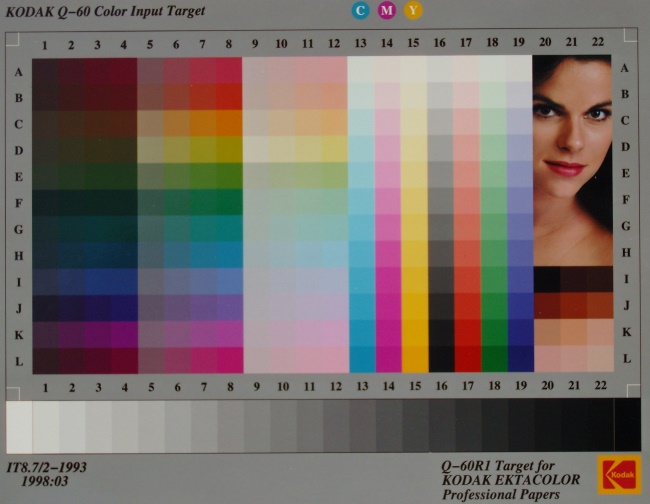
The NV10 underexposed the Kodak Q-60 color target, which other cameras have done as well. However, the overall color (tint) is correct. The second photo shows the scanned version, corrected to appear like the original as best as I could.
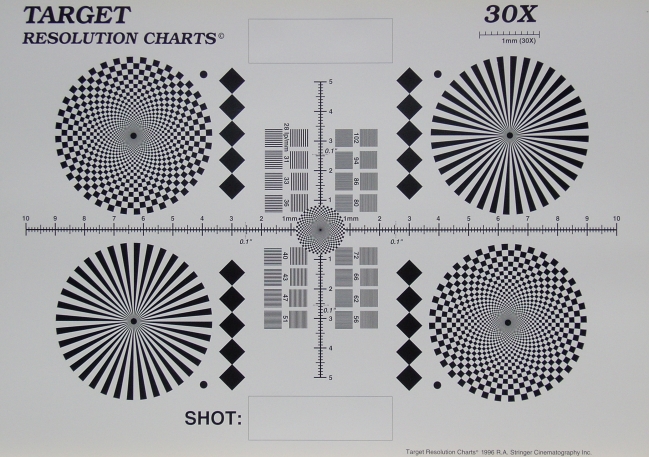
I measured a resolution of 124 lp/mm (line pairs per millimeter) on the sensor, using a Stringer Target Resolution Chart. Because sensors have so many megapixels these days, I had to double the linear placement (instead of filling the frame with 8.5" left to right - 30x the width of the sensor - I had to set it at 17"), so that the resolution would be indicated within the chart's presentation. First, the entire chart.
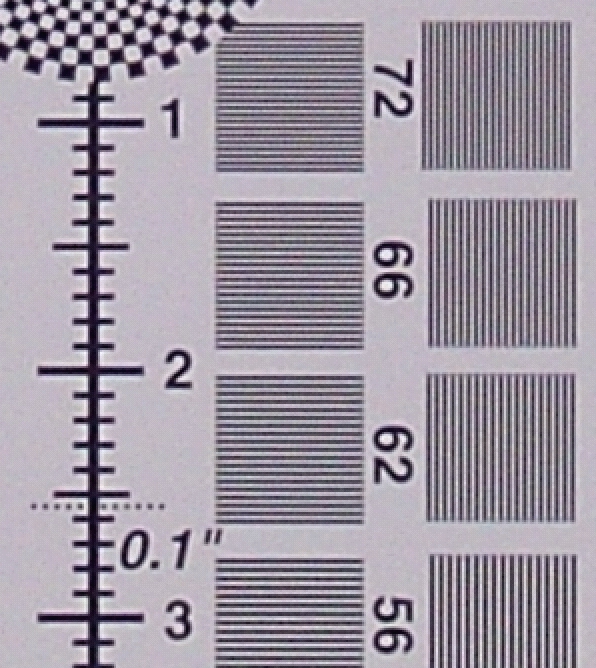
Now, here is a 2X blowup of the region in the lower right quadrant. Going from 62 to 66, aliasing starts to show up. Multiplying the 62 x 2 gives the 124 lp/mm resolution. The line pairs per mm refers to one line pair consisting of one dark line and the white line space next to it.
Keep in mind that the resolution of the sensor is a relative thing, that is, relative to the size of the sensor and its lens. With a larger 10 MP sensor, the resolution could actually be less, because it is putting a lower number of lines physically on that 1 mm of sensor surface area. However, that larger sensor would very likely produce a better picture, because of lower noise. The value of the sensor linear resolution will become more apparent as we review additional cameras. Conclusions The Samsung NV10 is a beautiful camera. It produces excellent images and is a pleasure to use. For $350, you can't go wrong.
- John E. Johnson, Jr. -
|
||||||







 YouTube
 Facebook
 Twitter
 LinkedIn
 Pinterest
 Google+
 Instagram
Magazine Publishing Solutions by
 Advontemedia