
|
||||||
|
Advantages of IP Naturally, the potential of a multi-room system alone is a great reason for an IP addressable system. But Polk Audio recognizes the potential of such a device in audio terms – "signal fidelity" or signal degradation from remote amplifiers from long distances of speaker wires. A Cat-5e cable on the other hand delivers the signal to the amplifier on the speaker and only then converted to analog, considered "lossless fidelity". Secondly, once that digital signal reaches the processor mounted on the speaker, bi- or tri-amplification is done more efficiently than from a processor - in the case of the 265, the base, midrange and treble receiving 100 watts, 75 watts, and 25 watts respectively. Even an analog source is converted to digital to be processed by the DSP before converting back to analog. Although the user can control bass, midrange, and treble, the "DSP Engine" includes a seven-band parametric Equalizer. I'm sure Polk Audio would be happy to supply the white paper on the whole discussion of the performance and design intent for the LC265i-IP speakers for those interested. In fact visit their extensive website; Polk Audio offers a substantial amount of information. I on the other hand just want to hear great music.
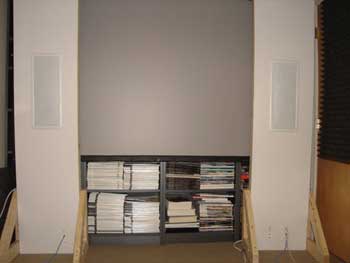
I will tell you the black box containing the control unit(s), which my son named the lunar module; should be located outside the listening area; the fan noise is actually disturbingly loud. As this is meant for a whole-house setup, it most definitely would end up in a closet anyway. My listening space is actually quite small at 9' x 11', but challenging as Paul would say. The speaker walls were set on the short end, tight to the wall about 7' apart. Traditional speaker wires aren't used here. The network and "COMM" cables are shielded Cat-5 with RJ-45 connectors. I assume most consumers having this type of system would have it professionally installed. After all, a network decoder card and programming have to be accomplished. Paul was reluctant to admit that these speakers can actually be set up in an analog system. "With the newness, we just didn't want to mess up all the pre-programming done in Baltimore."
It will ask whether a Performance Enclosure is used, or if your room is oddly shaped. An interesting question is the type of room you have acoustically - is the room dead, neutral, or lively? The DSP finally gives you an adjustment EQ setting for Bass – Mid – Treble. A help menu is available and will answer basic questions. Just to relieve anxieties about the Optimizing software, the speaker comes with default factory settings. Loading music into the server is simple because the ReQuest server loads like a CD player. The NetStreams control pad in hand, I can call up all that music. Listening I think my mind and ears were prepared to hear a very digital sound. After all, short of manually loading the CD into the music server, the amplification is digital, the transmission of sound through Cat-5 wires is digital, there was nothing analog from beginning until the very end. Surprisingly it was to the contrary. Is it politically correct in the audiophile world for me to say "Wow!" about in-walls? Overall, what immediately surprised me was bass and plenty of it. Sitting about ten feet away, I felt it in my chest. Reviewing the specifications you'll notice that the 265 dips down to a low 20 Hz, and it's quite evident. I also found that the Polk unit had no trouble reaching delicate highs such as sweet violin strings. Count Basie's Straight Ahead CD was thoroughly enjoyable – brass was brassy and brawn. On Track 3, "Lonely Street", the solo clarinet hung in mid-air, and I swear I felt the clarinet player raise and lower his instrument. The 265s handled the Tallis Scholars 25th Anniversary CD amazingly - my small room could easily have been any grand high gothic cathedral - recessive at times, delicate and warm, forward and bold, creating a sense of space. I basked in the full range I was hearing. Kelly Joe Phelps' Tap the Red Cane Whirlwind literally sounded new to me, considering how many times I've heard this guitar/vocal rich CD. I've never quite heard how thick he mutters as he plays his guitar, and the Polk LC265i-LP was quite revealing. Even the placement of his voice relative to the position of the guitar on his lap was astonishingly precise. Track 2 "Not so Far to Go" has a folksy-jazzy guitar introduction, and it completely dragged me into his performance – I could reach out and touch his guitar. Rene Marie's scat version of "Bolero" on her CD Live at Jazz Standards leaves me spellbound and hearing it through the Polk in-walls is no exception. Her voice is warm and soothing and ever so feminine – the LC265s give her such richness and color. Looking for the Downside Perhaps it was more a room acoustic issue, but my early listening yielded some brightness in the mid to high range - I do believe my room was just a bit shy of ideal for the Polk 265s, and there may be a benefit to a larger room size. I was able to compensate for this in the Optimizing software. On some recordings - and there didn't seem to exist any commonality - there is a "pop" between tracks. Other than odd and a bit annoying, it had no significant effect on my enjoyment. Conclusions If you sit back and think about speaker technology over the last 20 years, not much has changed. Certainly, active speakers are not new, but I think this new IP based technology is a dramatic swing. Whether it catches on or not is yet to be seen. Considering how mainstay whole house audio distribution systems have become, I don't see why Polk Audio's product wouldn't be incorporated into the scheme of things.
You'd be
hard pressed to find an in-wall speaker that approaches audiophile quality,
with
tight deep bass, fluid and clean midrange, and airy and light highs. Polk
comes pretty close with the LC265i-IP. - Piero Gabucci -
|
||||||
 Setup
Setup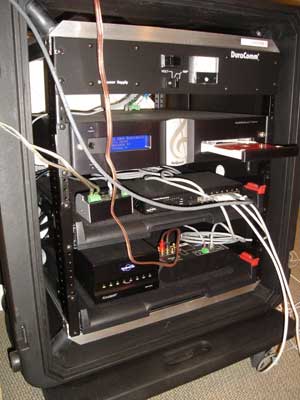 The
Optimizing software was installed on my laptop and
took me through some very basic questions, including room size and where
their located in your space. It will ask for measurements off the side
walls, distance between speakers, and distance off the floor measured to the
tweeter, ceiling height, distance to sitting position, even the width and
depth of the sitting position.
The
Optimizing software was installed on my laptop and
took me through some very basic questions, including room size and where
their located in your space. It will ask for measurements off the side
walls, distance between speakers, and distance off the floor measured to the
tweeter, ceiling height, distance to sitting position, even the width and
depth of the sitting position. 




 YouTube
 Facebook
 Twitter
 LinkedIn
 Pinterest
 Google+
 Instagram
Magazine Publishing Solutions by
 Advontemedia