
|
||||||||||||
|
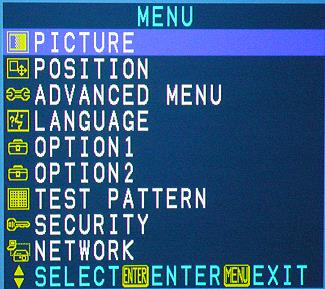
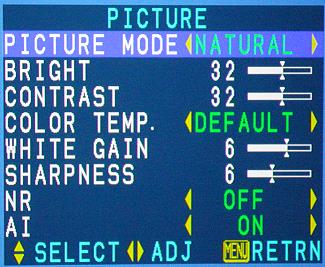
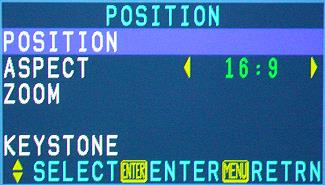
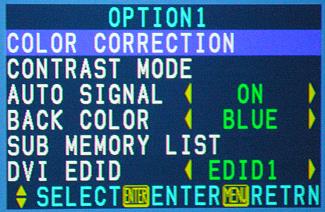
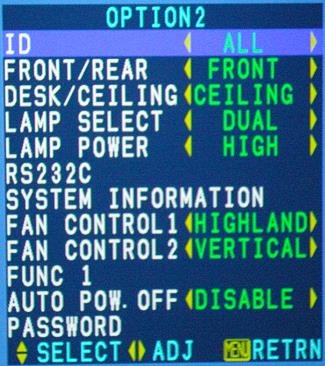
The menu system is shown below.
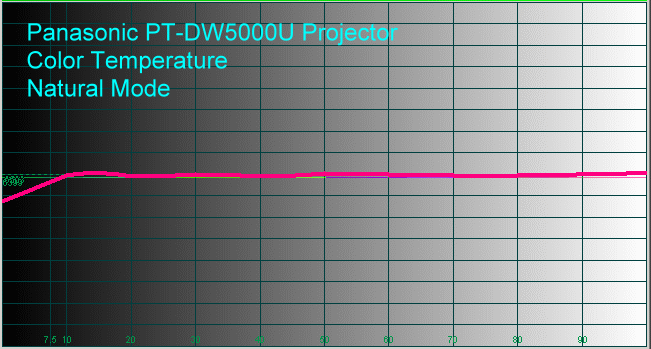
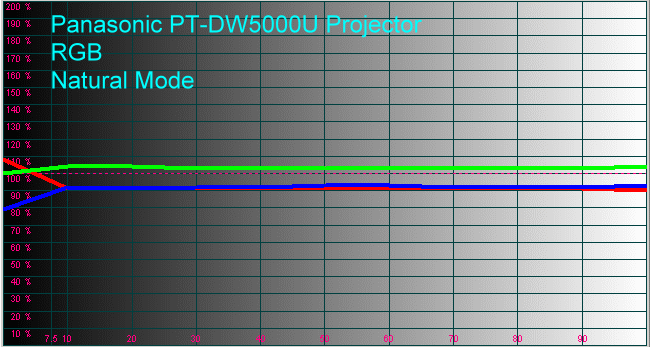
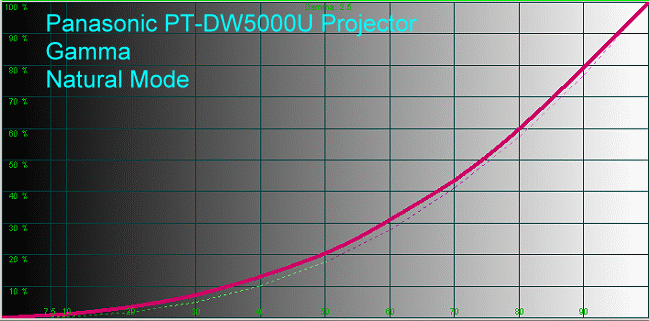
It's basically a very easy-to-use menu. Because there are two bulbs, you have to be careful how you set up the Fan Control, seen in the Option 2 menu. Otherwise, the bulbs won't last as long as they otherwise would. I used the Natural and Standard modes for the review. I ended up preferring the Standard mode, with some changes to the options in the Picture menu. As you will see below, this threw off the gamma curve, but it was the way I preferred the image to look. On the Bench The first three graphs are the Color Temperature, RGB, and Gamma for the projector in the Natural mode, with default settings in the menu. The Color Temperature is just about right on the money, a bit lower than D6500 by just a few hundred K. The RGB balance is with green being high, and red and blue being low. The projector gamma is described by a gamma curve of 2.5, which is ideal.
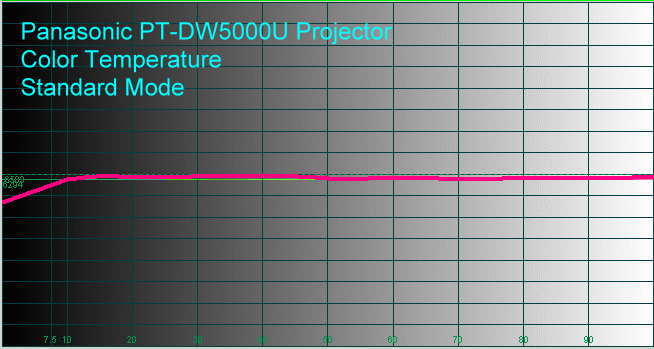
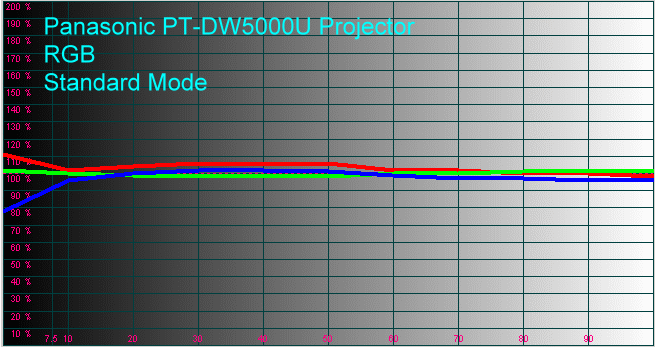
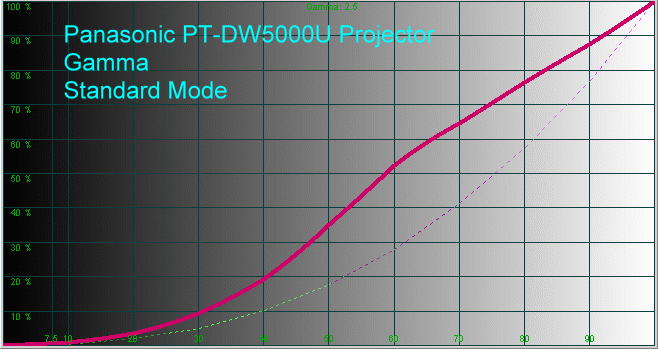
As I said, I preferred the Standard mode, with some changes to the Picture menu. I adjusted everything so that it was "just right" in terms of my enjoyment and ability to see all of the shadow detail. Then I obtained the following graphs. The Color Temperature is about the same as it was with the Natural mode, perhaps just a tiny bit cooler. In both cases, the temperature is very consistent across the various IRE values. The RGB balance is better than it was in the Natural mode, but the gamma is now far away from 2.5. However, this is what produced the most pleasing image to my eyes. It brings the shadows up to visibility more quickly than with a gamma of 2.5. In any case, it is obvious that the PT-DW5000U has a very good picture quality right out of the box. In fact, it is the best I have ever tested. There is a menu for adjusting red, green, blue, magenta, yellow, and cyan, but it only works with analog inputs, e.g., component video. It does not work with the DVI input. I would hope that outboard video processors can add individual color adjustments for the primary colors as well as the secondaries with DVI and HDMI connections at some point.
For Full On/Off Contrast Ratio (CR), the PT-DW5000U measured 1036:1 in the Natural mode, and 909:1 in the Standard mode. These were measured in the High Contrast setting. The ANSI Contrast in the Natural mode dropped to 340:1. Some consider the ANSI contrast the most realistic, because you nearly always have a mixture of bright and dark scenes in the image, but it is only realistic for the room in which it is measured. My home theater is in my family room, and there are other objects in there, such as white curtains, that reflect light. I could significantly improve the ANSI contrast by using dark curtains and painting my walls black, but I don't particularly care to watch movies in a dungeon. So, the Full On/Off CR is the most reproducible measurement for review purposes. I want to note that I have seen projector reviews in other publications where they measured a Full On/Off CR higher than this projector, but an ANSI CR lower. So, maybe my home theater room is not all that bad. I suspect that it actually may be a typical one amongst consumers, being used for other purposes besides home theater. Also, the lens can affect contrast in that if it uses low dispersion glass, the blacks in an ANSI test pattern will be blacker. This projector also has a Normal Contrast setting, which opens an iris (it stays open, compared to staying closed down in High Contrast setting). However, this reduced the Full On/Off CR to 657:1 (Natural mode). The High Contrast setting gave me plenty of brightness, and good contrast too. In terms of light output, I measured 2,008 lumens for the Natural mode and 1,764 lumens in the Standard mode (High Contrast setting). Keep in mind this is the output that I watched movies with. It is not the maximum light output, which measured at 4,509 lumens (Normal Contrast setting, with brightness turned all the way up in the menu), and that is right on the button for the specification. Granted, this DLP projector does not have the enormous contrast ratios that are found in some DLP units, but those also do not have the incredible brightness that the PT-DW5000 has. No projector has everything. You have to decide on your priorities. Nevertheless, the contrast in this Panasonic is acceptable. Some consumers might be disappointed that the PT-DW5000U has a DVI input instead of the more modern HDMI. However, so far, I have not seen any differences in the image produced with DVI vs. HDMI inputs on projectors. That may change down the road when the HDMI specification includes "Deep Color" which could use 12 bits, but for now, there seems to be no difference. Most sources (DVD players and satellite boxes), as well as receivers have HDMI, so the digital audio and digital video will still go to the receiver. You simply use an HDMI-to-DVI adapter for the video output from the receiver to the projector.
|
||||||||||||





 YouTube
 Facebook
 Twitter
 LinkedIn
 Pinterest
 Google+
 Instagram
Magazine Publishing Solutions by
 Advontemedia