
|
|||||||||||||||||||||||||||||||||
|
CEA 2010 Output Scores: The average sound pressure for the 20-32 Hz (defined
by CEA as "ultra low bass") bandwidth, and for the 40-63 Hz (defined by CEA
as "low bass") bandwidth has been calculated using the above
distortion-limited output values. As required by the CEA 2010 standard, the
sound pressure levels have been normalized to a 1 meter test distance.
Bandwidth Linearity Score: The bandwidth linearity score for a given
bandwidth is determined by dividing the average distortion-limited SPL over
that bandwidth by the maximum distortion-limited SPL occurring within that
bandwidth, and expressing the result as a percentage. The Klipsch scores
very well, particularly above 25 Hz.
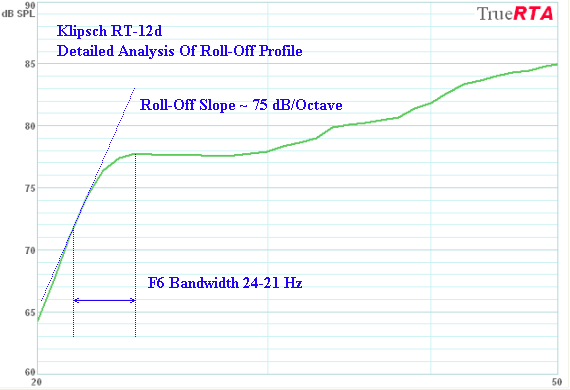
Transient Response: An evaluation of the frequency response (particularly
the F6 bandwidth and the roll-off slope) can be used to predict the system
transient response. These variables affect the rate of phase change with
respect to frequency, which in turn manifests itself as latency and ringing
in the time domain. This phenomenon can be characterized by evaluating group
delay, impulse response and spectral decay.
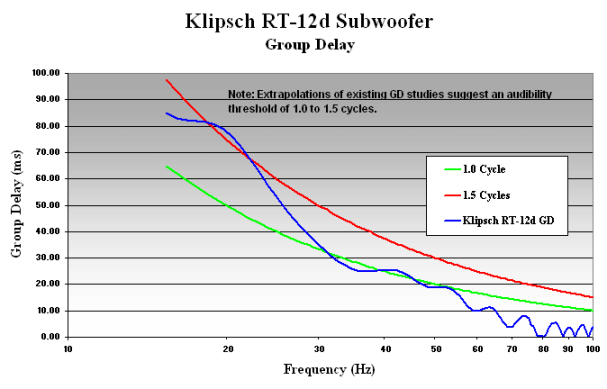
The down-sloping FR from 60-30 Hz increases group delay to near 1.0 cycle from 55-32 Hz. As the system roll-off is approached, the group delay curve rapidly rises below 32 Hz, eventually exceeding 1.5 cycles at 22 Hz.
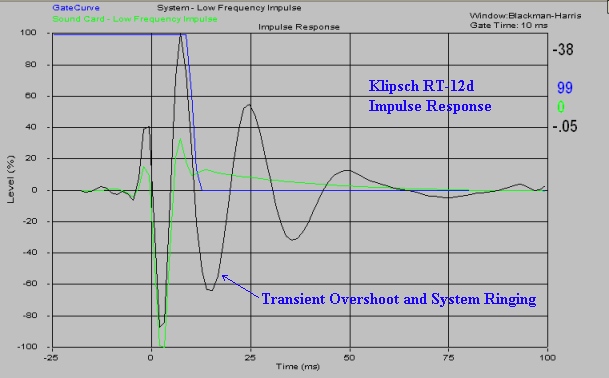
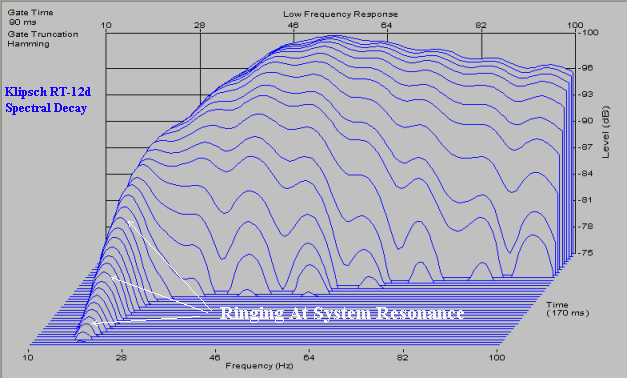
As expected, the impulse response exhibits ringing for approximately 80 ms. The blue line is the gate curve, the green line is the impulse response of the measurement system, and the black line is the impulse response of the subwoofer. The spectral decay 3-D graph shows this ringing occurring at system resonance (22-23 Hz).
While the audibility of latency and ringing at very low frequencies is
subject to debate, extrapolations of existing group delay studies conducted
at higher frequencies suggest an audibility threshold of 1.0-1.5 cycles.
Readers should be reminded that the in-room frequency response and the
structural integrity of the listening room can have a large (if not
dominant) influence on our subjective impressions of subwoofer transient
response. Subjectively "slow" bass with excessive "overhang" can often be
greatly improved with parametric equalization (such as offered by the Klipsch Room Correction software) and bass traps.
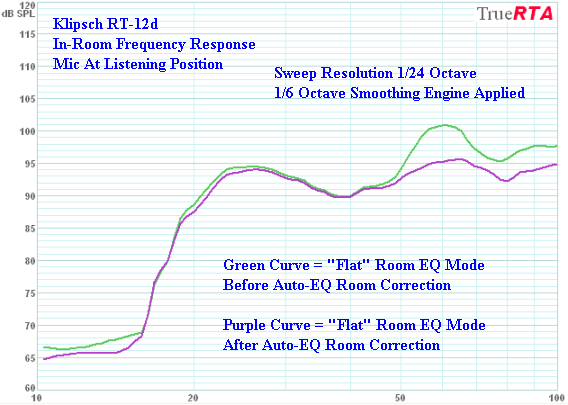
Then I measured the frequency response before/after the auto-EQ Room
Correction feature. I used the Flat EQ Mode setting as the starting point
for the auto-EQ routine. As shown in the screen shot, the Room Correction
feature reduced the severity of a mid-bass peak, which audibly improved the
sound quality. The final frequency response was 22-100 Hz
± 2.5 dB, which
is impressively flat.
For music/movie evaluations, the main speakers were set to "Small" with a crossover frequency of 100 Hz. The digital bass management circuit imposes a 2nd order high pass filter on the speakers, and a 4th order Low-Pass filter on the subwoofer. Accordingly, I set the Low-Pass filter on the RT-12d to the "Low-Pass Off – LFE Mode" setting. I set the phase control to 0 degrees and adjusted the subwoofer distance setting in the SSP to obtain the best phase integration with the mains.
|
|||||||||||||||||||||||||||||||||




 YouTube
 Facebook
 Twitter
 LinkedIn
 Pinterest
 Google+
 Instagram
Magazine Publishing Solutions by
 Advontemedia