
|
|||||||||
|
Introduction Lexicon has long been recognized as one of the leaders of the high end audio market. As a subsidiary of Harman International, they’ve benefited from decades of experience and research in the audio field. But on the DVD player front, they’ve usually come up a bit short of the mark that their other lines of equipment dwell in, at least in the video department. The RT-20 is Lexicon’s newest Universal DVD player and a huge step forward in video prowess.
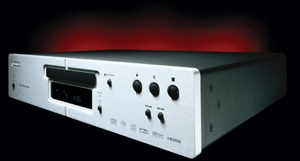
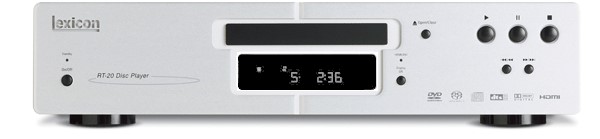
Design and Function In fact, the product as a whole is almost identical from a cosmetic point of view, which is completely fine with me since the previous model was a great looking unit. The tray is sturdy and not the flimsy piece of plastic you normally find with most DVD players. The buttons on the front panel are large and milled as well adding the feeling that Lexicon has paid attention to the overall design and materials used in this player.
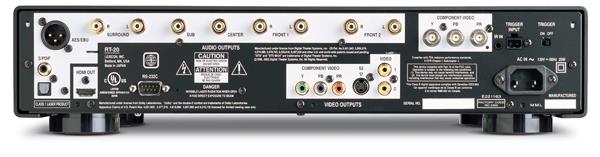
There is a small display underneath the tray that shows the usual information such as title, track, and time, but it will also tell you sound formats and sampling depths, which come in handy when you want to make sure you are listening to the format you want to, on multi-format discs (SACD discs often also have a conventional CD layer). The display has several settings for overall brightness, for those concerned with ambient light in their room. The main differences you’ll find from the RT-10 are on the inside and on the back panel. The back panel now sports a new HDMI output for digital video and audio playback. Of course, there are also the standard connections we’ve grown accustomed to: S-Video, Composite, and Component, but a digital output is our preferred connection to alleviate unneeded digital-to-analog and analog-to-digital conversions. It also provides the end user a one cable solution for movie and CD playback if that is the primary use of the player. If high resolution formats such as SACD and DVD-Audio are used, you’ll still have to connectg the 5.1 analog multi-channel RCA outputs, as the RT-20 does not yet support the current HDMI 1.1 or 1.2 specifications. Hopefully Lexicon will support the latest version in a later upgrade. I was a bit disappointed that Lexicon didn’t support a Firewire or iLink connection with this player. The Pioneer and Marantz platform that this player is based on do support them, and this would provide a pure digital connection for not only CDs and DVDs but for all existing high resolution formats as well; it is a bit of an oversight at this price point in my opinion.
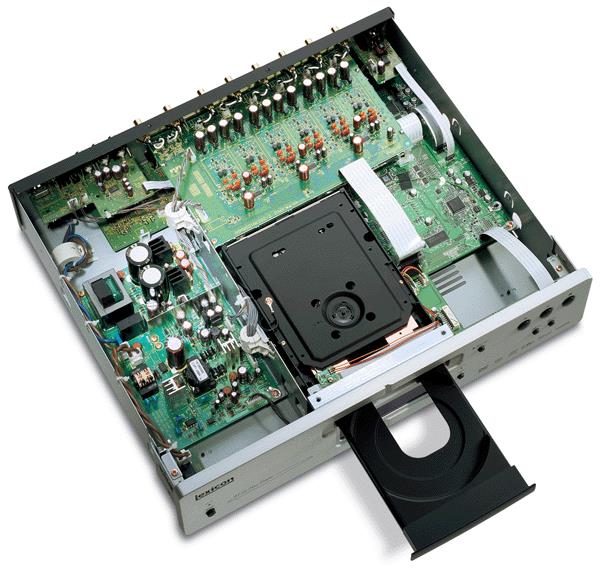
Some of the other highlights of the RT-20’s back panel are the BNC-type connectors for component video output. These ensure 75 ohm compliance for video and also provide a far better connection with the cable. You’ll also find an XLR (balanced) two-channel output for stereo playback. In my past experiences with balanced stereo outputs, the performance takes a nice step forward from the typical RCA output, especially if the product is using true dual differential designs (as the Lexicon does). The sound is cleaner and tends to have a more dynamic presence. It also eliminates noise that is picked up in the cable between the player and preamplifier, assuming the XLR input on the preamp is also true balanced (rather than simply shorting pins 1 and 3). The inside of the player is pretty much the same as before. The boards are all laid out nicely with good separation between the power section and the main video/audio boards. This player is modeled after the Marantz DV-9500 but with some modest changes including the outer case design and some audio filtering tweaks. The biggest difference from the RT-10 is the HDMI board from Silicon Image.
|
|||||||||





 YouTube
 Facebook
 Twitter
 LinkedIn
 Pinterest
 Google+
 Instagram
Magazine Publishing Solutions by
 Advontemedia