
|
|||||||||
|
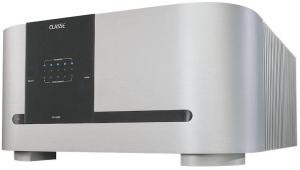
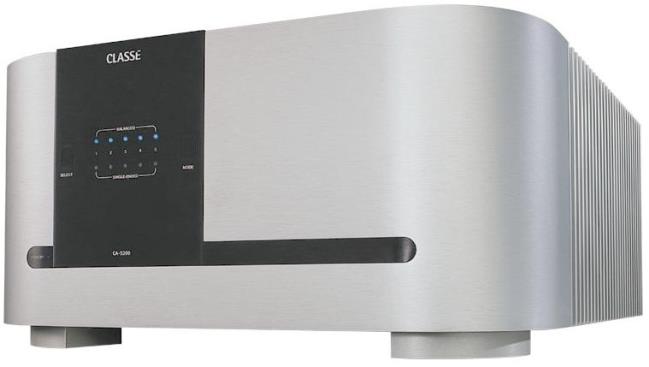
Introduction Classé, long renown for building CD players, preamps, processors, and power amplifiers, began in 1980 with its first amplifier. The company is located near Montreal, Quebec, Canada. The president of Classé, Mike Viglas, took it over from David Reich who originally founded the company, and has managed it for the past two decades. In 2001, Classé became part of the B&W Group, which is based in the U.K. As most consumers know, B&W is famed for their speakers. The CA-5200 is the latest of Classé's multi-channel power amplifiers. The Design Delivering 200 watts rms x 5 into 8 ohms, and nearly 400 watts rms x 5 into 4 ohms, the CA-5200 is a power house. Weighing in at 121 pounds, it contains a 2.5 kVA (2,500 watts) toroidal power transformer that has dedicated secondaries for each of the five channels. Each channel has its own set of power supply capacitors, rated at 46,800 μF, with a DC voltage of ± 84 volts. That provides 165 Joules of energy storage for each channel, and a total of 825 Joules. That is a huge amount of energy! The large transformer and set of power supply capacitors is why the amplifier can just about double its power output into 4 ohm loads. The input stage uses J-FETs because of their high input impedance (eliminating the need for coupling capacitors), while MOSFETs are used for the driver stage, and bipolar transistors for the output stage. Bias adjusts itself depending on the demands, such that about 30% of the output is always in Class A. As a result, the amplifier gets pretty warm during use, and should be given plenty of ventilation. The front panel has a power Standby On/Off button and two other buttons that let you select each channel to be run in balanced (XLR input) or unbalanced (RCA input) mode. If the 5200 is receiving AC, it stays in standby mode, which readies the power supply for power-on. I did find that it took about a half hour from a fresh power-on to having the 5200 sounding its best (it was a little too bright when listened to immediately). The standby power configuration does not affect this, so you will need to wait a bit before doing any serious listening.
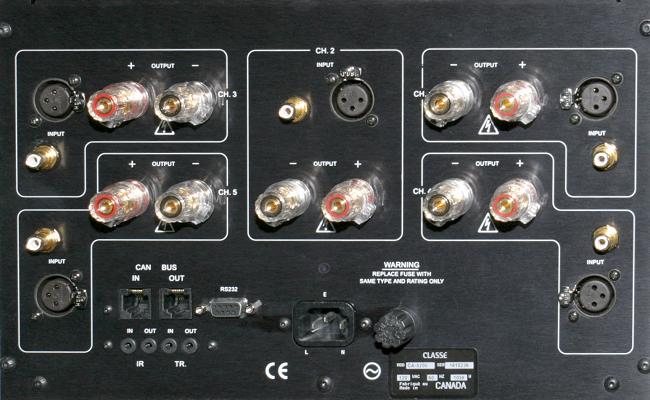
The rear panel, shown below, has an XLR and RCA input for each channel, along with a set of five-way speaker binding posts. They are not labeled as front left/right, center, and rear left/right, but you can see from the way they are laid out on the panel, that the top ones might be connected to the front left/right, the center one to center, and the bottom ones for rear left/right, just for ease of connecting things over the top and down the back later on when you might not want to move the amplifier. That is what I did anyway.
The back panel also has jacks for triggering on/off, a bus to connect several amplifiers together so that they can all be turned on in sequence, and an RS232 port for upgrading software down the road.
|
|||||||||





 YouTube
 Facebook
 Twitter
 LinkedIn
 Pinterest
 Google+
 Instagram
Magazine Publishing Solutions by
 Advontemedia