
SVS PB10-ISD Subwoofer October, 2004 Ed Mullen
|
Introduction
SVS has made a big impact (literally) in the home theater and music world over the last five years. They offer a very extensive line-up of powered and passive subwoofers in both cylinder and box configurations. SVS sells its products direct, over the Internet, and has separate manufacturing and R/D facilities in Ohio, as well as several other satellite offices across the country.
The PB10-ISD, reviewed here, represents the long anticipated SVS entry into the $400 subwoofer class. As part of this review, I spoke with SVS co-founder Ron Stimpson. He said that customers had been asking for a more affordable SVS that wouldn't compromise on performance. With their performance reputation on the line, the PB10-ISD needed to have better accuracy, deeper extension, and more clean output than the competition. They strongly believe it's the best entry-level subwoofer in the world, and they've also developed a contemporary cabinet with quality features not normally found in this price class.
Pretty big words; let's see if the PB10-ISD lives up to its billing.
Fit and Finish
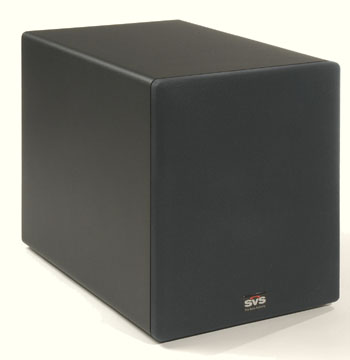
The PB10-ISD cabinet looks like a ¾-scale version of an SVS dual driver subwoofer cabinet, with a rectangular appearance. The external dimensions are approximately 15" wide, 18" tall, and 21” deep. The sub weighs about 60 pounds uncrated. SVS says they tried hard to “right size” the enclosure during the design phase, and I think they succeeded.
The PB10-ISD is a bass reflex design, and the recessed woofer and flush-mounted vent are both front-firing. The ABS plastic vent is widely flared at both ends, with an inner diameter of 3 inches and an outer flare diameter of 4.875". The BASH amplifier is flush-mounted at the rear. All components seem to be well fitted, especially considering this is an early production example.
The cabinet is an elegant design with rounded corners on the sides, and a flat edge at the front and rear. There are no visible ridges or end caps, so it gives the appearance of being one piece. The cabinet is finished in a finely textured satin black vacuum-sealed vinyl coating. The finish looks fabulous, with no detectable surface defects. The vinyl seam runs discretely along the bottom of the cabinet, and you have to look hard to find it.
The fiberboard grille is remarkably light considering it is 1” thick (required to clear the high excursion woofer). The fabric is close knit and stretched tightly, and the workmanship on the back side is excellent, with neat adhesive work and no loose threads. The grille grommets are soft rubber, and the cabinet grille pins are chrome; this is a big step above the more typical plastic ball and socket arrangement.
There are six low-profile soft rubber feet on the bottom of the cabinet. These “grippy” feet are threaded into the cabinet with T-nuts, and can be removed if the user wants to slide the subwoofer around on carpeting to experiment with different placement options. The feet can even be left off, and the enclosure will still not leak air – a nice touch. The rubber feet worked well on hard surfaces like laminate, with no buzzing, vibrating, or wandering. This is a flexible and high quality floor interface solution.
I removed the driver to get a closer look inside the cabinet. I was pleasantly surprised to discover the woofer mounted with machine screws and T-nuts. The front baffle of the MDF cabinet is 1” thick, and the other panels are ¾”. The interior is neatly lined with fiberglass. Rapping my knuckles at several spots on the cabinet revealed no audible resonances, and it appears to be very solid and acoustically inert.
The TC Sounds-built dB-10 woofer is a proprietary SVS design. It features a huge synthetic rubber surround, impregnated pulp cone with inverted dust cap, an extra deep basket with a double stacked magnet structure, a high thermal capacity large diameter voice coil, and heavy-duty, long-throw suspension components. It is very substantial and weighs about 20 pounds. Co-founder and chief designer Tom Vodhanel says the exact Thiele-Small (T/S) parameters are proprietary, but did state the motor strength, maximum linear travel, power handling, and distortion characteristics are class-leading.
Amplifier Feature Set
The Indigo digital BASH amp is rated at 300 watts continuous and has the following features:
- Auto-On/On Toggle Switch
- Single Low Level RCA Input
- Gain/Volume
- Phase Control (0-180 degrees
continuously variable)
- Replaceable Fuse
- Detachable Power Cord
- Power Switch
A steep slope infrasonic high-pass filter is used to protect the woofer from over-excursion below the tuning point. SVS also uses a custom equalization circuit to optimize the frequency response. The variable phase control offers a wider range of adjustment than a 0/180 phase switch, allowing the user to dial in the phase response of the subwoofer with that of the main speakers. Variable phase is also very useful for integrating dual subwoofers that will be located in different areas of the room.
The RCA input is gold plated to maximize conductivity and minimize the potential for corrosion. I liked the smooth movement of the large rubberized gain and phase control knobs. The power cord is heavy duty and thick. There is plenty of exposed surface on the machined aluminum face plate for heat sinking. A bit of volume boost was needed to initialize the auto-on circuit, but the subwoofer always stayed on during movies and music, even during quiet passages.
Since the amplifier lacks speaker level inputs and a low-pass filter, a Dolby Digital A/V receiver or “pre/pro” is required to operate the PB10-ISD. Digital bass management and the subwoofer pre-out is an almost universal connection method for home theater, and is also becoming increasingly popular for all music formats.
Ground Plane Frequency Response Measurements
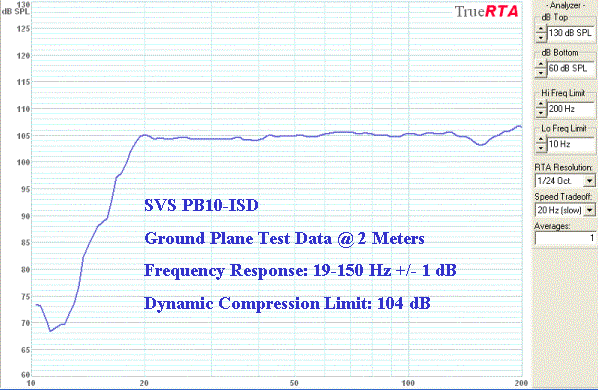
In order to determine the quasi-anechoic frequency response, the PB10-ISD was tested outdoors, away from any reflective structures, and measured using ground plane techniques. Measurements were conducted with the microphone facing the woofer and vent, at 2 meters from the depth centerline of the subwoofer enclosure, and the phase control set to 0 degrees.
Frequency response (FR) sweeps were conducted at progressively increasing sound pressure levels until dynamic compression was noted. Dynamic compression is indicated when the input/output ratio becomes non-linear, and the subwoofer frequency response starts to compress and exhibit anomalies. In other words, the dynamic compression limit is defined as the highest SPL at which the frequency response starts to change. Dynamic compression is caused by exceeding mechanical, thermal, port flow, or amplifier output limits.
The PB10-ISD frequency response measured an almost unbelievable ± 1 dB from 19 Hz - 150 Hz. The sharp roll-off below 19 Hz indicates the presence of a steep infrasonic high-pass filter to protect the woofer from over-excursion below the tuning point. With respect to dynamic compression, the curve stayed linear up to 104 dB across the entire operating bandwidth, at which point about 1 dB of compression was noted at around 20 Hz.
Ground Plane Total Harmonic Distortion (THD) Measurements
Harmonic distortion occurs when harmonics (multiples) of the fundamental signal are produced due to non-linear behavior of the electrical, magnetic, or mechanical aspects of the driver. A subwoofer with low THD will sound clean and distinct, especially at the deepest frequencies where distortion harmonics are easiest to detect.
Measurements were conducted at 2 meters from the centerline of the subwoofer enclosure. To calculate the 1 meter test values, add 6 dB to the 2 meter reading. THD was limited to 10% unless otherwise noted. With the exception of 22 Hz, test frequency spacing was at 1/3 octave intervals.
Audio reviewer Tom Nousaine calculates bandwidth linearity by dividing the average SPL by the maximum SPL and expressing the results as a percentage. A score of 100% means the subwoofer exhibits perfect output linearity across the given bandwidth.
SVS PB10-ISD 10% THD Values (Ground Plane 2 Meters):
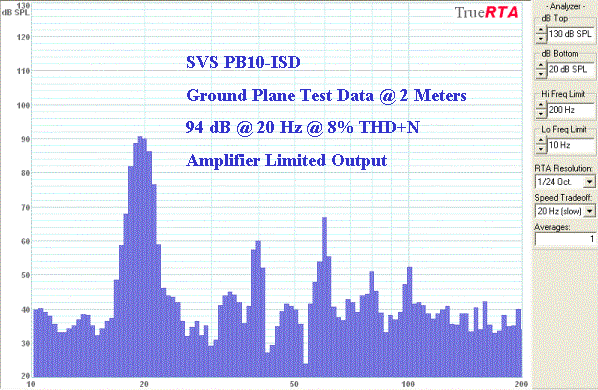
20 Hz: 93.9 dB (8.0 % - amplifier limited)
22 Hz: 96.9 dB (2.7 % - amplifier limited)
25 Hz: 102.2 dB
32 Hz: 104.1 dB
40 Hz: 105.8 dB
50 Hz: 106.7 dB
63 Hz: 105.7 dB
80 Hz: 104.0 dB
20-80 Hz: Average 102.4 dB; Bandwidth Linearity 96%
22-80 Hz: Average 103.6 dB; Bandwidth Linearity 97%
25-80 Hz: Average 104.8 dB; Bandwidth Linearity 98%
These distortion and bandwidth linearity values are simply outstanding. Note the amplifier limited the output at 20 Hz - 22 Hz, and the distortion at 22 Hz was only 2.7%!
In-Room Frequency Response Measurements
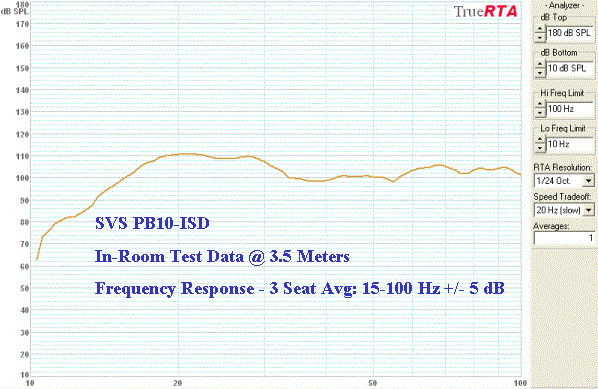
To simulate a typical user setup, the PB10-ISD was placed in the front left corner of my 2,000 ft3 home theater room. For bass management, all speakers were set to small with a crossover of 80 Hz. The phase was set to about 90 degrees; this provided the best results in my room. The in-room FR sweeps were processed through the pre/pro with only the main speakers and the PB10-ISD operating.
The in-room FR was measured at three different listening positions, all about 12 feet from the PB10-ISD. The three curves were then combined to create an average response curve. The three curve average measured an excellent ± 5 dB from 15 Hz - 100 Hz, with some room gain noted in the bottom octave. Room gain can help compensate for the human ear's lack of sensitivity to very deep bass.
Subjective Impressions and SPL Levels for DVD Movies
To provide a real world indication of how loud the PB10-ISD can play in my mid-size HT room, I measured some sound pressure peaks from a few action-oriented DVDs. I used a B&K Model 2205 SPL meter (set to C-weighted Fast) at the listening position. The sound pressures listed are straight meter readings, with no correction factor applied.
As a guide for setting the maximum playback level, I normally increase the master volume until minor distortion and compression artifacts are noted on the deepest and most challenging scenes. But with the PB10-ISD, I discovered it's nearly impossible to drive this subwoofer into audible distress. The combination of high output linearity in the 20 Hz - 80 Hz bandwidth, a steep infrasonic high-pass filter, and a sophisticated amp limiter, are very effective at keeping the PB10-ISD well behaved. The PB10-ISD can eventually be driven into compression, but it just politely refuses to play any louder, acting almost like it has a servo circuit.
Confident in the knowledge the PB10-ISD was fairly bulletproof, I simply set a comfortably loud playback level and broke out the sound meter. My HT system is calibrated to Dolby Reference Level at master volume 0.0 with the Avia Guide to Home Theater DVD. Master volume settings are listed for reference purposes only.
1) Matrix Revolutions (DD 5.1), Master Volume -4
The PB10-ISD really showed its mettle on this demanding DVD, pressurizing the room from the ground up, and belting out real power in the 20 Hz - 25 Hz bandwidth. Revolutions has a steady undercurrent of near infrasonic bass in many of the action scenes, and the PB10-ISD conveyed this effect very well.
Scene Time Stamp Peak SPL APU Stomp 0:59:02 104 dB Rumbling Before Dock Breach 1:02:42 102 dB Driller Hits Ground 1:03:20 105 dB APUs Firing 1:03:49 104 dB Driller OutRigger Stomp 1:05:03 102 dB Kid Fires APU 1:19:17 104 dB 2) Lord Of The Rings – The Return Of The King (DD-EX 5.1), Master Volume -9
The PB10-ISD hit hard on the battering ram scene, and delivered the deep “Oliphant” collision with authority. It also dug down to fully capture Frodo's ultra deep heartbeat at Mount Doom.
Scene Time Stamp Peak SPL Battering Ram Hits Door 1:46:45 106 dB “Oliphant” Stomping 2:04:20 104 dB “Oliphants” Collide 2:06:05 105 dB Witch King Spike Ball Strike 2:10:10 106 dB Frodo's Heartbeat 2:40:33-2:40:57 104-105 dB 3) Monster's Inc. (DD-EX), Master Volume -9
The PB10-ISD hung tough on the “23-19” Sock Detonation, with no audible distress and excellent punch. And it massaged the chair nicely on the famous “Boo Crying” scene.
Scene Time Stamp Peak SPL “23-19” Sock Detonation 0:18:40 104 dB “Boo Crying” 0:47:50 104 dB 4) Star Wars Episode I - The Phantom Menace (DD-EX) Master Volume -5
The PB10-ISD dished out plenty of tactile infrasonic bass on the “Canyon Exits”, hit hard on the “Pod Racer Explosion”, and felt dynamic on the “Canyon Drop” scene.
Scene Time Stamp Peak SPL Pod Racer Explosion 1:01:39 103 dB Pod Race Canyon Drop 1:03:34 107 dB Pod Race Canyon Exits (time varies) 105-107 dB Subjective Music Evaluation
1) Time Out - The Dave Brubeck Quartet, Columbia Records/CBS, 1959 (1997 Direct Digital Remaster)
This famous classic jazz recording features Eugene Wright on the acoustic bass. He displays masterful finger work on "Three To Get Ready", and the PB10-ISD stays detailed and lively, cleanly separating each finger pluck and accurately conveying the delicate timbre of this instrument.2) Sound Hound Classical Organ CD, Artist Unknown, 2003
Track 9 "Be Thou My Vision" contains a sustained 17 Hz note at the 1:30 mark. The PB10-ISD pressurized the room nicely on this passage, with no audible doubling or port noise. This is an excellent performance for any subwoofer, but is downright amazing for a single 10” driver. The Bass Archives hotlink provided courtesy of Rudi Benkovic.
3) Together Again - For The First Time – Mel Torme and Buddy Rich, RCA Studios (Norman Schwartz) 1978, MFSL Original Master Recording
Buddy Rich launches into a rapid fire drum solo at the 4:00 minute mark of "Blues In The Night". The PB10-ISD stayed focused and distinct on each kick drum strike, and the tom hits showed good attack and presence. Later in the track, Tom Warrington exhibits the kind of bass work that made him famous, and all notes sounded natural on the PB10-ISD.
4) Tchaikovsky Symphony No. 6 in B Minor, ‘Pathetique' – Royal Philharmonic Orchestra (Menuhin conducts), Long Island Music 1994, Sony 20/16 Super Bit
Allegro molto vivace features several crescendos accompanied by hard kettle strikes. The PB10-ISD provided that groundswell of sound pressure so essential for a realistic and convincing crescendo, and the kettle strikes were deep and powerful, with excellent foundation and percussive timbre.
5) The Globe Sessions – Sheryl Crow, AM Records 2001, DTS-ES 6.1 Discrete
Sheryl Crow has soul, and nowhere is that more evident than in "Crash and Burn". This tune features subtle bass guitar and gentle tom strikes to provide an emotional foundation. The PB10-ISD sounds utterly natural on this track, allowing the listener to get fully drawn into the song without distraction.
Conclusions
I'm really excited about what the PB10-ISD brings to the $400 subwoofer class. The enclosure design is modern and elegant, with excellent fit and finish. High quality parts and fittings are used throughout, with obvious attention to detail and appearance. The floor interface solution is thoughtful and well designed.
SVS reports that nearly all of its customers use digital bass management and the subwoofer pre-out for both home theater and music formats. As such, I view the decision to eliminate the speaker level inputs and the low-pass filter as a cost savings measure that has no real downside for most enthusiasts, especially at this price point. Furthermore, SVS says that elimination of the high level connections freed up space for a larger amplifier, and also improved heat sinking capacity for even better reliability.
The Indigo BASH digital amplifier has engineered performance features like variable phase, a custom EQ curve, a steep high-pass filter, and a sophisticated limiter. The woofer is a high performance unit with long linear travel, low distortion, and high power handling. The vent is wide flared at both ends to keep air flow smooth and quiet. The enclosure is rigid and inert, and has a healthy internal volume for good efficiency and output at the lowest frequencies.
All of these features combine to have a synergistic effect, and the result is class-leading performance. The PB10-ISD has an amazingly wide and flat frequency response and outstanding bandwidth uniformity. Its frequency response and clean output capabilities maintain almost perfect parity right up to its dynamic compression limits. This makes it extremely well behaved and clean sounding (especially in the 20 Hz - 30 Hz bandwidth) at its operating limits.
This sub sounds great on music: accurate, non-fatiguing, and highly involving. For HT applications, the PB10-ISD goes deep, loud, flat, and clean. It gets to below 20 Hz with authority, and moves the room from the ground up, indicating it has real bottom end. In a moderate size room, its output capabilities are all most people will need. If you are a true bass head and like to listen at/near Reference Level, buy two PB10-ISDs - for only $800 you'd have a bass system that would rival other competitive offerings costing far more.
In short, the PB10-ISD has an SVS pedigree to the core, and from a performance value perspective, it is their best work to date. It is a remarkable achievement, and truly represents a quantum leap forward in the $400 subwoofer class.
At the time of this report, SVS stated that pre-orders have far exceeded even their high initial expectations. TC-Sounds is already running full tilt manufacturing dB-10 woofers to meet the current pre-order demand and projected sales quotas for November and December, 2004. SVS is requesting that early adopters be patient as supply catches up with demand over the next several weeks.
- Ed Mullen -
|
||||||
|
© Copyright 2004 Secrets of Home Theater & High Fidelity |
|
|
|





 YouTube
 Facebook
 Twitter
 LinkedIn
 Pinterest
 Google+
 Instagram
Magazine Publishing Solutions by
 Advontemedia