
|
||||||||||
|
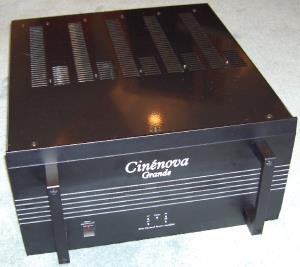
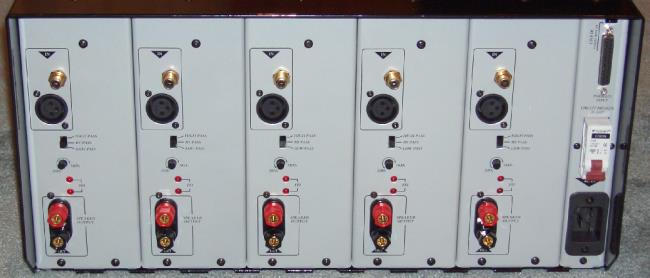
Introduction Earthquake Sound is a name that probably all of us are familiar with, sort of like Monster Cable. It is just too catchy a name to forget. If you are familiar with their products as well as their name, you know they have been big in subwoofers, and I mean BIG! At shows such as CES, they are famous for having passersby stand on one of their subwoofers and get a massage at 18 Hz. Big amplifiers and big drivers make for a nice massage by the way. In the last couple of years, Earthquake has branched out to market speakers and power amplifiers, and also to cater to auto sound consumers. As a result, they market some products under the name Nova, since Earthquake really only applies to the big stuff. The Design The subject of the present review is the Earthquake Cinenova Grande Five-Channel Power Amplifier. A seven-channel version is also on the way. The Cinenova sports 300 watts rms into 8 ohms for each channel, doubling into 4 ohms. Yes, that means a big power supply, and in this case, each channel has its own toroidal transformer and power supply capacitors. The result is a 141 pound behemoth that needs two people to move into place. Fortunately, when Joseph Sahyoun - President of Earthquake Sound - was here for a video interview, he and his associate moved the amplifier for me. The rear panel has the business end of each amplifier module, which includes XLR balanced as well as RCA unbalanced inputs (the amplifier is not a fully balanced circuit though), and five-way binding posts. On the right side, you can see a DB-25 jack for external control of the amplifier, a circuit breaker, and the grounded AC socket.
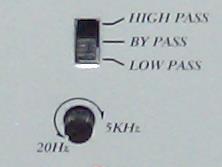
Each module also has something quite unique: a variable potentiometer which, when enabled, lets you low-pass or high-pass that module at a frequency from 20 Hz up to 5 kHz. A slider switch lets you select whether the frequency on the potentiometer is to be low-passed or high-passed. The photo below shows a close-up of one of the amplifier modules where the low-pass, high-pass control section is located.
Here is a graph of how the amplifier responds when the crossover is activated. I took one measurement with the setting at high-pass and the other at low-pass.
The Sound I tested the Cinenova Grande in our lab, using a Yamaha Universal Player, Classé SACD-2 Player, Lexicon MC-12 SSP, Balanced Audio Technology Preamplifier, Carver Amazing Ribbon Speakers, and Thiel CS2.4 Speakers. Cables were Nordost, BetterCables, and Slinkylinks. I might have said that I was surprised at how much power the Cinenova has in driving my speakers, but when I grunted and groaned, moving the amplifier around the room for bench tests and then near the equipment rack for the listening tests, I already guessed that, " . . . this sucker is going to blow the walls out." And it did. My Carver ribbons are not easy speakers to drive. The are not very efficient and have a reasonably low impedance. However, the Cinenova did not flinch at all, and that is what I wanted to find out. I would never have used a mass market receiver with the ribbons, but that is why there are big outboard power amplifiers to use instead (with the pre-outs on receivers). Besides
the massive raw power that delivered a smooth upper range, the bass was
extremely tight. This was evidenced on one of my favorite pieces of music,
Fanfare to La Peri, by Dukas.
This is one of the really nice things about SACD. The sound has a smooth feel to it, rather than the sometimes edgy feel that 16/44 CDs have. So, if the source is smooth, and the result were harsh, one would have an easier time placing blame on the power amplifier. Well, the Cinenova was blameless. It was as smooth as I have ever heard a solid state power amplifier perform. It has a slightly laid back high frequency region that lends itself to playing music and movies LOUD! The Saint-Saëns Symphony No. 3 (Telarc SACD-60634), in SACD, is thunderous, and the kettle drums in Movement 1 were as tight as they could possibly be with the Cinenova. If you like organ music, try Louis Couperin's "Chacone in G minor", which is track 3 on this same disc. SACD is great stuff!
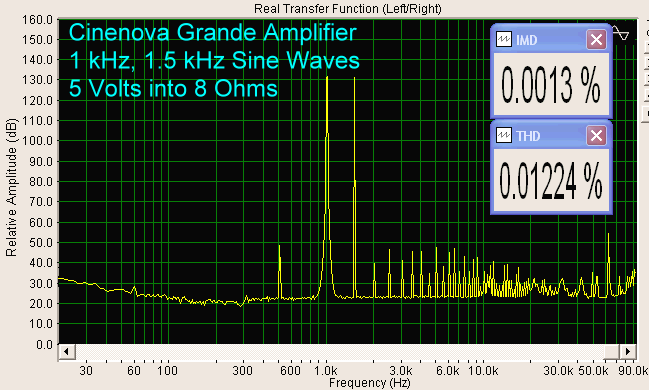
And of course, there is the Telarc SACD of Tchaikovsky's 1812 Overture (Telarc SACD-60541). This is a piece that Telarc has to warn consumers about on the disc jacket, saying that the cannons are very loud, and we should be careful when setting the playback level. Well, the playback level at the point just where the clipping lights come on the Cinenova front panel, represents loudness levels that would satisfy anyone. I can get the clipping lights to come on with any amplifier using this SACD, by the way. The transients at the front edge of each cannon shot are extremely demanding. Another great SACD album is The Film Music of Jerry Goldsmith (Telarc SACD-60433). Perhaps the most recognizable track on this album is the opener, "Star Trek: The Motion Picture", which sounded absolutely outstanding with the Cinenova in the system. Now, the Cinenova is a powerful amplifier, and it is meant to be used with powerful sound tracks. So, I bypassed the stack of Jane Austen DVDs, and went straight for the good stuff . . . you know, Mel Gibson, Schwarzenegger, Stallone, Keanu Reeves. OK, now we are talking. The Cinenova is very much at home with action films. The latest Matrix DVD (Revolutions) has a showdown between the humans and machines that will separate the 'wanna be' from the "definitely am'. Well now, the Cinenova showed that it is definitely in the latter category. On the Bench At 1 kHz and 5 volts into an 8 ohm load, THD + Noise (THD+N) was less than 0.02%. THD values by themselves (without the noise calculation) are about 1/3 of the THD+N values. In the IMD graphs, THD is shown, but not THD+N, because the software cannot calculate IMD and THD+N at the same time. Also, THD is usually the highest at the low output levels (except for when the amplifier goes into clipping). Therefore, values shown below are worst case, which is the kind of information that is most important.
IMD was a low 0.0013% using 1 kHz and 1.5 kHz sine waves.
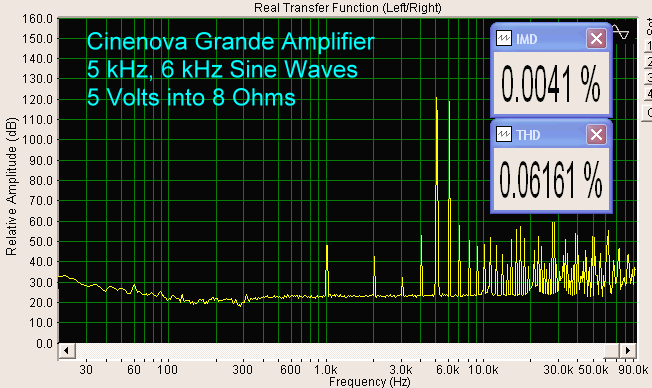
With 5 kHz and 6 kHz sine waves, IMD was a bit higher at 0.0041%, but still a low level.
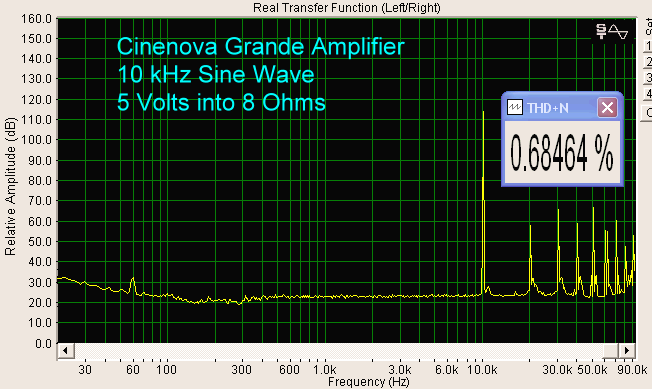
At 10 kHz, THD crept up to 0.68%.
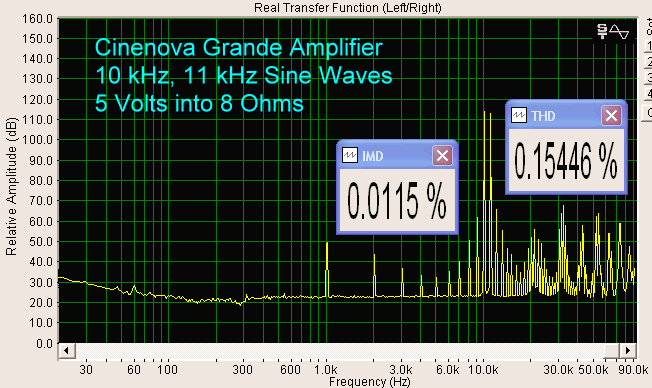
At 10 kHz and 11 kHz, IMD was still a manageable 0.0115%.
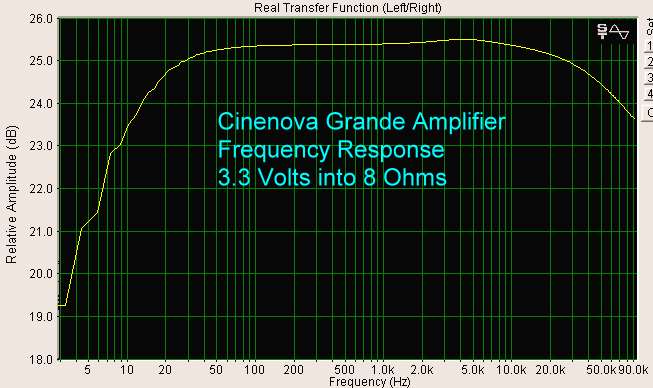
The measured frequency response was ± 0.3 dB, 20 Hz to 40 kHz.
Conclusions The Earthquake Cinenova Grande five-channel power amplifier is a weapon of mass destruction. Colossal raw power is its modus operandi. Couple the SPL that it can deliver with a slightly laid back high end, and you can entertain your neighbors down the street without them having to leave their own living room.
|
||||||||||
 If you like to play your music and movies loud, you could high-pass
all the modules at, say 60 Hz, and let your subwoofer take up the slack at < 60
Hz. This takes the load off your speakers of reproducing these low frequencies.
You could also use two modules to bi-amp a speaker - bypassing its crossover -
with one module driving the woofer and another module driving the tweeter. One
module might be set to low-pass at 1.8 kHz and the other to high-pass at 1.8
kHz, if that is the configuration in the speaker's crossover network.
If you like to play your music and movies loud, you could high-pass
all the modules at, say 60 Hz, and let your subwoofer take up the slack at < 60
Hz. This takes the load off your speakers of reproducing these low frequencies.
You could also use two modules to bi-amp a speaker - bypassing its crossover -
with one module driving the woofer and another module driving the tweeter. One
module might be set to low-pass at 1.8 kHz and the other to high-pass at 1.8
kHz, if that is the configuration in the speaker's crossover network.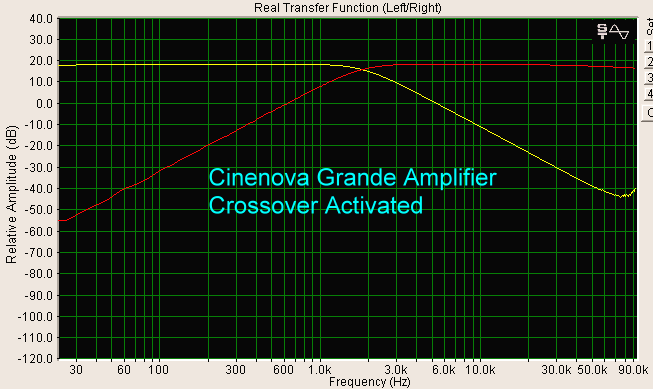
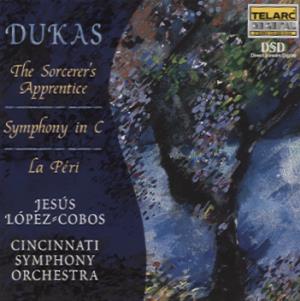 This
recording is a recent SACD release by Telarc (CD-80515-SA), and I wanted to see if the
Cinenova would keep the trumpet fanfare as clear and precise as I have heard it
with other high-end amplifiers like my BAT VK-500 and McIntosh MC-602. It did.
This
recording is a recent SACD release by Telarc (CD-80515-SA), and I wanted to see if the
Cinenova would keep the trumpet fanfare as clear and precise as I have heard it
with other high-end amplifiers like my BAT VK-500 and McIntosh MC-602. It did.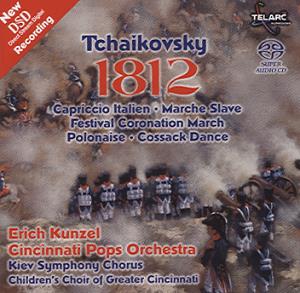 One
of my favorite string pieces is Barber's "Adagio for Strings", and I used a
recent Telarc SACD (SACD-60641) to test the Cinenova. There are violins in full
harmony, and I could distinguish them all here.
One
of my favorite string pieces is Barber's "Adagio for Strings", and I used a
recent Telarc SACD (SACD-60641) to test the Cinenova. There are violins in full
harmony, and I could distinguish them all here.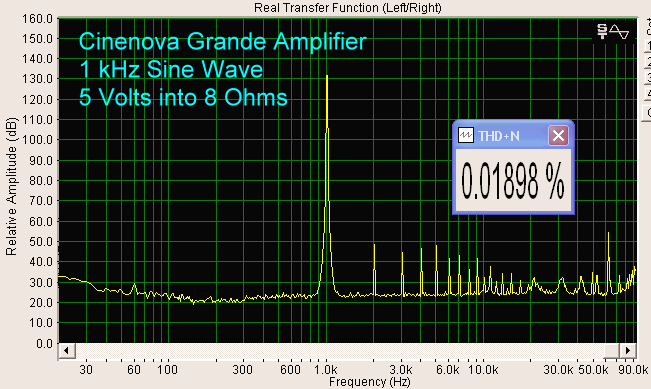





 YouTube
 Facebook
 Twitter
 LinkedIn
 Pinterest
 Google+
 Instagram
Magazine Publishing Solutions by
 Advontemedia