
Anthem Statement A5 Five-Channel and A2 Two-Channel Power Amplifiers November, 2004 Kris Deering
Introduction
As many of you know, Anthem has recently entered the higher end market with its new Statement line of products. This line includes the Statement D1 Pre-amp/Processor, which we already reviewed and loved.
Anthem has two series of power amplifiers for this new line as well: the P Series and the A Series. The P Series is the flagship of the line and offers unprecedented power requiring two dedicated power outlets! You can read more about the P Series amp with Sandy Bird�s review, coming soon The A Series also offers plenty of power but is more affordable.
The Design
The Statement A amplifiers are based on their already popular MCA series of amplifiers. There were some small changes made to the electronics, but the biggest change is in the cosmetics department.
The amps are only available in black and feature a brushed metal face with large wings on either side. The A5 has five blue lights for channel indicators on the front, at the bottom, that illuminate when the amp channels are powered up. The A2 is the same except it only has two lights (and two channels). Unlike the P series amps, the A5 and A2 have slightly different chassis from one another. They are identical in height and width but the A2 is a bit less in depth. Since the A2 only has two channels, the chassis didn�t need to hold as much stuff, so Anthem was able to put the transformer and capacitors centerline. Personally I would have preferred the two designs shared the same chassis. I am one of the people that keep amps out of a rack and instead place them on stands on the floor. Having two different sizes takes away from the symmetry of the units.
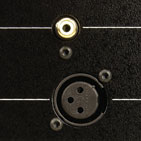 The back panel layout is
the same on both units except the A5 naturally having three more sets of inputs
and outputs.
The A series offers both balanced XLR and unbalanced RCA input connectors. The
balanced inputs are true differential inputs (pins 1 and 3 are not shorted), but the amplifier is not a fully
balanced dual differential design.
The back panel layout is
the same on both units except the A5 naturally having three more sets of inputs
and outputs.
The A series offers both balanced XLR and unbalanced RCA input connectors. The
balanced inputs are true differential inputs (pins 1 and 3 are not shorted), but the amplifier is not a fully
balanced dual differential design.
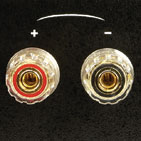 The
binding posts are three way designs and very robust. They offer plenty of room
in between each post for larger cables and access. My only complaint here was
the lack of locking clips for the XLR inputs. I have noticed this with all of
Anthem�s designs and I haven�t been able to figure out why they have omitted
them. Without the locking tabs it is pretty easy to knock the connector out of
the jack and thus defeats one of the benefits of XLR. (Editor's Note: XLR
locking tabs are only on input jacks. For outputs, the locking tab is on the
cable. The lack of tabs on XLR input jacks is actually quite common, but I agree
that they are desirable, as the "click" that you hear when the plug is fully
inserted into the XLR jack is very reassuring. To remove the cable, you depress
the tab and pull the cable plug out.)
The
binding posts are three way designs and very robust. They offer plenty of room
in between each post for larger cables and access. My only complaint here was
the lack of locking clips for the XLR inputs. I have noticed this with all of
Anthem�s designs and I haven�t been able to figure out why they have omitted
them. Without the locking tabs it is pretty easy to knock the connector out of
the jack and thus defeats one of the benefits of XLR. (Editor's Note: XLR
locking tabs are only on input jacks. For outputs, the locking tab is on the
cable. The lack of tabs on XLR input jacks is actually quite common, but I agree
that they are desirable, as the "click" that you hear when the plug is fully
inserted into the XLR jack is very reassuring. To remove the cable, you depress
the tab and pull the cable plug out.)
For powering up the
amplifiers, Anthem has given the end user a few different choices. On the back
panel is a small toggle switch that gives you the option of a normal switched
power up,
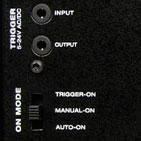 an automatic power up when the amp receives a signal, or a trigger
option. There is also a reset switch for the internal breaker. The Statement
amps do not use a normal fuse but instead use an AC line breaker.
an automatic power up when the amp receives a signal, or a trigger
option. There is also a reset switch for the internal breaker. The Statement
amps do not use a normal fuse but instead use an AC line breaker.
The amplifier channels are directly coupled and do not have any DC fuses on the rails. This is one of the bigger changes from the MCA series which included fuses on the rails. I have heard lots of complaints from consumers about fuses in amplifier designs, especially when the amplifier uses a 10 amp fuse but is designed for a 15 amp circuit. This chokes the amplifiers total output capability by limiting the current input from the wall.
The Statement amplifiers rely on current, temperature, and voltage monitoring for safe operation. When the electronic monitoring internal to the amp senses that the issue has cleared, operation resumes as normal. During my time with the amplifiers, I did not run into any problems with this, meaning that the amplifiers had plenty of power to spare in my tests.
Peeking under the hood of both amplifiers, I found the layout to be very clean, with each channel essentially having its own module. These modules are not monoblocks though since the A5 shares two transformers between its five channels and the A2 uses only one, otherwise the channels are identical. Each channel has eight bipolar output devices allowing for more current output and a cooler design. The heat sinks are incredibly large for each channel and do a great job of dissipating heat. I have had these amps running for almost two months now and never turn them off. They never got more than comfortably warm to the touch.
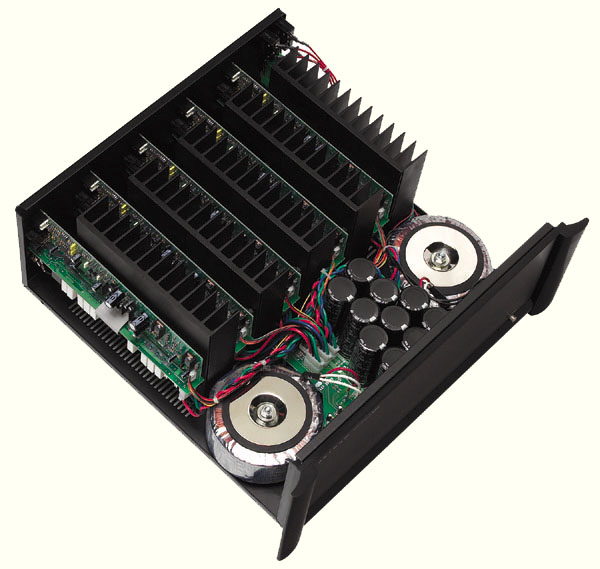
The A series amps have plenty of muscle. Each channel features 30,000 microfarads of capacitance! In comparison, most high end receivers have that much for all channels combined!! This is why separates can have a clear advantage over an all-in-one design, assuming of course that you are willing to pay the cost difference (capacitors are an expensive component). The A series is a direct coupled amplifier with no capacitors at the output, lending to a more authoritative sound in the lower end (some amplifiers have to put a capacitor at the output to eliminate DC, and sometimes an inductor to eliminate RF going to the speakers).
For power output the A5 is rated at 180 watts rms continuous per channel, all channels driven full range, with an 8 ohm load. Because the A2 has the same transformer but only two channels driven, the output is rated a bit higher at 200 watts per channel. For my reviewing purposes, the amplifiers were driving a 4 ohm load and showed no signs of hesitation or fatigue.
As I mentioned before, the A series is based largely on the popular MCA series of amplifiers. Both amps feature the unprecedented signal to noise ratio of 120 dB! The A series has a slighter faster slew rate than the MCA amps, but this was the only difference I could find on the specification sheet.
The Sound
Needless to say the Anthem specs are impressive by any standards, but that doesn�t mean much without a great sound. I had heard some opinions on the amps from several sources long before I received them. Unfortunately those opinions were all over the board ranging from �a bright amplifier� to �stunning�. However, I know that every configuration is different so I was anxious to hook the amps into my own setup.
For this review the A5 and A2 were combined with my Anthem Statement D1 processor (SSP) and a Denon DVD-5900 DVD player. For loudspeakers I used five Onix Reference 3 loudspeakers and a pair of Paradigm Signature ADP surrounds. All speakers were set up with an 80 Hz crossover in the processor.
I didn�t perform any break-in for the amps. I have had them powered on for close to two months now continuously and haven�t noticed a change in their sonic signature. The amps were used a minimum of about two to four hours a day for both movies and music. The A2 powered the main left and right channels, and the A5 powered the rest.
In the last year I have had the opportunity to review some great offerings in this price range. These include the Krell Showcase, Aragon 2007 and Sunfire Signature 7. Each of these amps was slightly different then the other but all were great amps in their own right. The Anthem A Series easily adds itself to this list.
 The strong point of the
Anthem is its beautiful musical nature. Despite the fact that I am the DVD
Player Benchmark Editor here at
Secrets, my theater usage is probably about 60% music and 40% theater. Music has
been a passion of mine for as long as I can remember, and I have always looked
for ways to improve its reproduction in my home.
The strong point of the
Anthem is its beautiful musical nature. Despite the fact that I am the DVD
Player Benchmark Editor here at
Secrets, my theater usage is probably about 60% music and 40% theater. Music has
been a passion of mine for as long as I can remember, and I have always looked
for ways to improve its reproduction in my home.
The synergy between the Anthem amps and the Onix speakers was incredible to say the least. The noise floor was astonishing quiet, increasing the dynamics I was used to with the Aragon amp. Even with all of my equipment on there was nothing coming out of the speakers as far as noise, regardless of the volume setting on the preamp. The amplifiers were also dead quiet with no mechanical hum at all from the transformers. This was an issue that I had with some other amplifiers in the past. This type of silence is a necessity for critical listening as it helps establish soundstage and depth. When an instrument just seems to come from empty space, it is an incredible experience. When I can hear the slight noise of the music hall or studio, I know I am getting a great presentation. These amps delivered this brilliantly.
My music tastes change day to day and I truly believe that anything I review should do well with any genre I throw at it. I don�t like equipment that caters to a specific genre (e.g., boom boxes) since my taste doesn�t. Whatever music I threw at the Anthem gear, it delivered in spades. Early in the review I really needed to do some comparisons with the AVM-20 and D1 since the sonics changed considerably with different music. The D1 added a level of refinement, especially with stereo playback, that I wasn�t getting with the AVM-20 and I wanted to be sure that this wasn�t overshadowing any changes the amplifier was bringing into the picture. The A5 performed as a transparent link between the processor and speakers, which is exactly what I expect from an amplifier.
I tried to throw as much dynamic music as possible at the Anthem power amplifiers. I used a lot of big band material and aggressive industrial riffs. Again the amps were completely transparent in their delivery of power when needed. I never felt that the amps were holding anything back in the presentation. The A Series reminded me a lot of the Krell Showcase amp in this regard. The Krell did a spectacular job with handling the lower end dynamics when running speakers full range. The Anthems also did a phenomenal job with this. I used some very aggressive bass tracks from Tweaker, A Perfect Circle, and The Crystal Method, and the Anthems never showed any signs of running out of steam.
Moving on to movies proved once again that these amps deliver the goods. Some highlights included Master and Commander, Underworld, House of Flying Daggers, and Hellboy. Regardless of volume levels, the Anthem amps didn�t seem to show any sign of fatigue and always offered a transparent soundstage.
Watching the "Echo Game" sequence in The House of Flying Daggers is one of those rare treats since it is a combination of riveting sound design, musicality, and sheer dynamics. It is a very percussion-heavy sequence that has a lot of low- end impact, mixed with sharper snare notes. The Anthem delivered all the dynamics with a musical grace that was effortless and very convincing. The silent noise floor only increased the dynamics, making this a scene that can be a bit unsettling in its intensity.
The same can be said for the amazing drum showdown that is in the final scenes of Drumline. I have heard this on price no object systems consisting of high-end monoblocks, and the Anthems showed that they didn't need to make any apologies in terms of sheer ability and musicality. This is definitely one of those rare scenes in a film that can point out shortcomings in almost any area of your setup.
For just raw blow you out of your chair and wake up the neighbors soundtracks, look no further then the Superbit edition of Underworld. It has an extremely aggressive soundtrack that makes the most of the entire surround system. Using the Dolby Pro Logic IIx enhancement of my D1 SSP, I was able to branch out the exciting surround soundstage even more and really give the amps a workout. The soundtrack starts right into the thick of it with a very cool sound design, even in the opening title. Every nuance is presented wonderfully by the A Series. From the detail of the thunderstorm to the madness of the shootout in the train station, it is all at blistering levels.
Conclusions
The job of an amplifier is simple, take the signal in and amplify it to the level needed for playback. The main problems I see from bad amps are a lack of power capability, especially in the low end, and an obvious sonic signature. The A5 and A2 had no problems at all in either of these categories and offered tremendous performance. Regardless of whether you are a music or movie fan, the Anthem Signature A Series amplifiers offer outstanding value and performance.
- Kris Deering -
Reference Equipment Used For This Review:
Anthem Statement D1 PreAmp Processor
Aragon 2007 THX Ultra 2 Power Amplifier
Denon DVD-5900 Universal DVD/CD Player
Onix Reference 3 Loudspeakers
Paradigm Signature ADP surrounds
SVS PB-2+ and Dual CS 25-31 Subwoofers
Behringer Feedback Destroyer Pro Parametric EQ
Exact Power EP-15A Voltage Regulator
B-P-T 2.5 Balanced Power Transformer
Bettercables, Blue Jeans Cable, and Onix Reference Interconnects
Onix Reference SP-200 Speaker Cable



 YouTube
 Facebook
 Twitter
 LinkedIn
 Pinterest
 Google+
 Instagram
Magazine Publishing Solutions by
 Advontemedia