
|
||||||||||
|
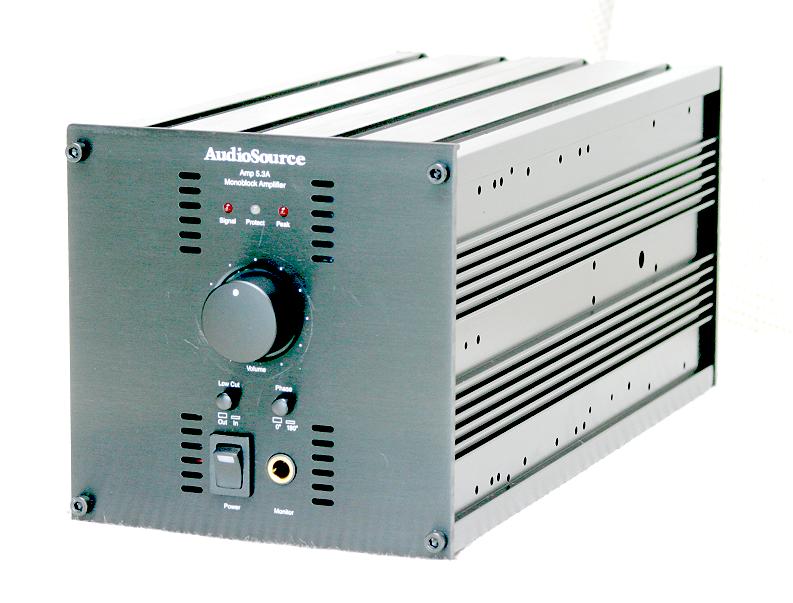
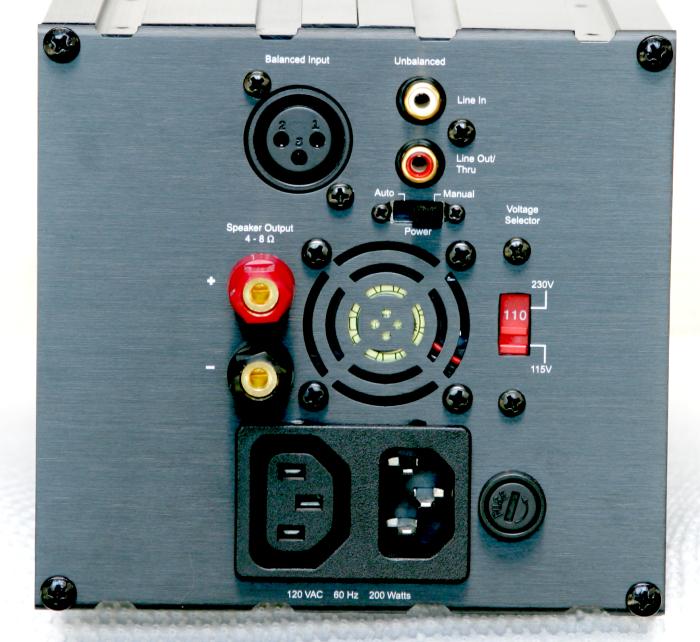
Introduction Many of us have low cost surround sound receivers that don't supply a lot of power. Often, they do have pre-outs for the various channels, and because the center channel delivers most of the sound, an easy and inexpensive upgrade would be a single channel power amplifier connected to the center pre-out. Unfortunately, typical outboard power amplifiers are stereo or five-channels. Monoblocks usually are quite expensive, because the majority of them are high-end products, such as tube monoblocks or high powered units that are two heavy to be manufactured as more than one channel. The Design Enter the AudioSource Amp 5.3. It is an ideal upgrade for the center channel on that lightweight receiver because it supplies 150 watts into 8 Ohms (more than a typical small mass market receiver), it has its own volume control that can account for any difference in sensitivity between itself and the receiver's amplifiers, and it has a low frequency cutoff (below 100 Hz) for use with small center channel speakers. It is also rated into 4 Ohms, which just about every small mass market receiver is not. This particular model has XLR as well as RCA input jacks, auto turn-on (senses input signal), and a phase inversion button. It is small and modular, and is inexpensive (MSRP $349.95, street price on the Internet is $262). The front panel has the on/off toggle, volume knob, low cut button, phase button, and peak output indicator. The rear panel of the 5.3 has quite a number of features for an inexpensive monoblock. At the top are the XLR and RCA input jacks, as well as a Line-Out/Thru RCA jack if you wish to daisy chain several power amplifiers. There is a slider switch for selecting Auto-on or Manual power-on. If you live in Europe, you can use it by switching to 230 Volts. The AC socket is grounded with detachable cord, and the speaker binding posts are good quality.
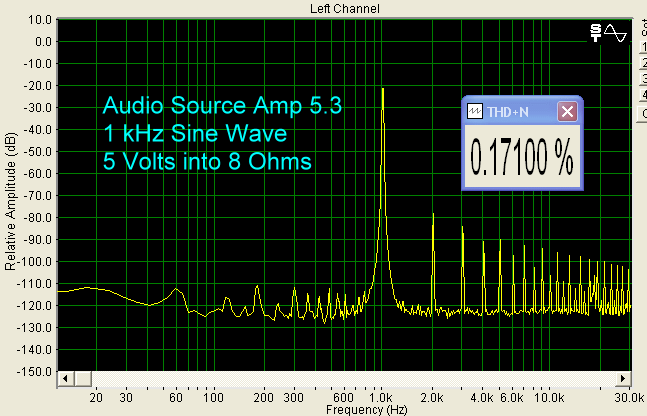
In Use I tested the 5.3 with our Theta Casablanca II, and the amplifier drove a Monitor Audio Studio 20SE speaker as the center channel (8 Ohms). A Rotel RMB-1095 power amplifier drove the remaining channels. I used the RCA unbalanced input for listening and for the Bench Tests below. The Amp 5.3 had no problem handling the sound tracks that I threw at it, including "Pearl Harbor", especially when I used bass management to eliminate everything below 50 Hz in the center speaker. Most new receivers, including the entry-level ones, have bass management, so I would suggest using it to maximize the efficiency that the amplifier will have in driving the speaker, especially since typical center speakers don't have large drivers. There is no sense in delivering low frequencies to a driver that can't move the air, but which will still eat up the current anyway. I did not use the Low Cutoff button on the amplifier, because I was already controlling the bass management from the Theta processor. Also, the Monitor Audio speaker has a good response to 50 Hz, do I did not want to cut it off at 100 Hz. The sound quality was smooth, and in general, a bit smoother than what you find in the amplifier sections of small mass market receivers. On the Bench The 5.3 is rated at THD < 0.1%. Our tests showed slightly higher than that, at 0.17% when outputting 5 Volts into an 8 Ohm load.
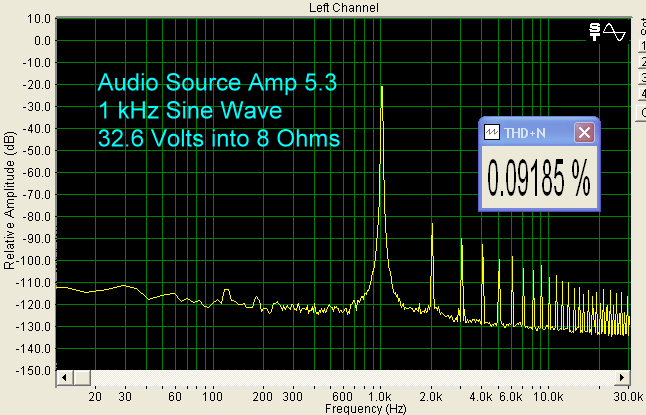
At full output into 8 Ohms (32.6 Volts was the maximum we could get, which translates to 133 Watts RMS), distortion was within spec, but the power output was a little below spec.
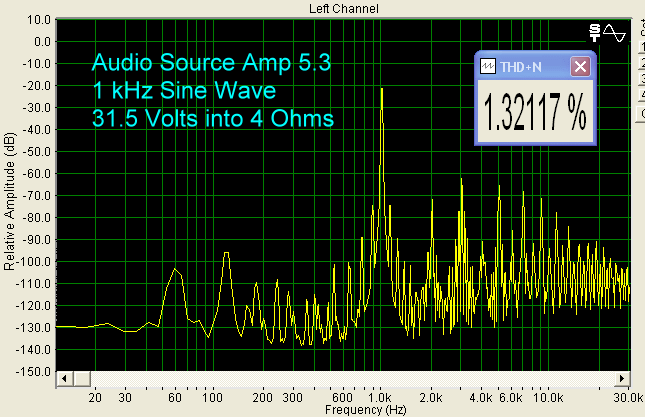
When driving a 4 Ohm load, and just going into clipping, the Amp 5.3 delivered 31.5 Volts, which is 248 Watts, almost right on the specification.
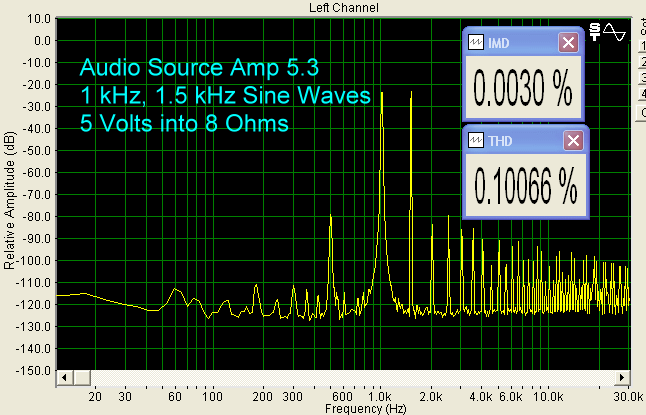
IM distortion, using 1 kHz and 1.5 kHz, was a very low 0.003%, at typical power levels.
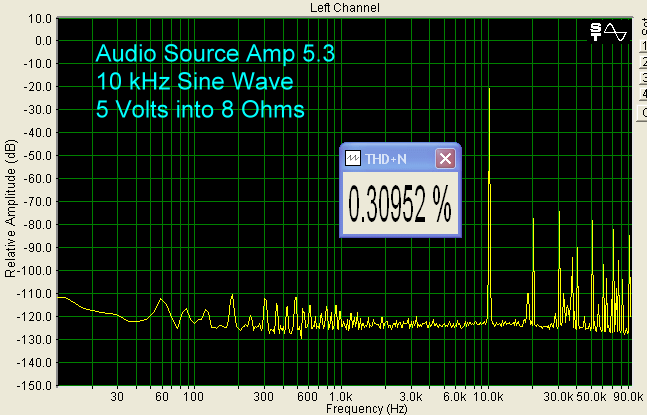
THD for a 10 kHz sine wave input, was higher than spec, but still manageable.
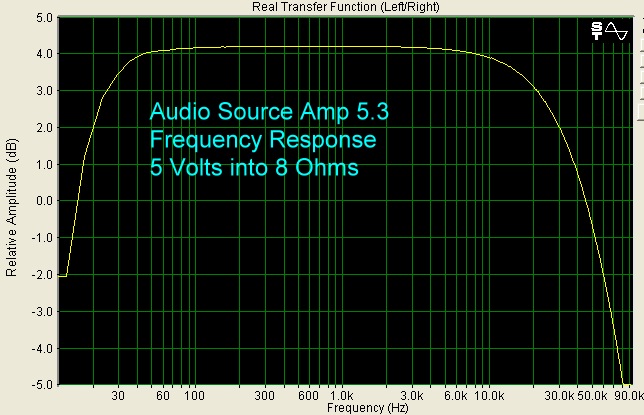
The frequency response of the Amp 5.3 rolls off below 50 Hz and above 10 kHz, but is within spec of ± 1 dB from 20 Hz to 20 kHz.
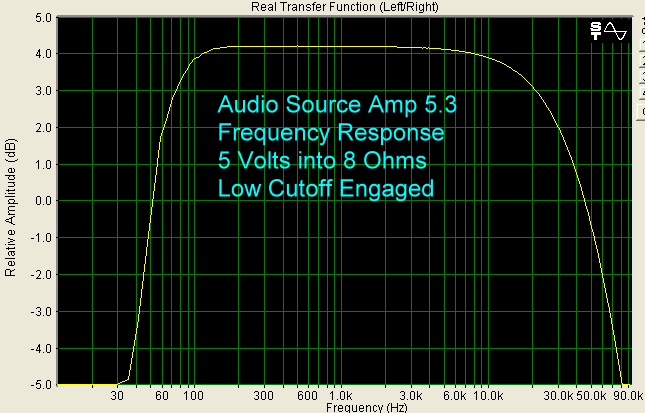
Engaging the Low Cutoff button results in steep roll-off below 100 Hz. This would be ideal for small speakers, but don't use both the bass management in the receiver and the low cutoff button on the amplifier at the same time.
Conclusions For those of you with small receivers who would like to get more "oomph" out of your system without going to an outboard power amplifier for all channels, the AudioSource Amp 5.3 is an easy and inexpensive solution, by using it to drive the center channel. It is very flexible, and has all the connections and features that you would ever need for this purpose.
|
||||||||||





 YouTube
 Facebook
 Twitter
 LinkedIn
 Pinterest
 Google+
 Instagram
Magazine Publishing Solutions by
 Advontemedia