
|
||||||||||
|
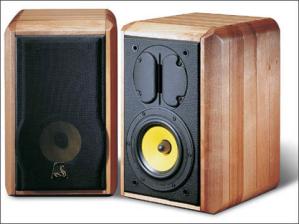
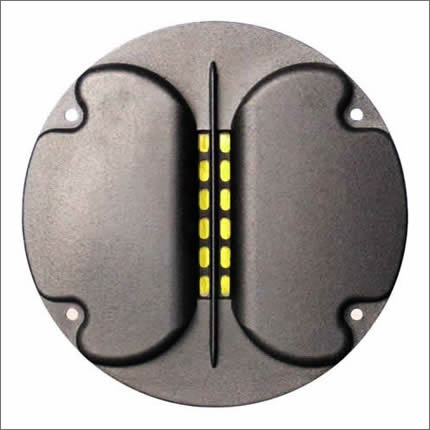
Introduction The people from Swans have made a name for themselves in the realm of high value small speakers. Originally a company that sold drivers and speaker kits, Swans now sells several models of complete loudspeakers. The Swans M1 is their top of the line bookshelf, also called a mini-monitor. All Swans speakers are made in China by Hi-Vi Research, a company specializing in driver design and manufacture. Swans still sells kits and drivers, but now places complete speaker systems at the forefront of their operation. Speakers like the Swans 2.1s have a cult following among value minded Internet audiophiles. The M1 is a significant step up in technology and price from the $495 model 2.1, showcasing Hi-Vi's planar ribbon tweeter technology. I was excited to have these speakers for review, from the moment I unpacked them. Fit and Finish Each unit weighs more than 17 pounds and is only 13 x 8 x 11 inches in size. The sculpted cabinet looks very elegant, with routed details on the top, sides and bottom of the case, with rounded edges and a beveled front face. The front panel of the speaker is covered with black pebbled leather (real) like a pair of quality binoculars. The cabinet is 1” thick MDF with Asian Oak veneer. The subdued satin finish is a nice change from the flashy gloss on some high end speakers. The smooth black rear panel has a pair of five-way binding posts of good quality that can accommodate large gauge cable lugs. A flared port is also on the rear. The drivers are the heart of the M1, and Swans is equipped with the best of Hi-Vi's developments. The RT1C-A tweeter uses a Kapton planar ribbon driver in a linear configuration with neodymium bar magnets. As expected with a ribbon design, frequency response is extended well beyond 20 kHz. The tweeter is mounted in a solid, cast aluminum frame.
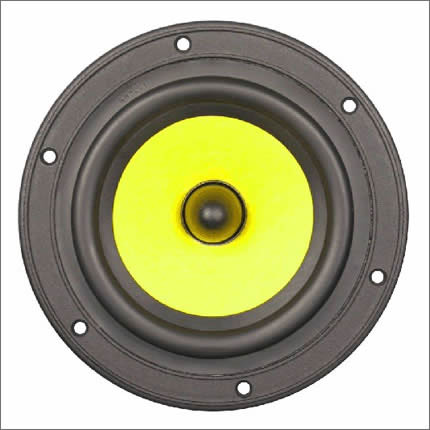
The woofer has a 5” Kevlar/Paper cone with a central phase plug in a massive aluminum basket, along with a large magnet. Each woofer weighs over 3.5 pounds. The resonant frequency of the driver is around 50 Hz, pointing to a bass extension in a vented enclosure in the upper 40 Hz range. The sensitivity of the system is a rather low 86 dB at 1m with a 2.83V input, but with an easy to drive impedance only dropping below 8 Ohms at around 2 kHz. All in all, these seem to be nicely designed, well made loudspeakers.
The Sound I initially left the speaker position and toe-in the same as the Solos. The first thing that struck me, even from a completely brand new state was the effortlessly extended, transparent, and smooth treble. The RT1C-A tweeter really delivers. At first the midrange and bass sounded a bit coarse and lacked focus. My system is used for home theater as well as audio, including every-day TV watching. This gave consistent use every day for several hours for break-in purposes. It took several weeks of use for the M1s to fully break in. After adequate break-in (I estimate over 200 hours at low to moderate volume levels), the midrange coarseness and lack of focus all but disappeared. Bass extension was limited to around 50 Hz, but with very good control, tonality, and agility. The speaker also matched well to my Rel Strata II subwoofer with the crossover frequency set to 49 Hz, giving the setup extension to below 25 Hz in my room. Aided by the superior tweeter, the imaging focus was sharp, especially with high frequency transients. The speaker liked to be toed in towards the listener more than the Solos. This toe-in reduced the soundstage width, but improved image and soundstage focus. Overall, the soundstage presentation was rather forward, generally at my normal listening position or slightly closer. I prefer a more distant soundstage to increase perceived space, but that is a personal preference of mine. With well recorded material, the M1s succeeded in performing the mini-monitor trick of disappearing, leaving the soundstage floating free of any attachment of the speakers. Compared to the Solos, the midrange smoothness was not as good, with some lesser recordings sounding a little coarse, and with an overall loss in liquidity. Treble, however, was superbly extended and weightless. Switching back to the Solos, I welcomed the midrange smoothness, but missed the effortless treble extension and liquidity. When reproducing loud, complicated passages, the Solos tend to dynamically compress, and lose some soundstage focus. The M1s never wavered, regardless of the complexity of the passage, but the overall focus of the soundstage never matched the Solos at their best. One clue to this slight problem is in the cabinet resonance. While certainly well made, the cabinets did ring slightly when rapped with my knuckle, with my ear pressed against the cabinet side. The larger and more massive Solo enclosures mustered a dull thud given the same treatment. Maybe increased bracing in the cabinets would improve
stiffness and lower the amplitude of the remaining vibrational modes.
Stored energy in the cabinets at midrange frequencies could account for
the slight shortcoming compared to the twice as expensive Solos. This is
not to say the M1s were bad; far from it. They just didn't make me want to
replace my trusty Solos just yet, although I do miss that treble. For the
price, there is a lot of positive about the M1s, and only a little of the
negative. For an audiophile on a budget looking for a small speaker
that does most everything right, the Swans M1 should certainly be on the
short list to audition. Not only do they have spectacular, effortless
treble, very good imaging, soundstaging, and a neutral tonal character,
they do it with build quality that far exceeds what you normally get for
under $1000/pair. Only when compared to much more expensive competition do
they falter, and careful matching to their associated electronics could
minimize even these small shortcomings.
|
||||||||||





 YouTube
 Facebook
 Twitter
 LinkedIn
 Pinterest
 Google+
 Instagram
Magazine Publishing Solutions by
 Advontemedia