 YouTube
 Facebook
 Twitter
 LinkedIn
 Pinterest
 Instagram

Introduction
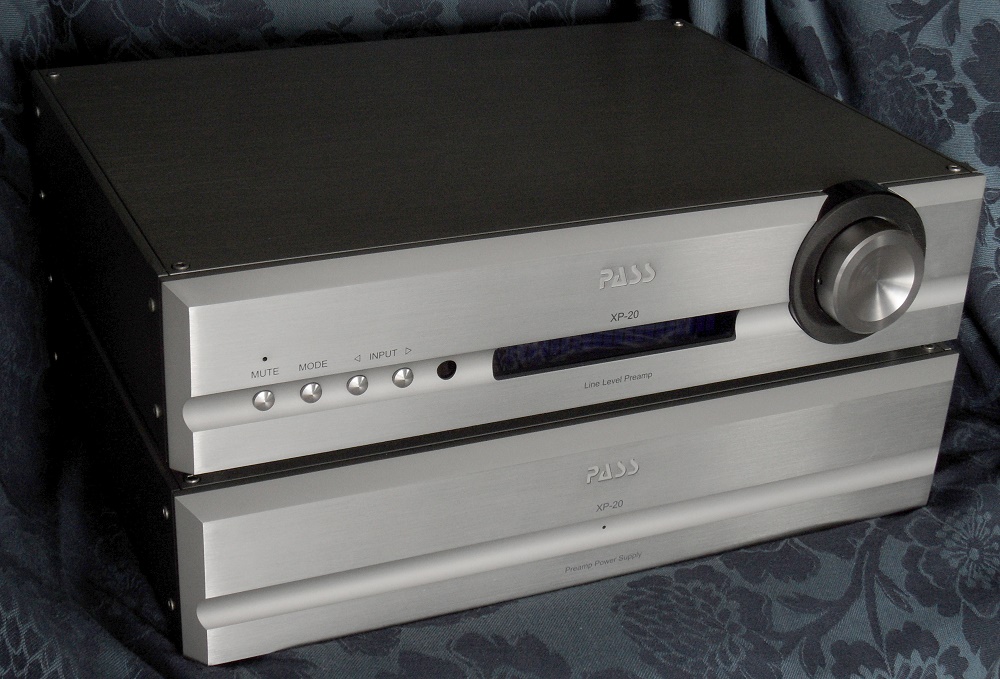
After having tested a Pass power amplifier and phono preamplifier, I could not wait to get my hands on a preamplifier, to complete the system analysis. The subject of this review is the venerable XP-20, which has been in the Pass inventory since 2009. It’s a fully balanced design, with separate power supply chassis for low noise. The bench test results were quite surprising. Read on to see for yourselves.
Specifications
- Design: Fully Balanced Stereo Preamplifier
- Maximum Voltage Output: 34 Volts into 100 kOhms
- MFR: 2 Hz – 60 kHz, – 3 dB
- Inputs: XLR and RCA
- Outputs: XLR and RCA
- Input Impedance: 96 kOhms XLR, 48 kOhms RCA
- Output Impedance: 100 Ohms XLR, 50 Ohms RCA
- Dimensions: 4″ H x 17″ W x 12″ D (Each Chassis)
- Weight: 40 Pounds (Both Chassis Together)
- MSRP: $8,600 USA
- Pass Labs
The Design
Pass states that the XP-20 is a significant improvement over the previous XP-10, adding more detail and weight to the deep bass. The former is due – as evidenced by the IMD bench test – to a vanishingly low IMD, while the latter is due to a more substantial power supply.
There are two gain stages, biased into Pure Class A, with a driver in between, resulting in no phase inversion at the output. This also keeps the signal path as short as possible.
The front panel has buttons to select the input, an LED readout panel for indicating the status of the preamp, including the volume, which is indicated in numbers.
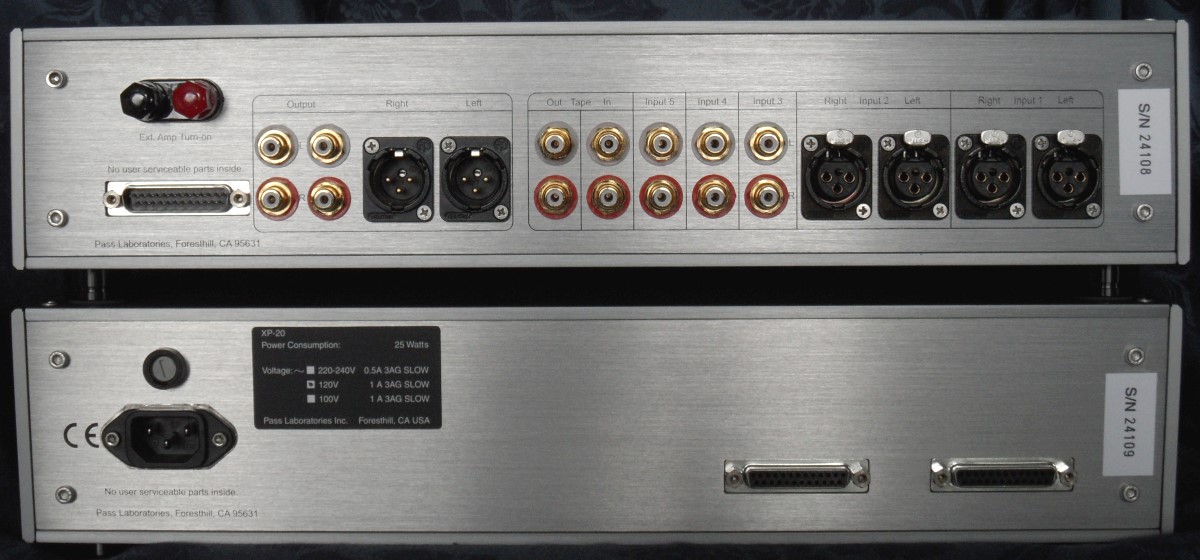
The rear panel has two sets of XLR (balanced) inputs, three sets of RCA (unbalanced) inputs, a tape loop, one set of XLR outputs, and two sets of RCA outputs. There is also a DB-25 connection and an included cable to connect the power supply.
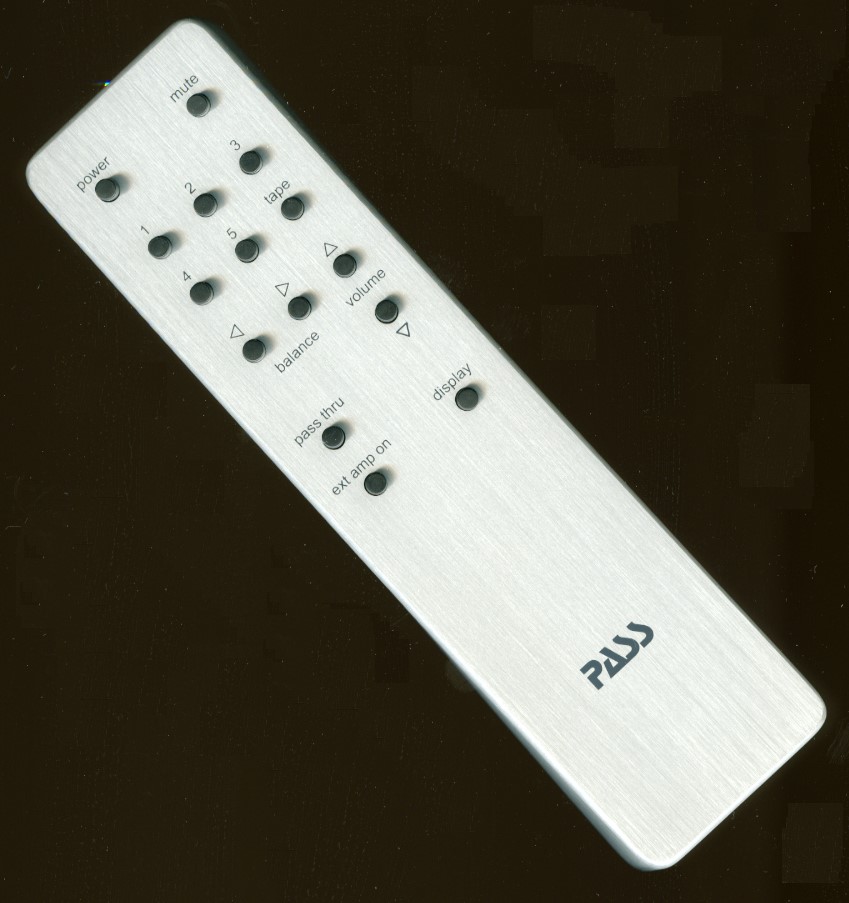
The remote control is routed from a single block of aluminum and matches the elegance of the preamplifier. It has the necessary features of power on/off, input selection, mute, volume, balance, pass-through (for multi-channel home theater use), and the ability to turn a power amplifier on as well as turn the preamplifier display on or off.
In Use
For the listening tests, I used an OPPO BDP-95 universal player, Classé CA-M600 monoblock power amplifiers, and Carver Mark IV ribbon speakers. Cables were Emotiva, Marc Audio, and Legenburg.
I was totally unprepared for the amount of detail that was presented to me in the music I played using the XP-20 preamplifier. It is none of that “There was more air around the brass,” or, “the background was blacker,” kind of thing, which are simply prosaic ways of saying there is less distortion, and in particular, less IMD. It was simply that absolutely every nuance was audible. When you look at the bench tests, you will see why.
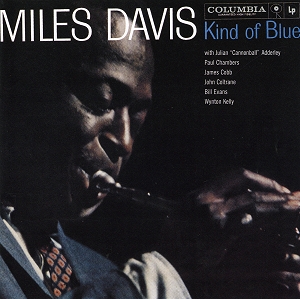
Even this classic Miles Davis jazz album that was originally released as an LP, and subsequently re-issued on 45 RPM LP, CD, and SACD (the version I listened to) delivered incredible detail. Brass is notorious for being harsh when there is significant distortion, but Mile’s trumpet was as smooth as silk. The sticking on Jimmy Cobb’s cymbals had the kind of detail I am used to when playing my own cymbals. Just when you think you have already heard everything the recording has to deliver, you discover something new. Wow!
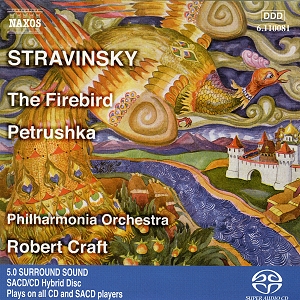
Stravinsky’s Firebird is not exactly background music, and the XP-20 brought it even more forward. Just abolutely amazing. It’s wonderful to be able to hear every instrument separate from all the others, rather than sounding like they slightly overlap, due to the mushiness produced by distortion products. There are some sections in this piece where the full orchestra is going at it, and I think even the stage hands must have been playing harmonicas and kazoos. I heard it all.
I tend to visualize scenes in my imagination when listening to music, and in Track 1 (“Introduction”), I visualized a submarine lurking below the surface of the Atlantic in 1941, and seeing a target, prepares the torpedoes to attack the ship. If the music sounds mushy, I have less visualization. It’s cloudy, as the music is not crisp and clean. Well, I could hear the Captain requesting the bearing of the target, and shouting, “Fire 1.” Great visualization. Wonderful preamplifier.
Now here is an album to test the bass capabilities of your audio system. I have plenty of power and big speakers, but a preamp with a weak power supply would roll off the low end. I heard every rumble, thump, and bass drum pounding away. Nope. No shortage of preamplifier drive capability here.

Pipe organ is the ultimate deep bass test, and Bach is King of the Organ Music Composers. The low pedal tones rattled the studs in my wall. Again, the power supply of the XP-20 stood the test.

On the Bench
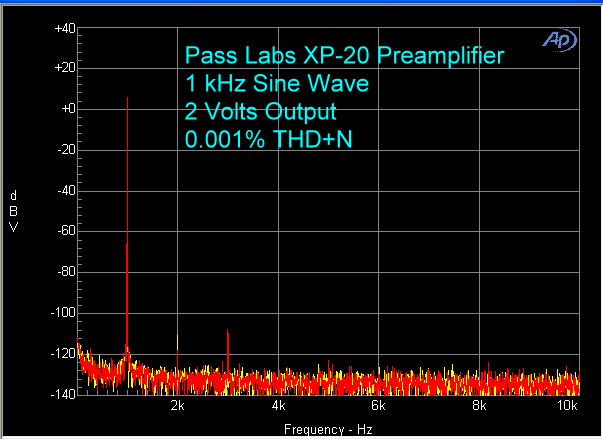
Distortion measurements were taken using the XLR inputs and outputs, and were made within an 80 kHz bandwidth.
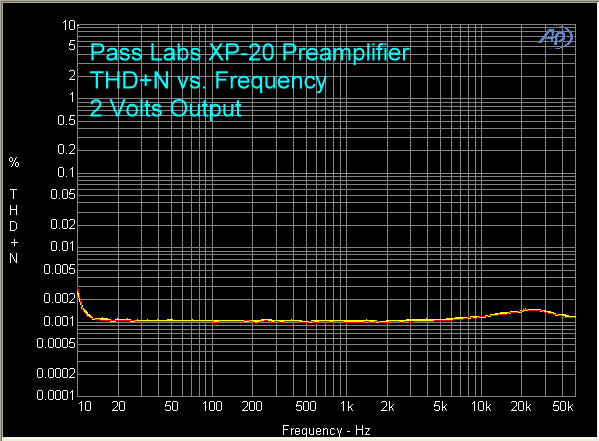
A 1 kHz sine wave test signal resulted in only 0.001% THD+N at 2 volts output.
Using a combination of 19 kHz and 20 kHz sine waves, the B-A peak at 1 kHz was 118 dB below the fundamentals.
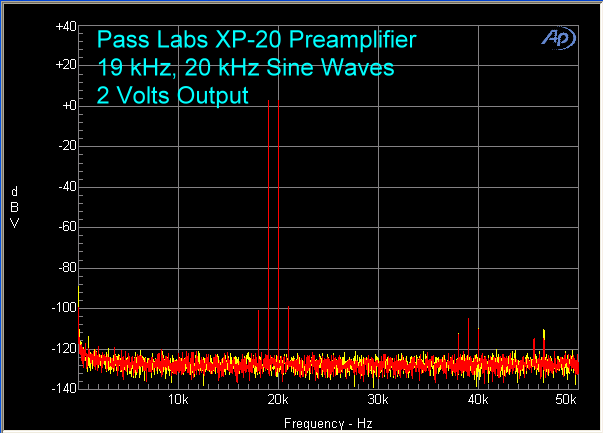
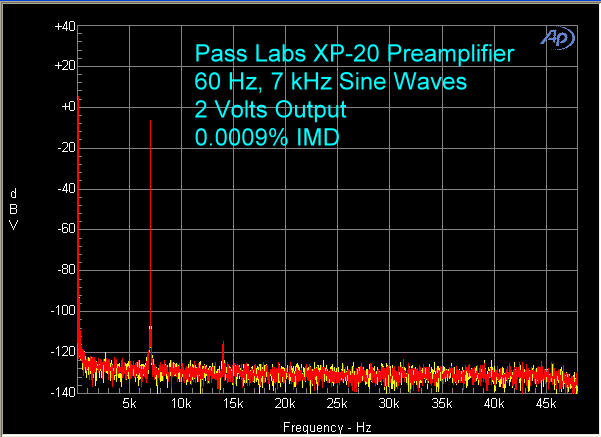
There was only 0.0009% IMD at 2 volts output, which is the lowest IMD we have ever measured on a preamplifier. This was responsible for the incredible amount of detail that I heard in the recordings.
IMD is an insidious infection of the music. It produces more damage than simple harmonic distortion. Here’s why. Let’s say you have a trumpet playing a single note at middle C and an oboe playing an E at the same time. Each instrument will have a fundamental frequency and harmonics that create the sound of the instrument. In the audio system, each of those fundamentals and harmonics produced by the instrument will have harmonics produced by the preamplifier, amplifier, and speakers. Those harmonic distortion peaks could be counted if you like. But, with IMD, what happens is all the harmonic distortion peaks interact with the other distortion peaks, creating additional distortion peaks that represent the sum of two peaks, and the difference between the two peaks (the lower one subtracted from the larger one). And, those interaction peaks, then interact again, with each other, and with other harmonic peaks. So, theoretically, you can have an infinite number of IMD peaks. The results? Mushy sound where instruments seem to be blending with one another rather than remaining distinct. The IMD measurement in the Pass XP-20 was a revelation for me, as I have heard preamps and power amps with 0.001% THD+N, but never a preamp or power amp with an IMD less than 0.001%. I conclude a direct correlation with the stunning detail I heard in the recordings with that low IMD.
THD+N was less than 0.002% all the way out to 50 kHz. Superb!
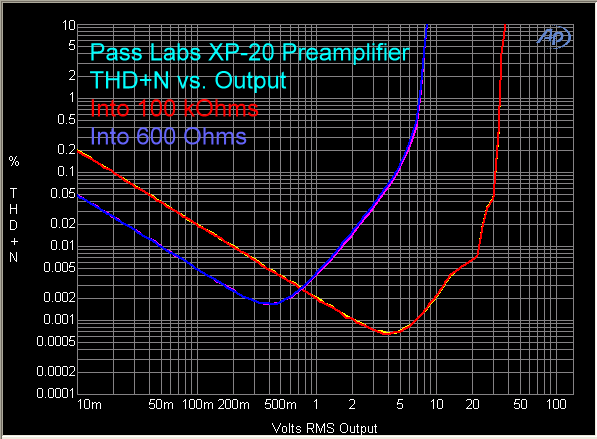
With a 100 kOhm load, the sharp knee (the practical output limit) was at 4 volts RMS. Output at clipping (1% THD+N) was at 34 volts.
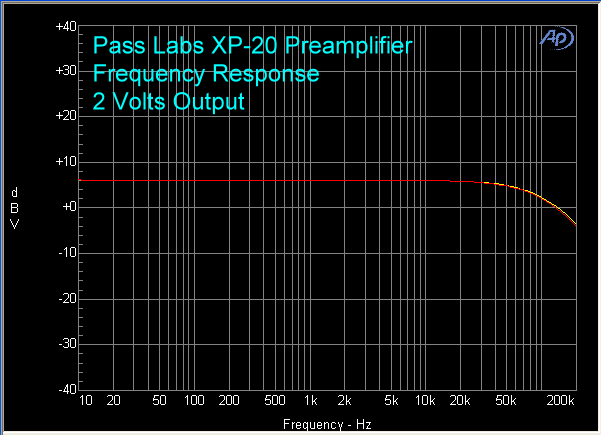
The frequency response was down 3 dB at 60 kHz as per the specification. In the audible band, the frequency response was 20 Hz – 20 kHz, – 0.2 dB.
Conclusions
The XP-20 is truly an amazing product, and in my opinion, it’s one of the finest preamplifiers in the world. The vanishingly low IMD results in astonishing detail that is unmatched by any preamplifier I have ever tested. It is so evident, you actually have to get used to hearing such a tremendous improvement in your music collection. Tube aficionados probably would not like this preamp, unless paired with a tube power amplifier, but for solid state fans, it will be love at first audition.
See Also Similar Preamplifier Reviews