 YouTube
 Facebook
 Twitter
 LinkedIn
 Pinterest
 Instagram


Introduction
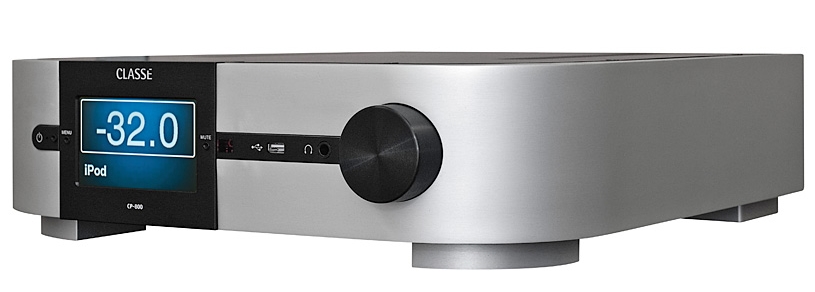
Classé’s new CP-800 is a high performance (“High-End”) stereo preamplifier, but it is not just yet another preamp with minor changes from previous models. This one has the option of switching in some DSP that adds several EQ bands and dedicated stereo subwoofer outputs. If you don’t use the DSP, it’s not in the signal path, and you can still call yourself a “purist” audiophile. Have no doubts; this is a very unique product, and the performance is stellar.
Speaking of switching, the CP-800 uses a switch mode power supply. Now, I know a lot of audiophiles rail against the idea of “switching” components, and I have been one of those people. But, switching technology has improved at an accelerating rate over the past few years, and it appears to be ready for prime time.
Specifications
- Design: Preamplifier, Switch Mode Power Supply, Class AB Output Stage
- Maximum Output Voltage: 18 Volts XLR (Balanced), 9 Volts RCA (Unbalanced)
- MFR: 8 Hz – 200 kHz ± 1 dB without DSP; 20 Hz – 20 kHz ± 0.1 dB with DSP
- THD+N: 0.0005% without DSP, 0.002% with DSP
- Input Impedance: 50 kOhms XLR, 100 kOhms RCA
- Output Impedance: 300 Ohms XLR, 100 Ohms RCA
- Inputs: (Digital) 1 XLR, 3 Coax, 4 Optical, 2 USB; (Analog) 2 XLR, 3 Coax; Ethernet, RS-232, Trigger
- Dimensions: 4.8″ H x 17.5″ W x 17.5″ D
- Weight: 23 Pounds
- MSRP: $5,000 USA
- Classé
- SECRETS Tags: Classe, Preamplifiers, Switch Mode
The Design of the Classé CP-800
The front of the CP-800 has an on/off button (standby), with the main power on/off toggle on the rear. There is an LCD panel that shows the volume level, but also has a menu for you to select DSP options, such as the frequencies where you would like to decrease the level (such as a room mode). The volume control dial is huge, which I like, because I have big hands. There is also a USB port, which is configured for connecting to your iPod (the oldest versions of iPods will not work with this port, however).
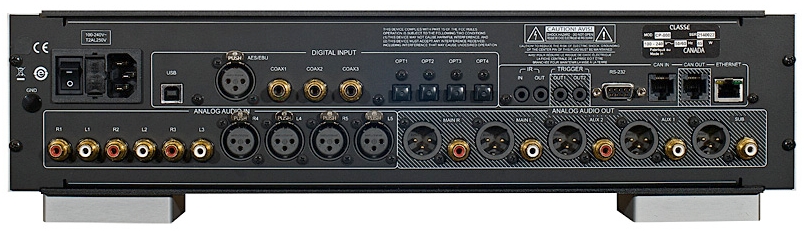
The rear panel is shown below.
You can see the on/off toggle, a grounded AC socket, digital input connections consisting of a USB jack, XLR, three coax, and four Toslink optical jacks. There are also trigger jacks, and RS-232 jack, and an Ethernet port (for future use). Analog inputs include three sets of coax and two sets of XLR. Analog outputs are two sets each of XLR and coax. The USB jack on the rear is asynchronous (as is the one on the front), and is for use with a computer’s digital music output (so, consider this input a “USB DAC”).
When I said the CP-800 is unique, I mean unique. Innovative is another word that comes to mind. The ability to take all digital circuitry out of the signal path so that the preamplifier is totally analog is a brilliant stroke of design engineering.
The switch mode power supply takes the incoming AC power, coverts it to DC, switches it at 140 kHz, ± 10 kHz depending on the music signal, and then smooths it with capacitors and inductors much the same as a standard power supply.
Below is shown a generic schematic that I came up with (by looking at many schematics on the Internet) that shows the path of power, so to speak, of a switch mode power supply.
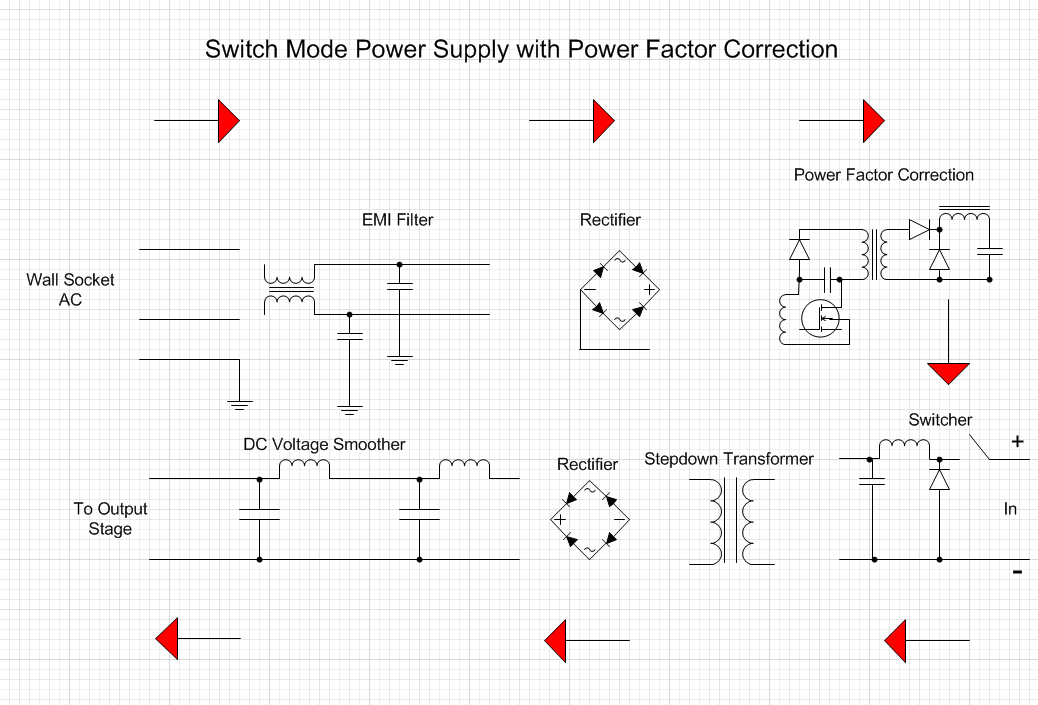
So, the incoming 120 volt AC goes through an EMI filter to remove radio frequency noise, then is rectified (converted to DC), and in the case of the CP-800, passes through a Power Factor Correction circuit (described below), then to the switcher, a voltage stepdown transformer, a second rectifier, and finally, the filters that smooth the DC so that it does not have any ripple. The fact that the voltage going through the stepdown transformer is at a high frequency, means that the transformer can be much smaller than if it were used at 60 Hz from the wall. The capacitors can be smaller too. The power supply is the most expensive part of hifi equipment, and being able to use smaller components due to the high freuquency reduces the cost to the consumer considerably. As such, this product, at $5,000, would cost somewhere around $8,000 if it were to use a conventional power supply of the same quality.
Now, about the Power Factor Correction: When AC comes into your hifi component and passes through a transformer (used to create the rail voltage), the transformer, being an inductor, stores power for a very short period of time, and then releases it back into the power cable, and therefore, back into the wall AC. This released power, being slightly out of phase (because it takes time for storage and release) with the incoming AC, distorts the flow of current in relation to the height of the voltage at any one instant in time. Seen below is a spectrum of AC power at the wall socket, but with an amplifier plugged into the wall socket, and with the amplifier turned on. The red spectrum is the 60 Hz AC, and the blue spectrum is the flow of current. Notice how the current flow is a very narrow peak, slightly off center with respect to the 60 Hz peaks. This causes multiple harmonics to be released into your house wiring which can contaminate the power supply of other components (which are also contributing to the problem themselves).
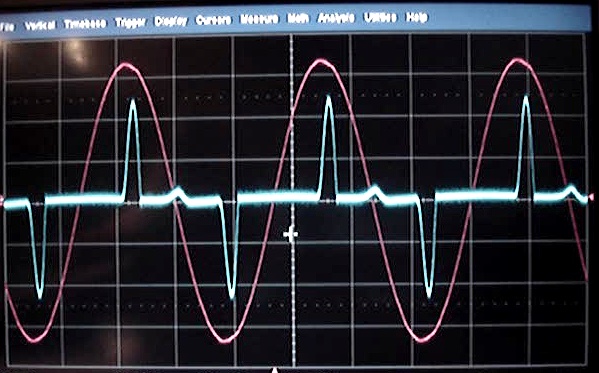
Through the use of a Power Factor Correction circuit, the wall AC can be made to look like this:

See how the current flow is in synch with the rise and decline of the 60 Hz voltage sine wave. This eliminates all the harmonics that a non-power factor corrected circuit produces. The area under the current curves is the same for both graphs, but power factor correction’s purpose is to eliminate harmonics being released back into the AC wall supply.
I should point out that many switch mode power supplies do not contain power factor correction. It is not necessary to have power factor correction for the switch mode power supply to function. However, the Classé CP-800 has power factor correction because it is a high performance product, and the design engineers want to eliminate as much harmonics in the circuit as possible.
Here is a photo of the inside of the CP-800:
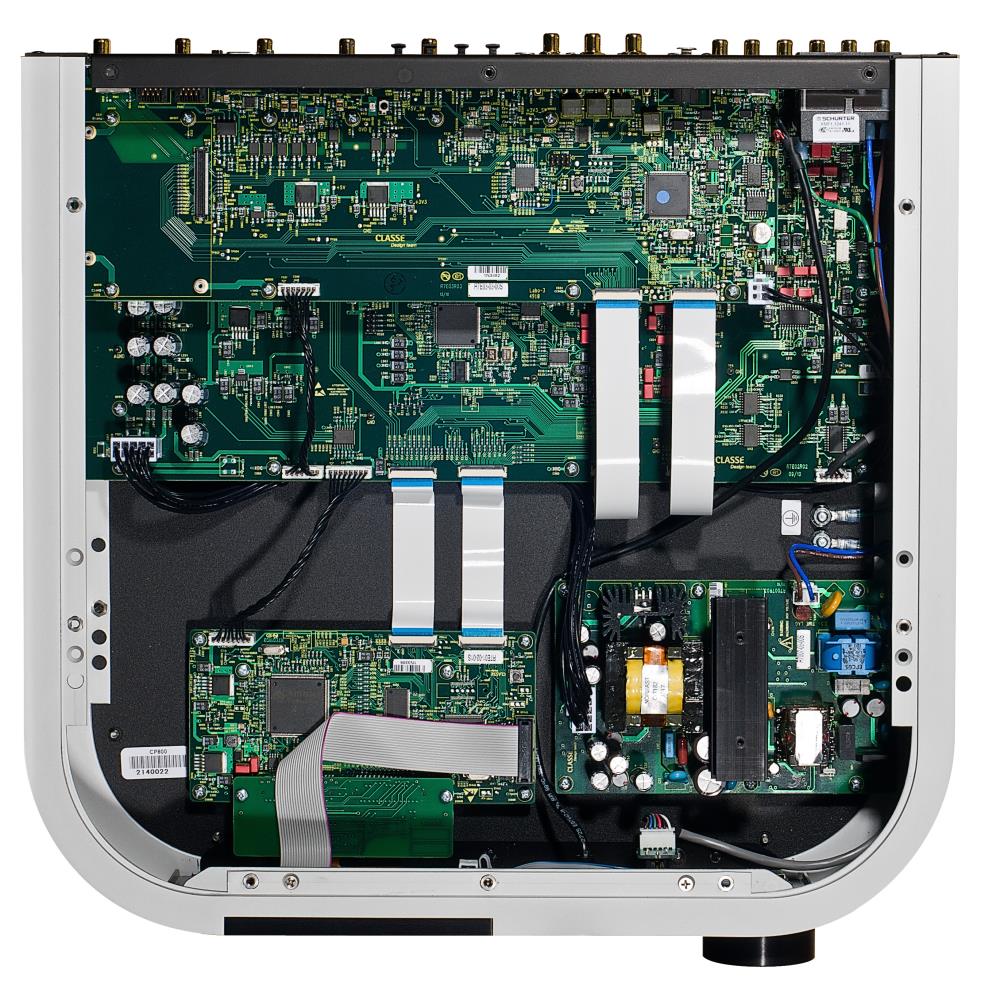
A large part of what you see is the DSP portion of the preamplifier circuit. The output stage is, in fact, a very high performance op-amp, which is small in physical size. Op-amps are another item that purists don’t like, but it’s because the technology of early op-amps was not very good. But that has changed. They are very good now, and Classé has put them to use in the CP-800. (Of course, inexpensive components still use inexpensive op-amps that don’t perform very well.) The CP-800 is fully differential (balanced) from input to output, and two OPA827 op-amps are used for each channel output (left and right), one for the + side of the signal and one for the – side. Of note here is that another set of op-amps are used for the RCA single-ended outputs, so you can use the XLR and RCA outputs at the same time.
The remote control is of routed anodized aluminum, with easy-to-read buttons that are tactile and shaped differently for easy distinction in the dark. Its rounded edges make it feel nice in the hands . . . very comfortable.

The Classé CP-800 In Use
I tested the CP-800 with an OPPO BDP-95 universal player, with the XLR analog out from the player to the CP-800, Classé CA-M600 monoblock power amplifiers, Carver Mark IV ribbon speakers, and Wireworld cables.
I played mostly SACD in two-channel mode, but also some CDs. There was a low frequency hump in the particular listening position I was using for the CP-800 tests, and I found that by using the DSP EQ, I could get that hump to disappear. I also tried out some boost in higher frequencies (~ 3 kHz) to add “presence”, and it worked, but I ended up just using the low frequency attenuation. I really could not detect any differences in the sound quality with or without DSP, so I settled in for the remainder of the listening with the DSP engaged, and the low frequency EQ active. As for the EQ, it is adjustable in 1 Hz increments up to 200 Hz, then 10 Hz increments up to 2,000 Hz, then 100 Hz increments up to 20,000 Hz. There are five EQ bands for each channel, with adjustable frequency, gain (how much of an increase or decrease you want), and Q (the width around the chosen frequency that the EQ band is to include).
There is also a feature in the EQ and Tone Control category, called “Tilt”. You can leave the EQ settings at 0 as well as the tone controls, but when Tilt is activated, EQ is added at 200 Hz and 2 kHz, which works well when you are listening at low volume. Keep in mind that all EQ is applied in the digital domain. For Bass Management, there is a menu where you can select the crossover frequency, slope, and whether you want to use one subwoofer or two subwoofers (either in stereo or mono). I didn’t need bass management active, as the Carver speakers are full range, with each speaker having four 12″ woofers.
Anyway, to the music:
As you can imagine from the cover art, this is not a background music album. Through the CP-800, every instrument was clearly delineated, due to the extremely low IMD. Dynamics were robust and without any apparent limitation. It helped to have 600 watt monoblock power amplifiers to use with the CP-800, because there are plenty of demanding passages on this, and many of the other albums I listened to (including some great Big Band music). The sound was as neutral as I have ever heard when the DSP was not engaged, and even with the DSP on, I was only dimming that low frequency hump, so the rest of the spectrum was not affected (except during my experimentation with high frequency boosts to add presence).

Full symphony orchestras are one of the best tests for IMD, because if the preamp (or power amp) has significant amounts of this type of distortion, the midrange is mushy, and detail is obscured. That simply did not happen with the CP-800, and if you take a look at the IMD spectrum in the Bench Tests page, you will see why. Neutrality, detail, dynamics, inaudible background noise – these are my descriptive terms for the CP-800.
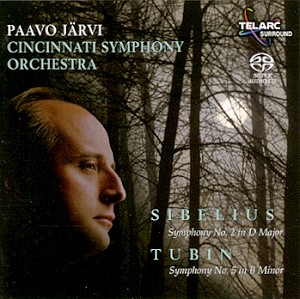
I listened to a great deal of music with the CP-800 because it was such a pleasure. I did take the opportunity to listen to chamber music, which is what I would call background music, and the CP-800 – I can say with all sincerity – sounded marvelous at low volume as well. I connected an iPod to the front USB port, and I don’t think I have ever heard music from an iPod digital dock sound so good. This was due both to the fact that I use *.wav encoding as well as Apple Lossless Encoding for my music files, but also because the USB circuitry in the CP-800 is asynchronous, which basically means that the bitstream comes into a buffer, where it is reclocked and then sent to the DAC, having used the CP-800’s clock to eliminate the large amount of jitter that is present in USB audio bitstreams.
The Classé CP-800 On the Bench
All distortion measurements were made within an 80 kHz bandwidth into 100 kOhms load. I used the XLR inputs for analog audio and the USB-F input (on the front panel) for my iPod.
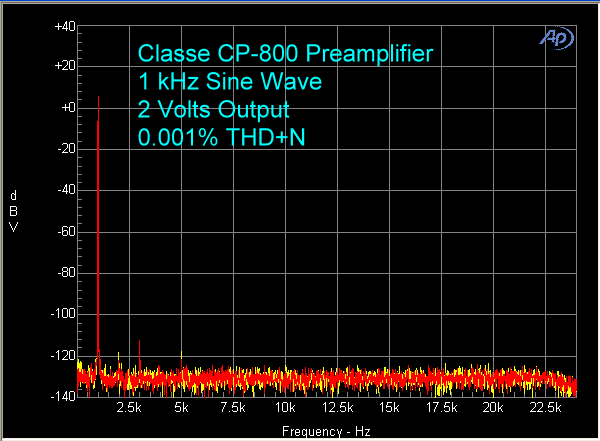
At 1 kHz, 0 dB volume setting, 2 volts output, no DSP, distortion was a vanishing low 0.001%. This is pretty much inaudible and fantastic performance. Note that you can totally turn off the power to the digital circuits by disabling them in the setup menu, but I did not do this, because I wanted to see how the unit performs with everything powered up. The low distortion result, with the digital circuits powered but not being used, indicates that the digital circuits are well isolated from the analog circuitry.
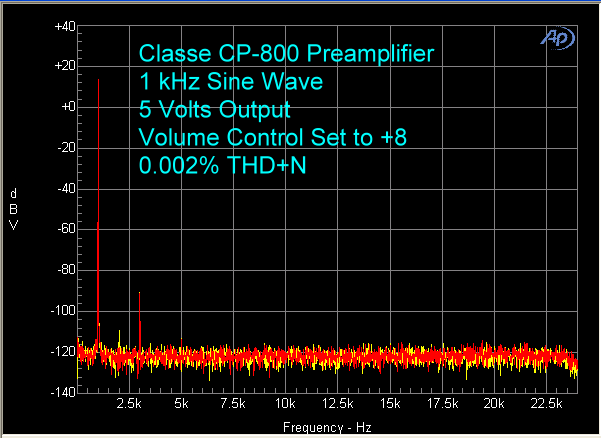
At 1 kHz, +8 dB volume setting (engages active preamplification, while 0 dB and below is passive), 5 volts output, no DSP, distortion was still very low.
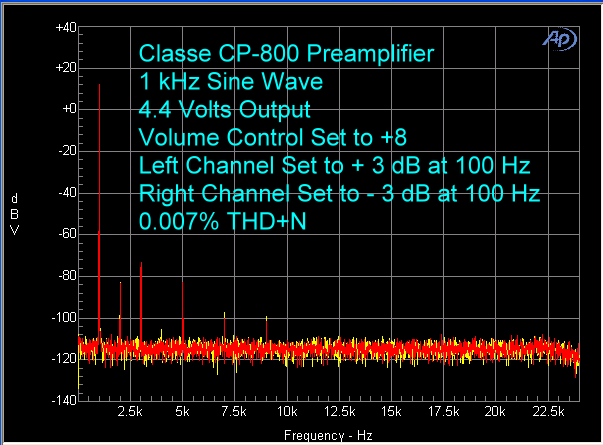
For this spectrum, I engaged the DSP by setting two EQ bands: one for the left channel, giving 100 Hz a 3 dB boost, and one for the right channel, giving a 3 dB attenuation. The volume control was set at 8. Distortion still remained below 0.01%, but it does show there is a price to pay for putting the signal through A/D and D/A.
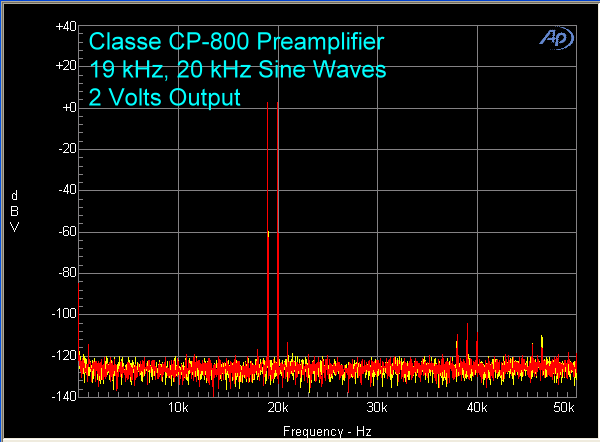
Using a combination of 19 kHz and 20 kHz sine waves, the B-A peak at 1 kHz was 120 dB below the fundamentals, which is superb.
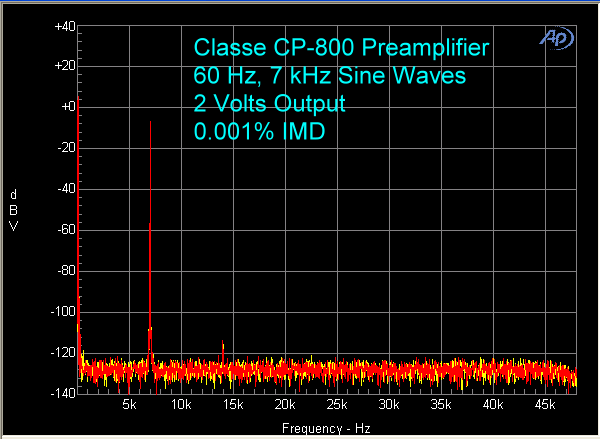
IMD was in line with the other measurements, at only 0.001%. IMD is an extremely important measurement, because a low amount – and it is very low with the CP-800 – means you will hear more detail.
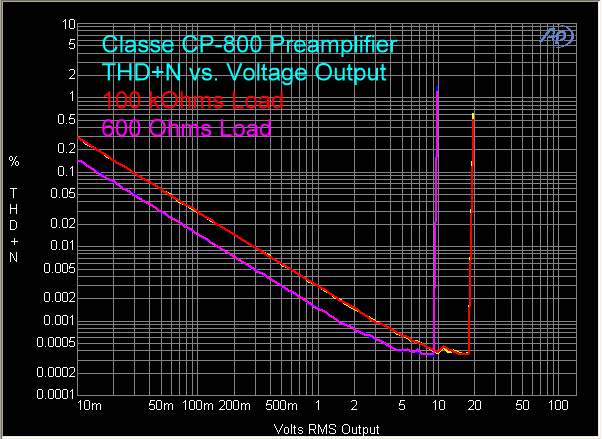
THD+N vs. Voltage Output indicates a robust power supply, as you can see. Even with a tortuous load of 600 ohms, the sharp knee was at 9 volts output. Keep in mind that you will only be using about 2 volts or so of output voltage. The rest is overhead, meaning a good dynamic range.
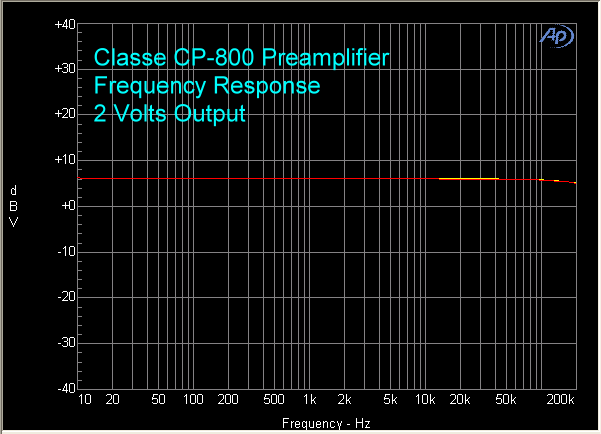
The measured Frequency Response was 10 Hz – 200 kHz, – 1 dB.
Conclusions About the Classé CP-800
This is one hell of a preamplifier. You get world class performance when used strictly in analog mode, and still quite excellent performance if you want to use subwoofers and some room EQ. In my opinion, this is a benchmark product.